This website is dedicated to the Hungarian born stamp dealers Béla, Géza, Eugen and Frank Sekula.
Each one of them ran his own stamp business with emphasis on international stamp trade, likely driven by their business acumen rather than a particular preference for philately.
All four assumed Swiss nationality and were based in Lucerne side by side for years.
Especially Béla’s business ideas provoked more than one scandal during his career.
However, the history of philately would arguably be poorer without the Sekula brothers.
Eugen Szekula at about the age of 25We will pay high prices for your stamps! (Nebelspalter 1944)
Eugen Sekula (1888–1950) was born as Jenő Szekula in Szeged on March 9, 1888.
When he was old enough, he joined Géza as an employee at Béla’s Internationale Philatelisten.
In April 1910, Eugen took over as responsible editor of Béla’s Händler-Zeitung (newsletter for stamp dealers), and by 1911 he was also office manager at Internationale Philatelisten.
On August 19, 1912, he married Elisabeth (Erzsébet) Zenner (born September 26, 1893) in Budapest.
Advertisements placed in the Hungarian Stamp Collector that same year show that he also was already trading in stamps on his own account at that time.
Like his brothers he then moved to Lucerne, initially still working for Béla.
In October 1913, Eugen traveled to the United States representing Béla’s company at New York’s first stamp exhibition, the New York Philatelic Exhibition.
First philatelic ads with the address Zürichstr. 62 appeared in Swiss newspapers in 1915, including those offering unused Belgian stamps confiscated by Germany during the occupation.
In September 1916 he moved to Grendelstr. 19, where he opened his own Briefmarken-Import und -Export (= stamp import and export) business Eugen Szekula in January 1917.
On July 5, 1919 he became a naturalized Swiss citizen of Geuensee.
Four weeks later, Eugen had to go through the same bitter experience as his two older brothers before him: On August 3, 1919, his daughter Erika Dorottya died at the age of just seven months.
In September 1919, Eugen closed his business at Grendelstrasse 19 and reopened it as Briefmarken-Import und -Exporthaus (= stamp import and export house) at the new address Hertensteinstrasse 56.
Around July 1922, Eugen moved into the extravagant Villa Heimeli at Steigerweg 15.
Like the rest of the family he changed the spelling of his name to Sekula in March 1923.
In 1924, his daughter Susy Susanna Eva was born, and two years later his second daughter Maya.
Apparently his business went well for many years, but in early 1933, in the wake of the global economic crisis and increasing German hostilities towards all stamp dealers bearing the name Sekula he was facing bankruptcy.
As a result, in August of that year Eugen converted his stamp import and export firm into the corporation Eugen Sekula AG at Dreilindenstr. 47, with himself as director.
In August 1934 the Eugen Sekula AG changed its name to Atlas Briefmarken AG in Luzern (Atlas Stamp Ltd. Lucerne).
In February 1935 the board of the Atlas Briefmarken AG in Luzern decided to leave Lucerne and move to Lugano; the corporation was renamed to Atlas Briefmarken AG in Lugano (Atlas Stamp Ltd. Lugano).
After less than three years, in November 1937 the Atlas Briefmarken AG in Lugano moved again, this time to Zurich, and became Atlas Briefmarken AG in Zurich (Atlas Stamp Ltd. Zurich) – first at Titlisstr. 14, from October 1940 onwards at Bahnhofstrasse. 74.
The company continued to sell stamps for another decade, but in its final years the business apparently no longer made enough profit.
In September 1946, Eugen joined his son-in-law Hans Bollmann and his daughter Susy with a limited partnership share of CHF 10,000 in founding the import and export company Hans Bollmann & Co. – possibly not least in order to have a second source of business outside the stamp trade.
Nevertheless, a few years later he was finally facing financial ruin, not only in his business but also in his personal life – with dire consequences.
On Sunday the 29th of January, 1950, the police was called to Sekula’s home at Rigistr. 18 where they found the lifeless bodies of Eugen Sekula, his wife Elisabeth and their disabled daughter Maya.
Both parents were already dead when the police arrived; Maya was hospizalized but died one day later without regaining consciousness.
All three had taken an overdose of sedative drugs, presumably due to their desperate financial situation.
Already on February 15, bankruptcy proceedings against Atlas Briefmarken AG in Zurich were opened, and three months later, in April 1950, the company was dissolved.
Although he was much less of a traveler, Eugen Sekula’s business acumen probably came close to that of Béla.
A failed attempt to establish his own postage paid labels in the Swiss postal system in 1930 shows that he was similarly creative, but he also employed the same sale tactics as Béla sending out unwanted stamp selections and then aggressively demanding payment – eventually with the same result:
In July 1934 the U.S. Post imposed a short-lived embargo on both of them, marking mail to them as fraudulent and returning it to the sender.
Cover — March 11, 1927
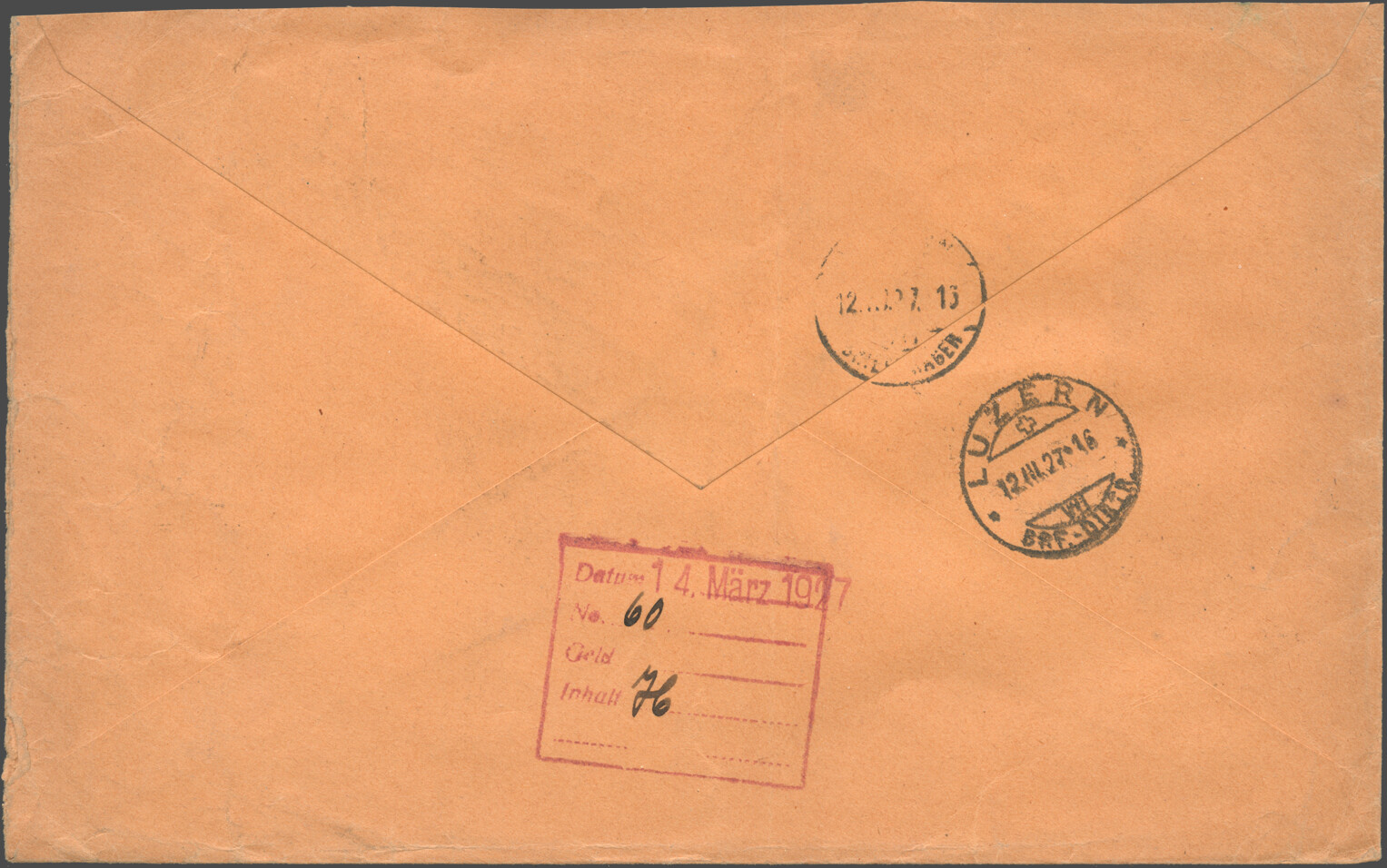
Registered mail sent on March 11, 1927, from La Sagne-Ste-Croix, Switzerland, to Lucerne. Arrived on March 12, 1927.
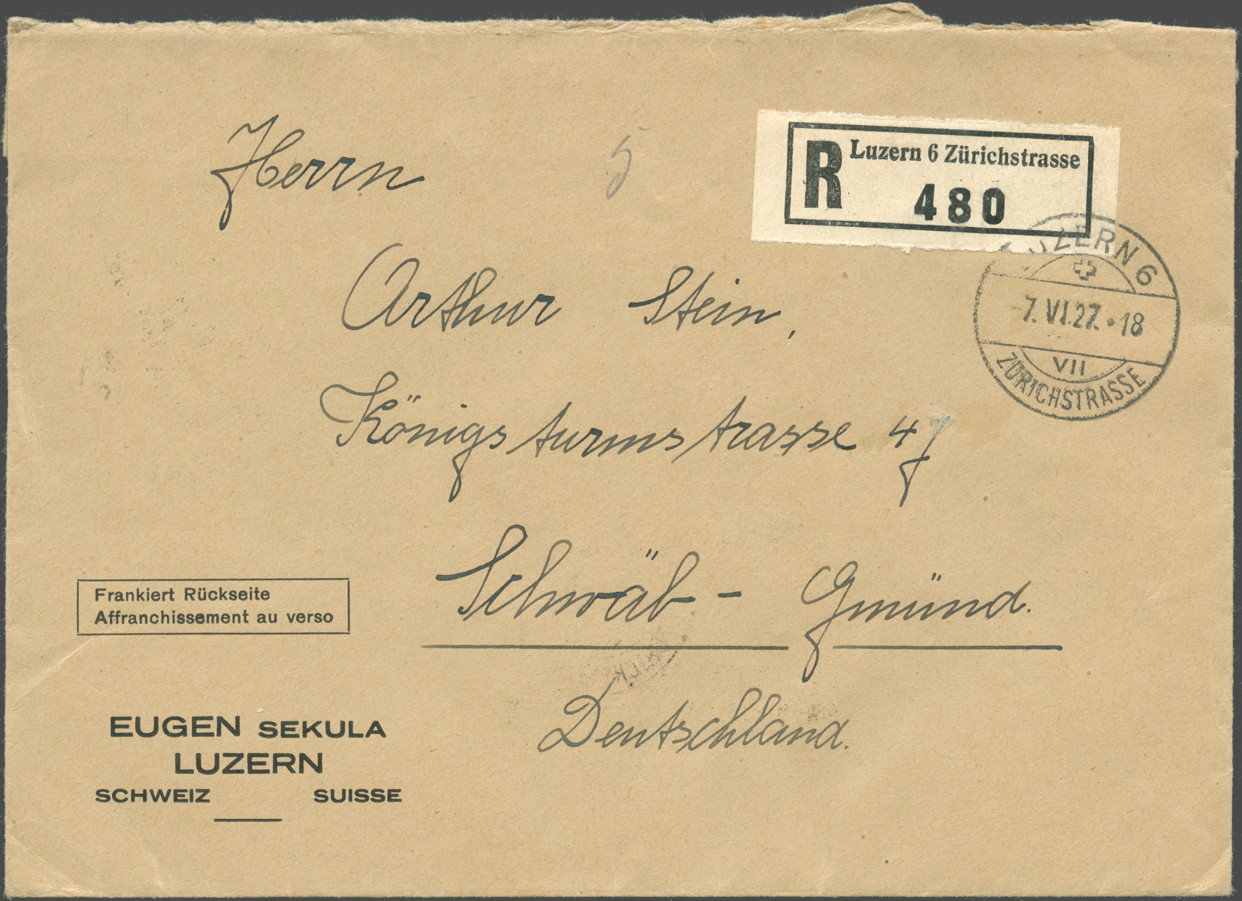
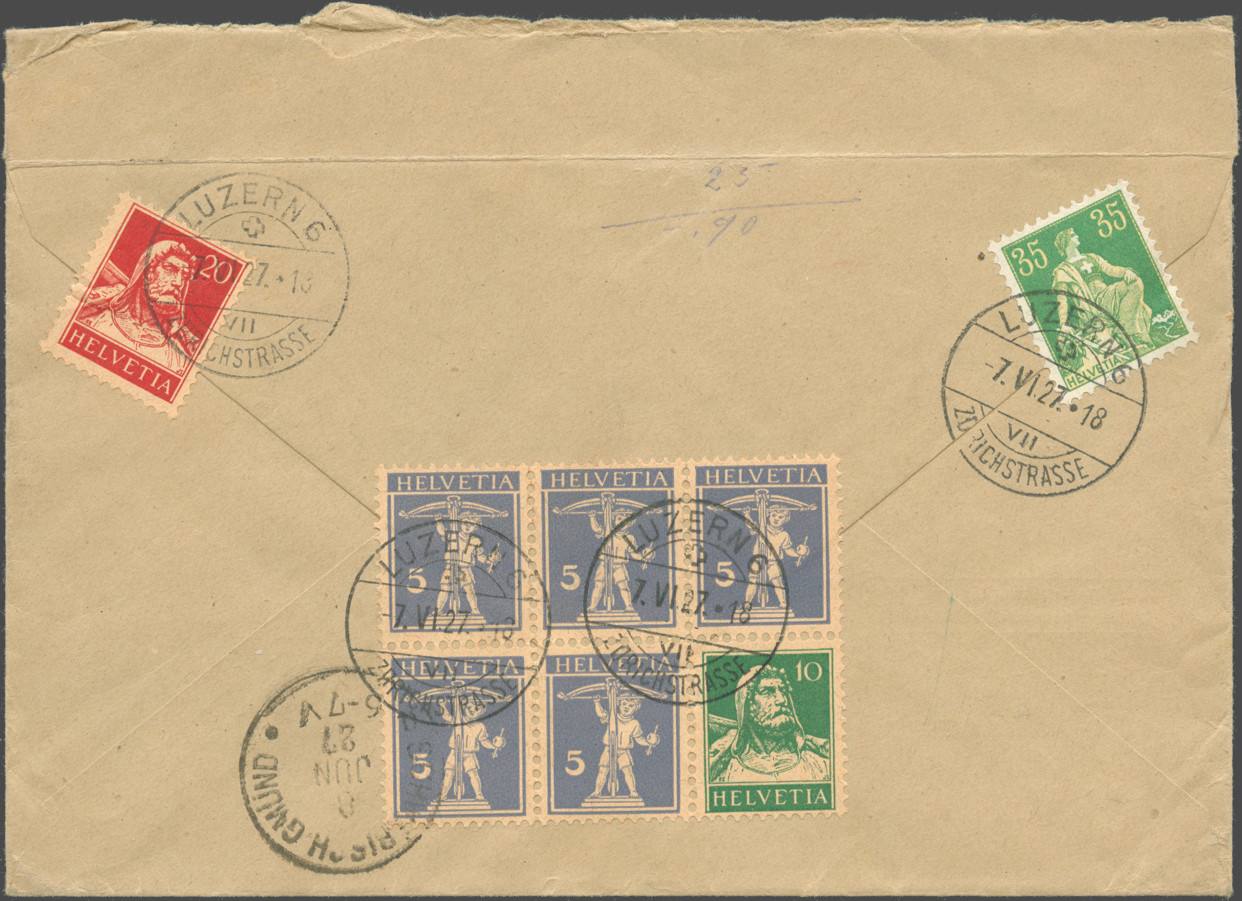
Cover — June 7, 1927
Registered mail sent on June 7, 1927, from Lucerne, Switzerland, to Schwäbisch-Gmünd, Germany. Arrived on June 8, 1927.
Cover — June 9, 1927
Registered mail sent on June 9, 1927, from Székesfehérvár, Hungary, to Lucerne, Switzerland.
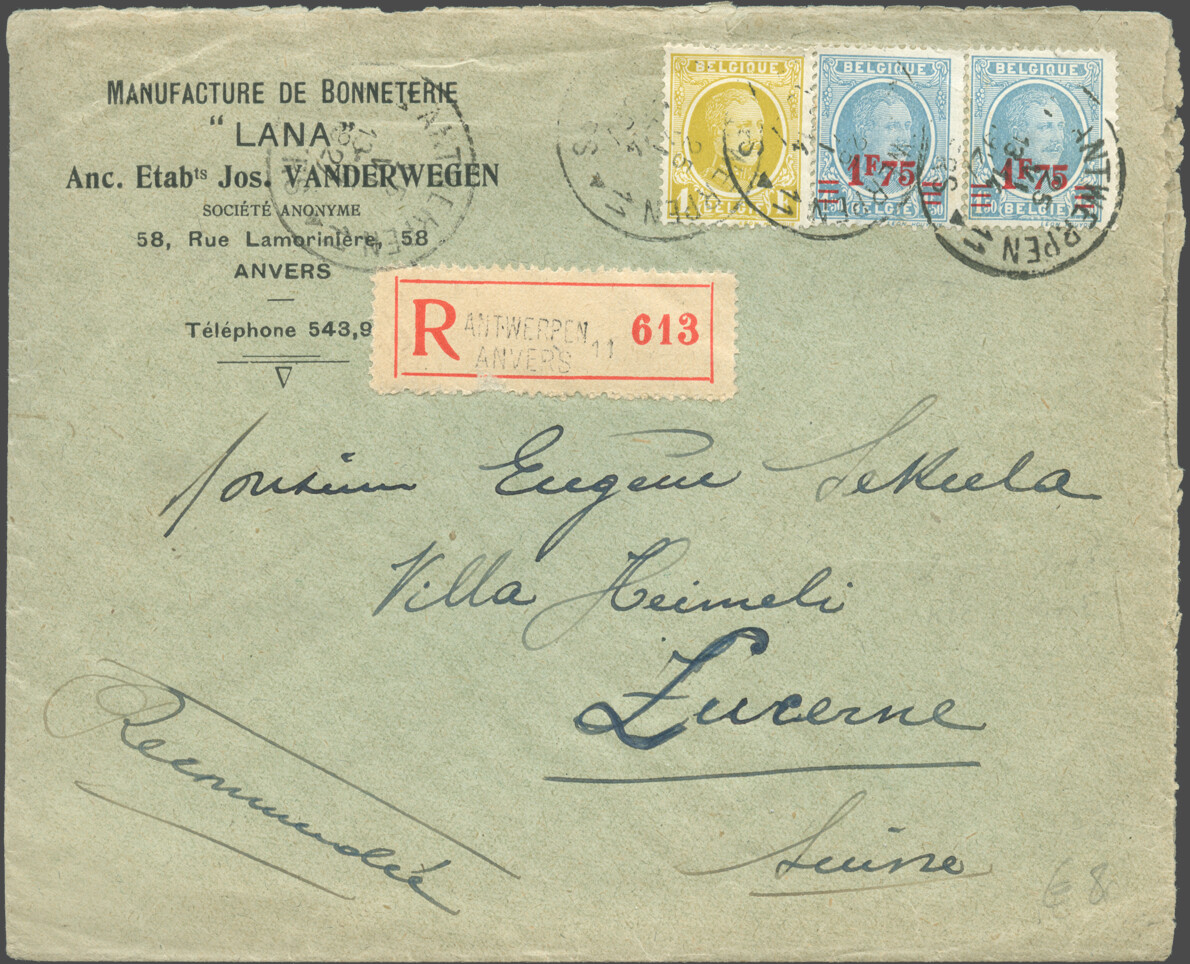
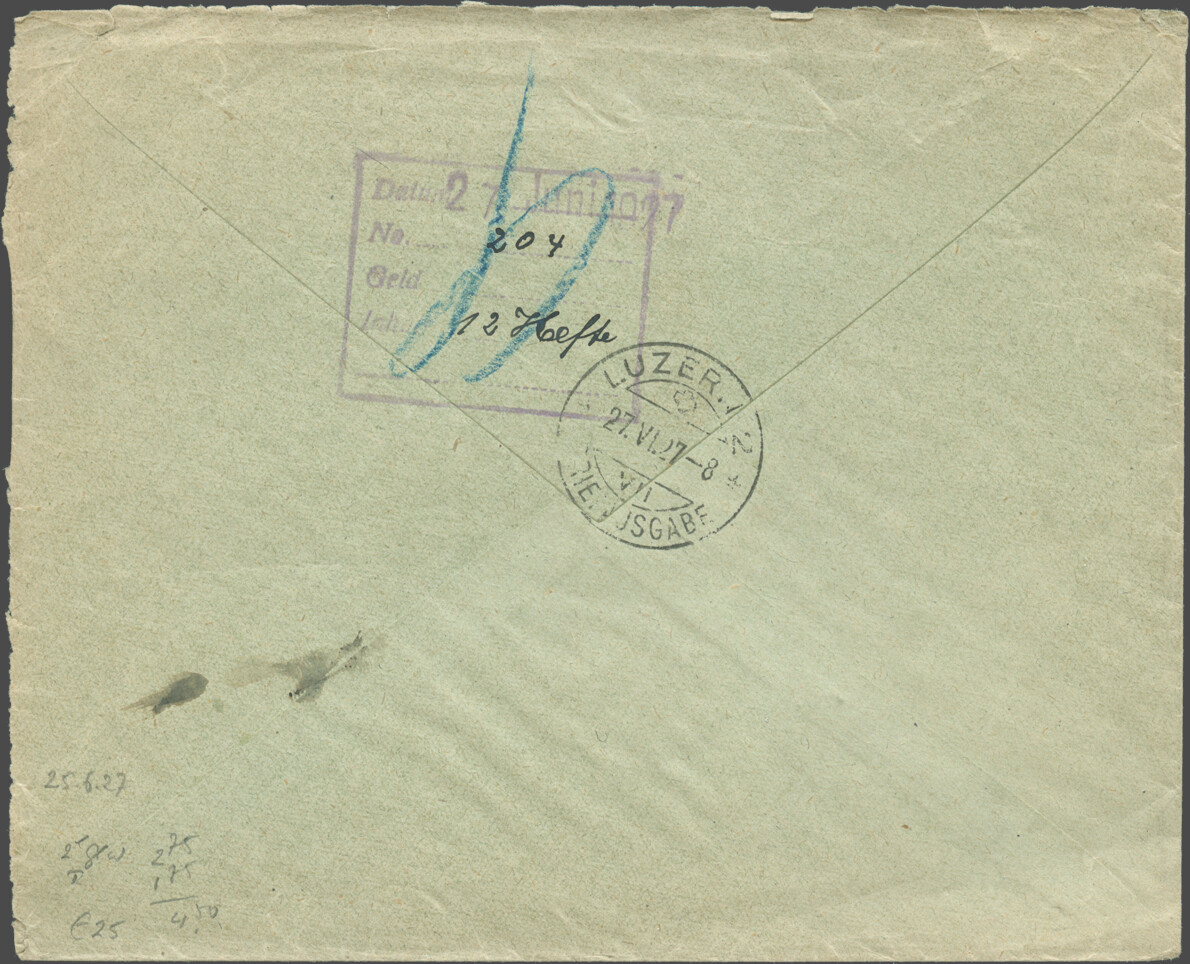
Cover — June 25, 1927
Registered mail sent on June 25, 1927, from Antwerp, Belgium, to Lucerne, Switzerland. Arrived on June 27, 1926.
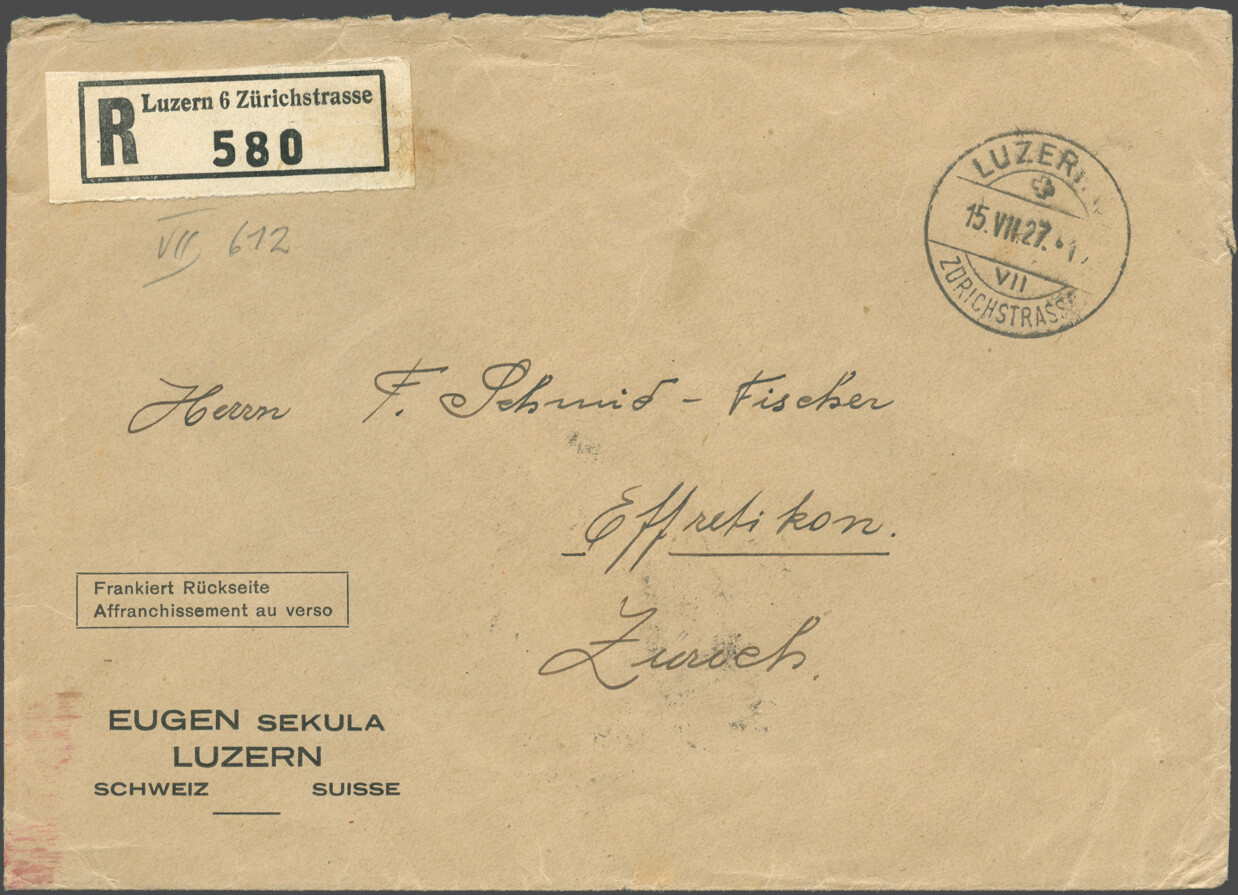
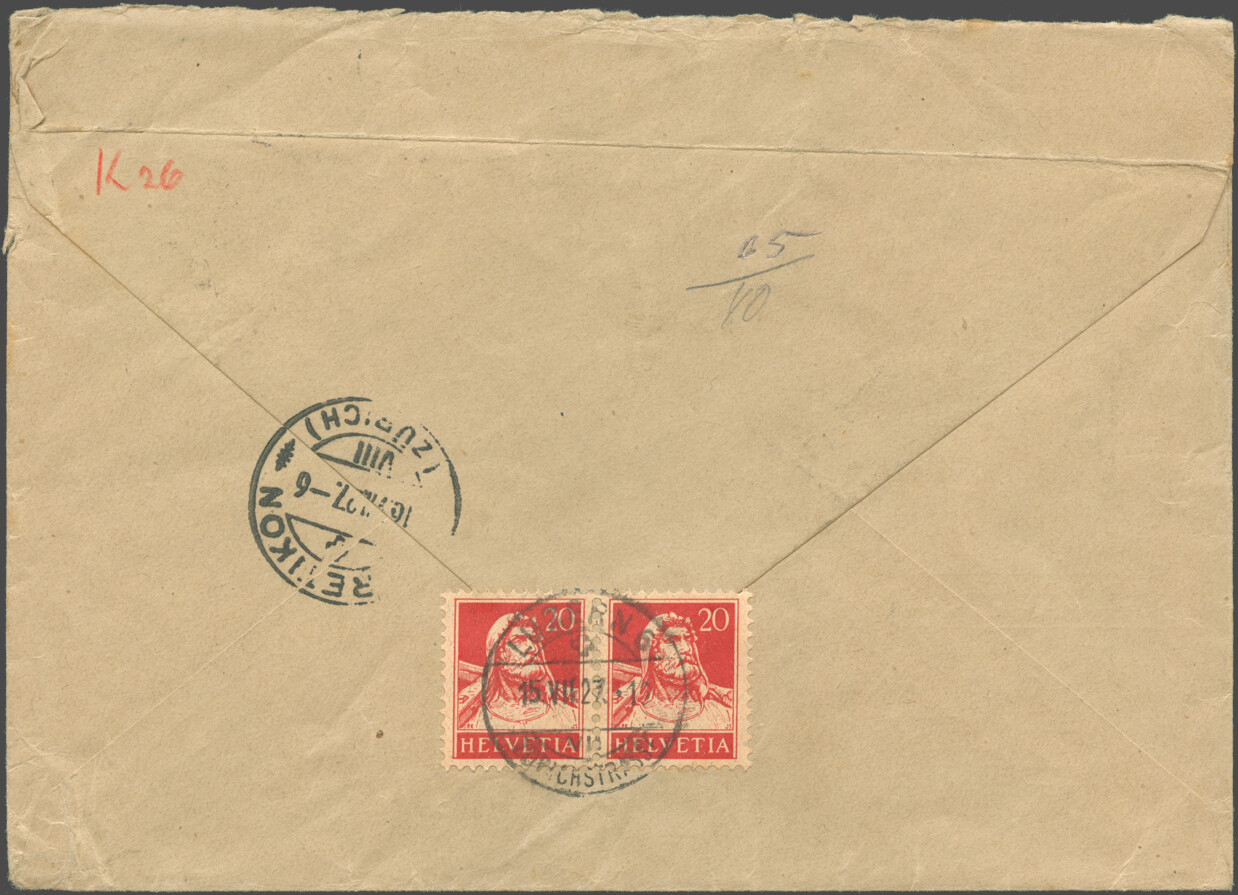
Cover — July 15, 1927
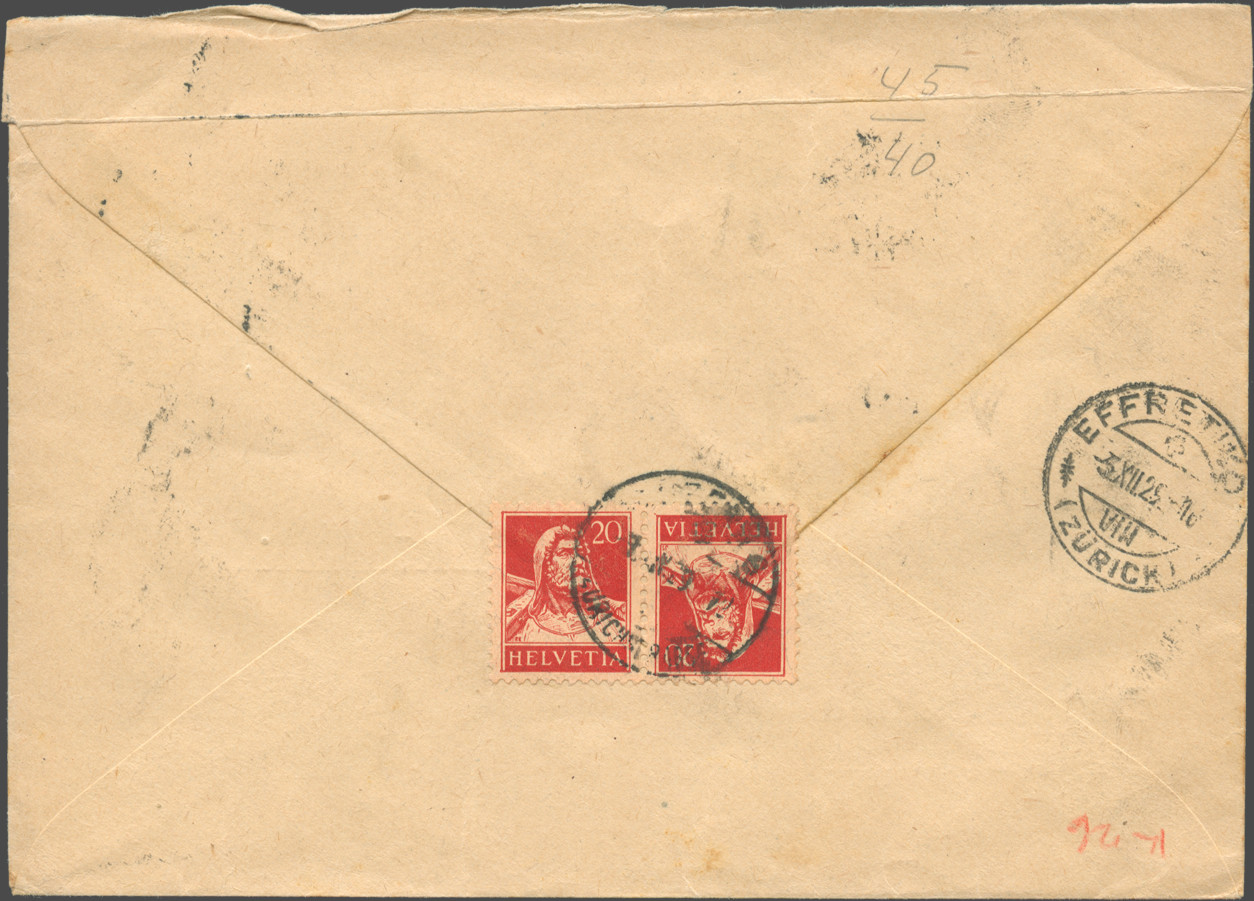
Registered mail sent on July 15, 1927, from Lucerne, Switzerland, to Effretikon. Arrived on July 16, 1927.
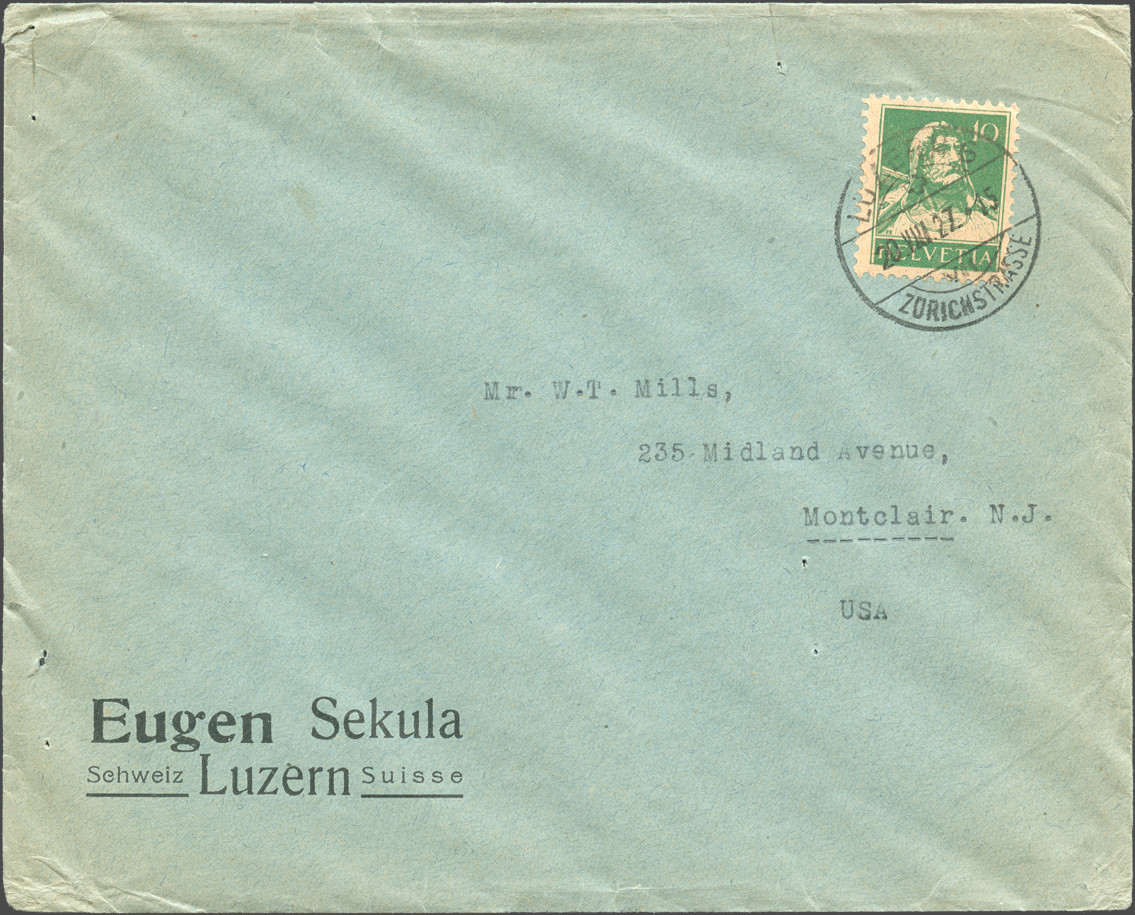
Cover — August 20, 1927
Sent on August 20, 1927, from Lucerne, Switzerland, to Montclair, New Jersey, United States. Arrived on August 20, 1927.
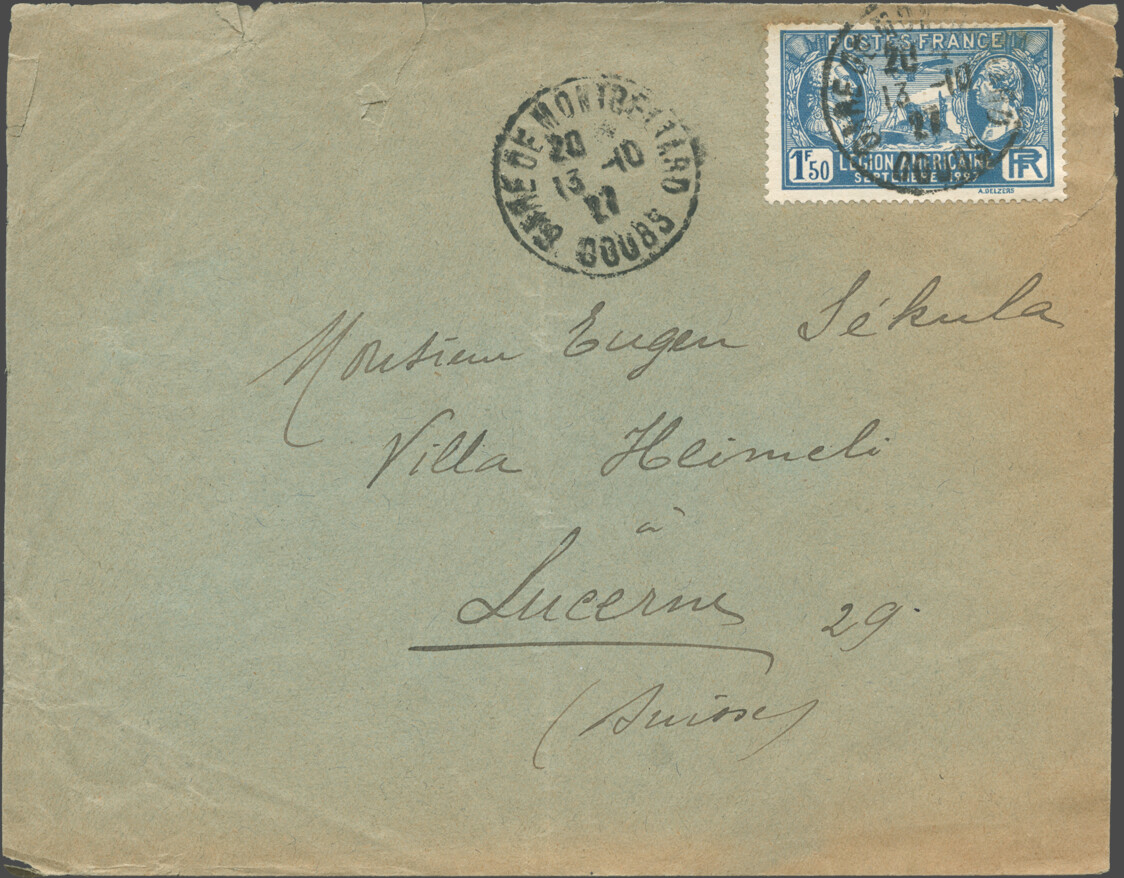
Cover — October 13, 1927
Sent on October 13, 1927, from Montbéliard, France, to Lucerne, Switzerland.
Cover — November 14, 1927
Sent on November 14, 1927, from Dublin, Ireland, to Lucerne, Switzerland. Arrived on November 17, 1927.
Cover — November 18, 1927
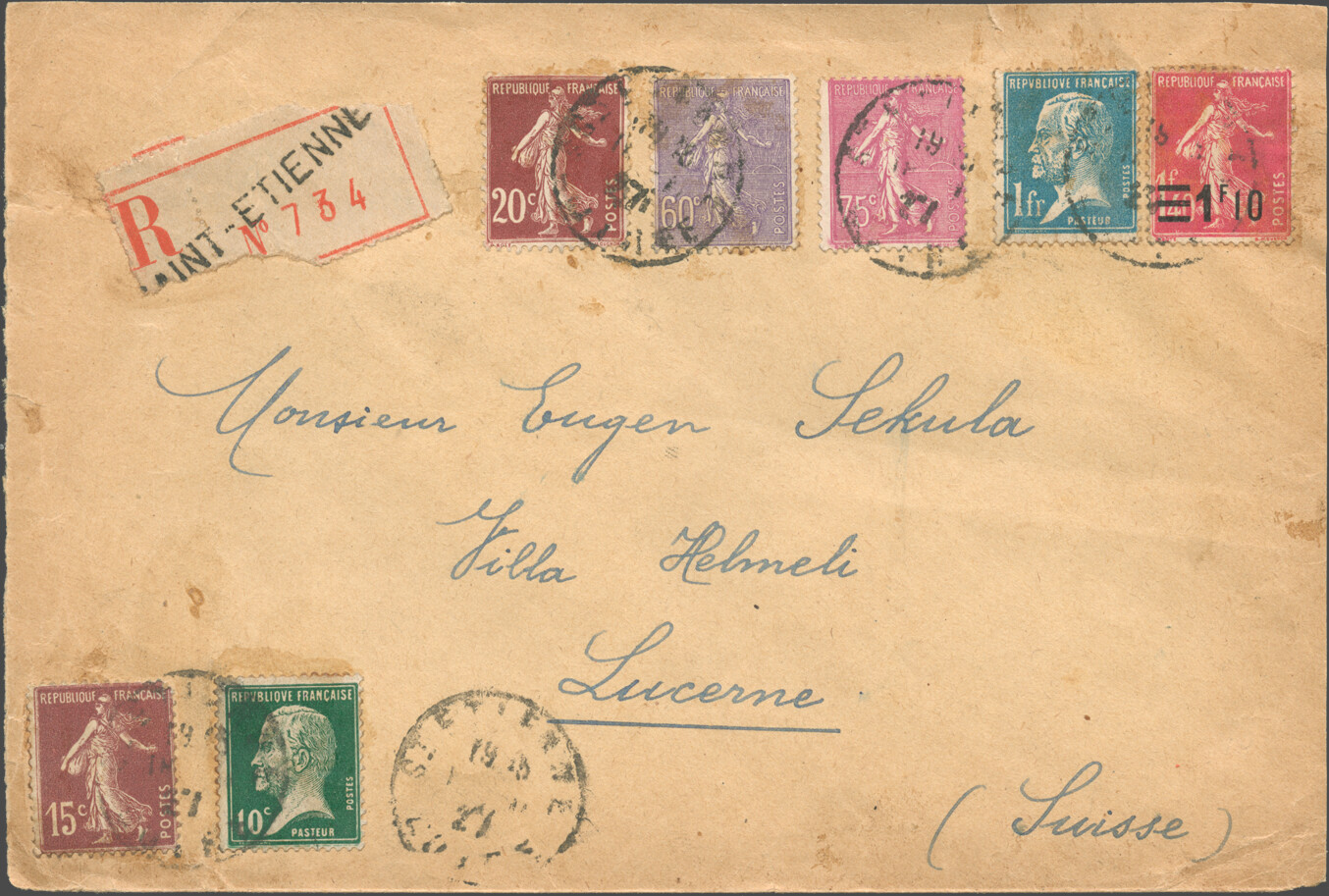
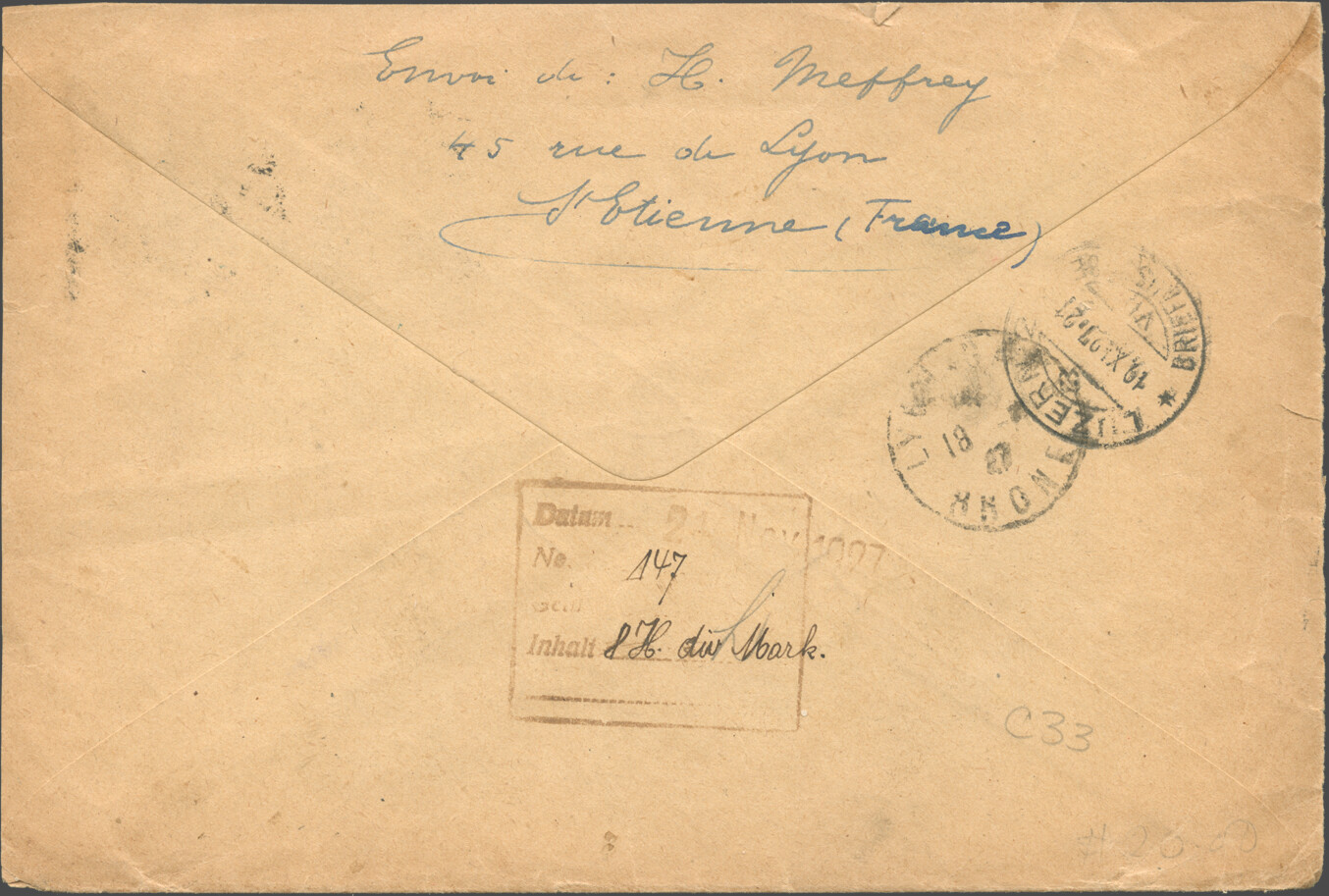
Registered mail sent on November 18, 1927, from Saint-Étienne, France, to Lucerne, Switzerland. Arrived on November 19, 1927.
Cover — December 1, 1927
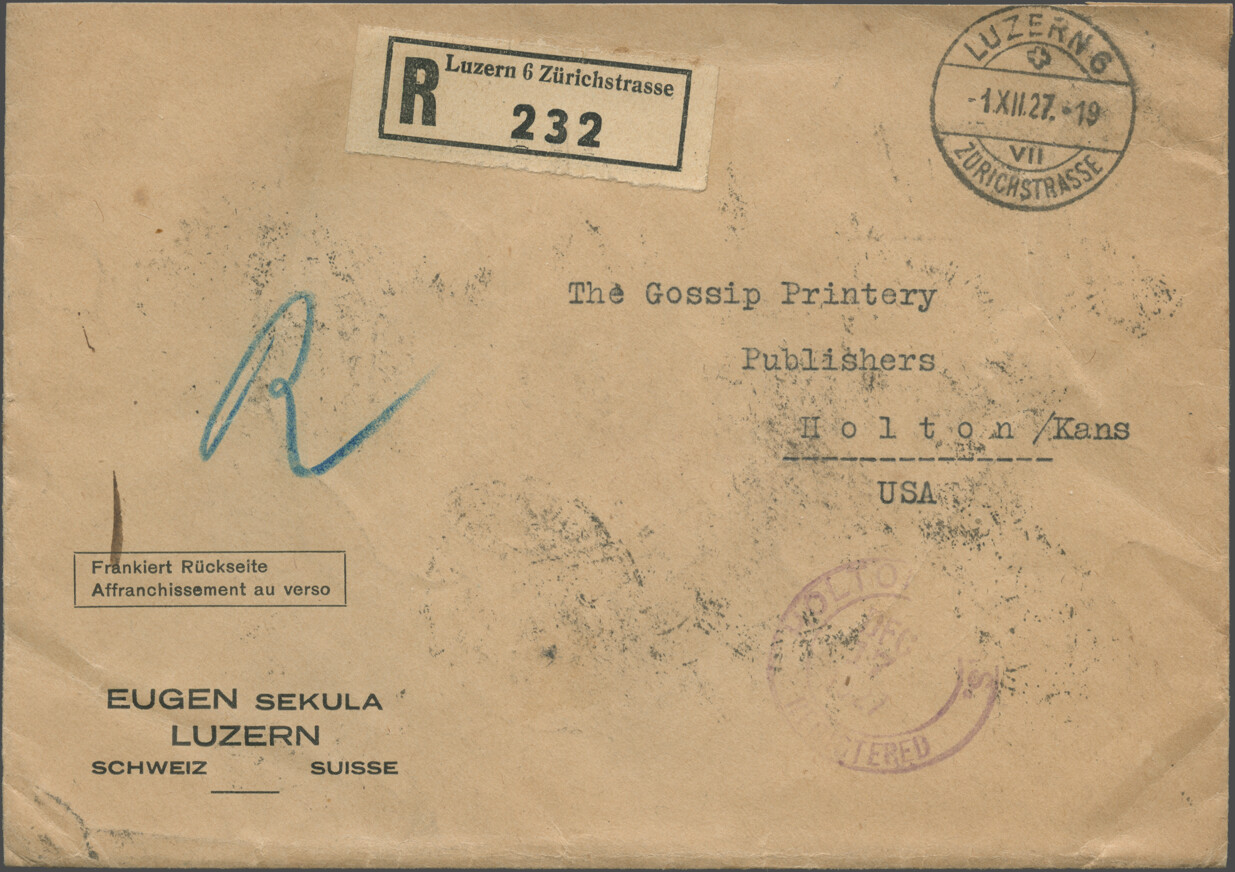
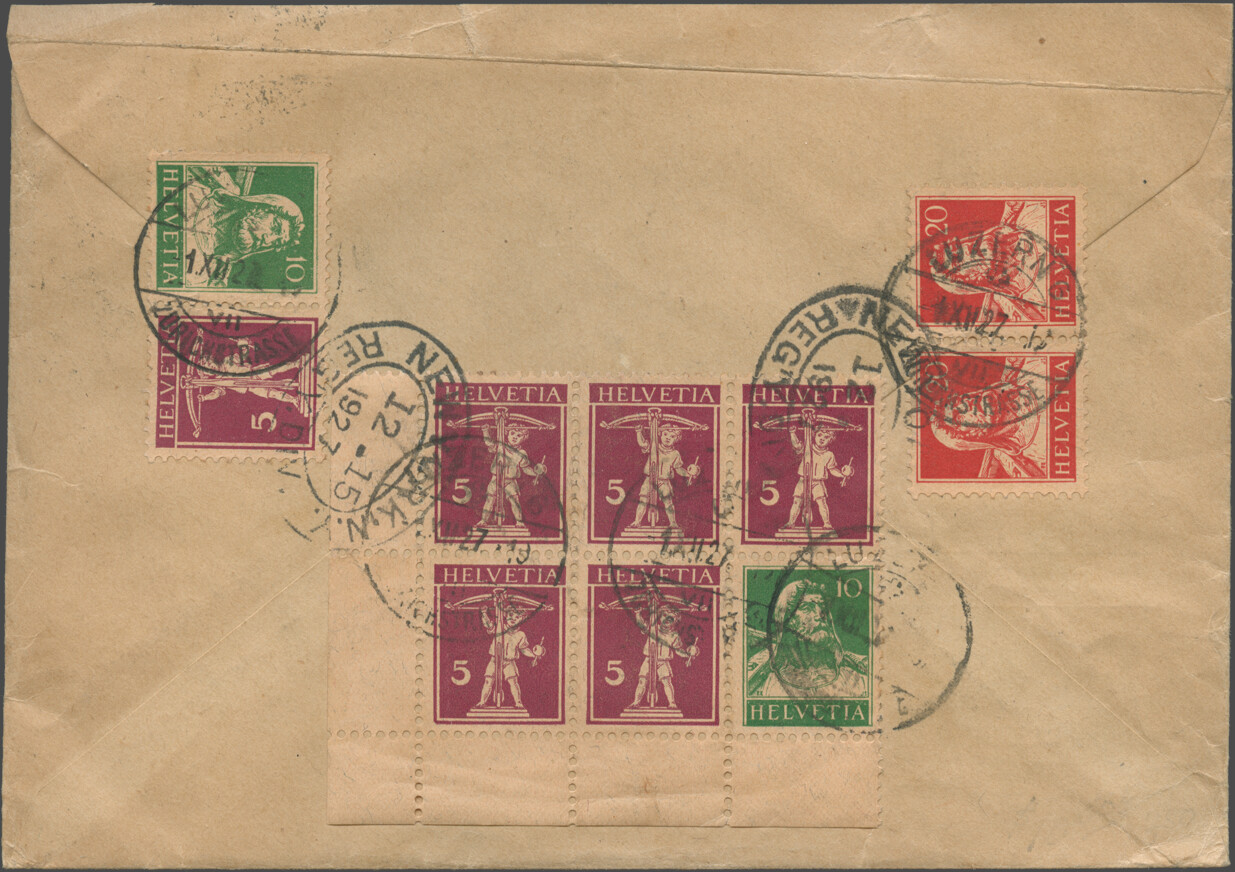
Registered mail sent on December 1, 1927, from Lucerne, Switzerland, to Holdton, Kansas, United States. Arrived on December 17, 1927.
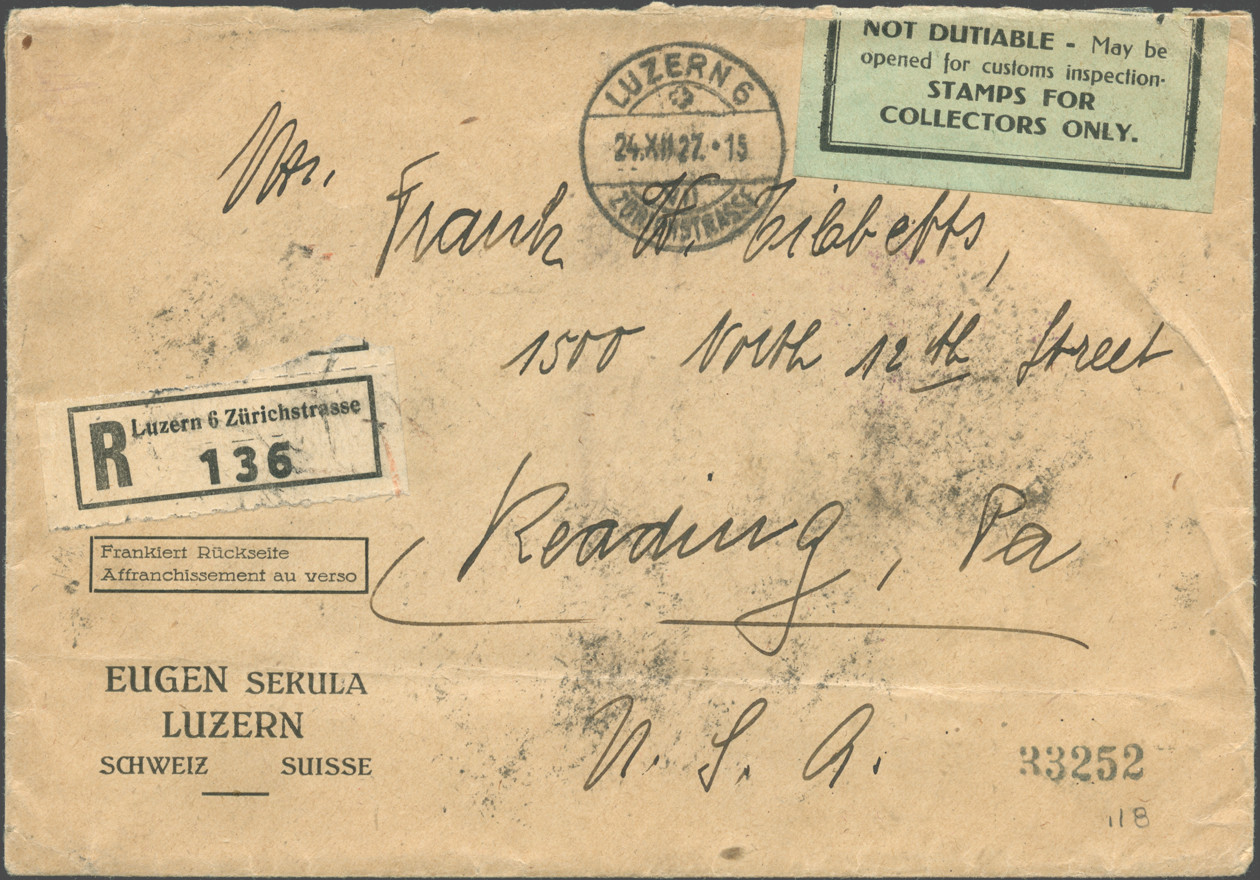
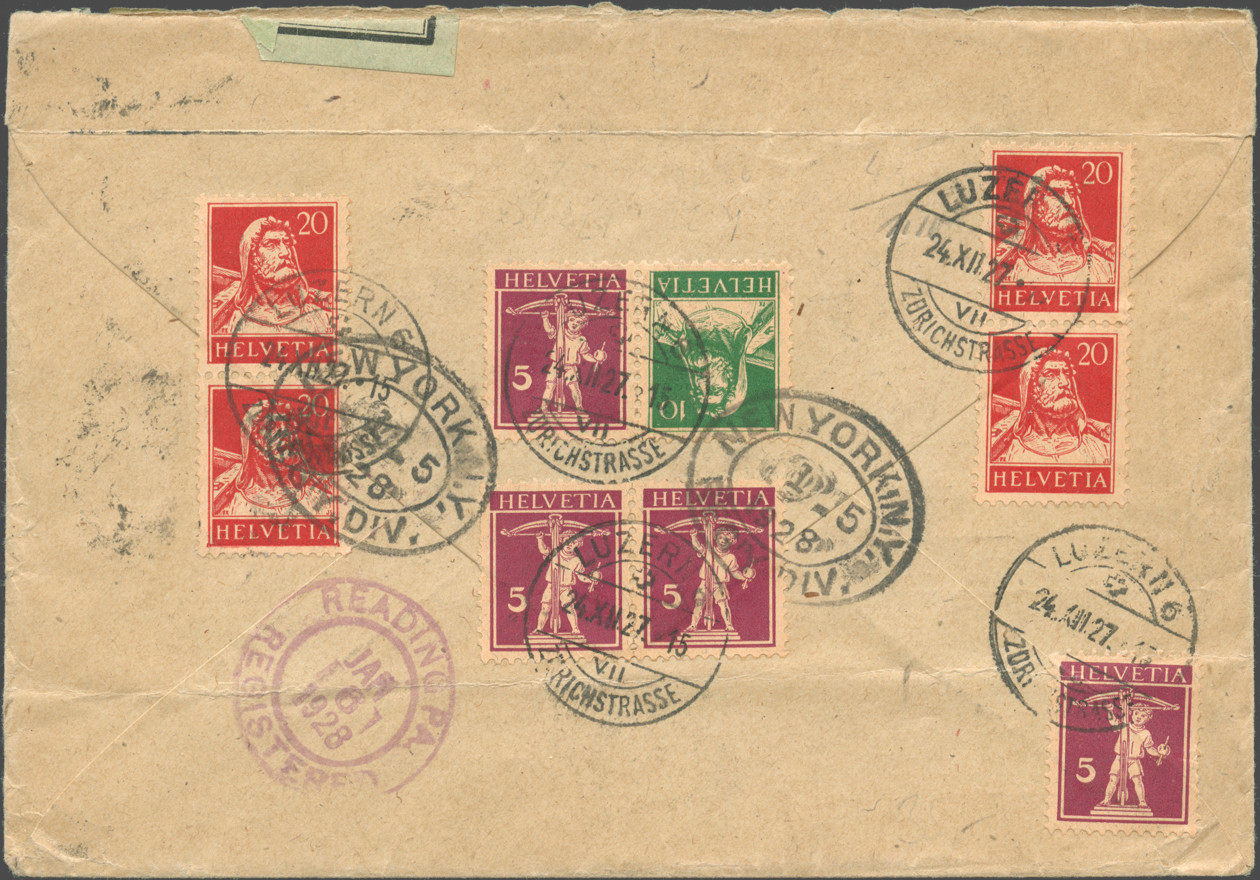
Cover — December 24, 1927
Registered mail sent on December 24, 1927, from Lucerne, Switzerland, to Reading, Pennsylvania, United States. Arrived on January 6, 1928.
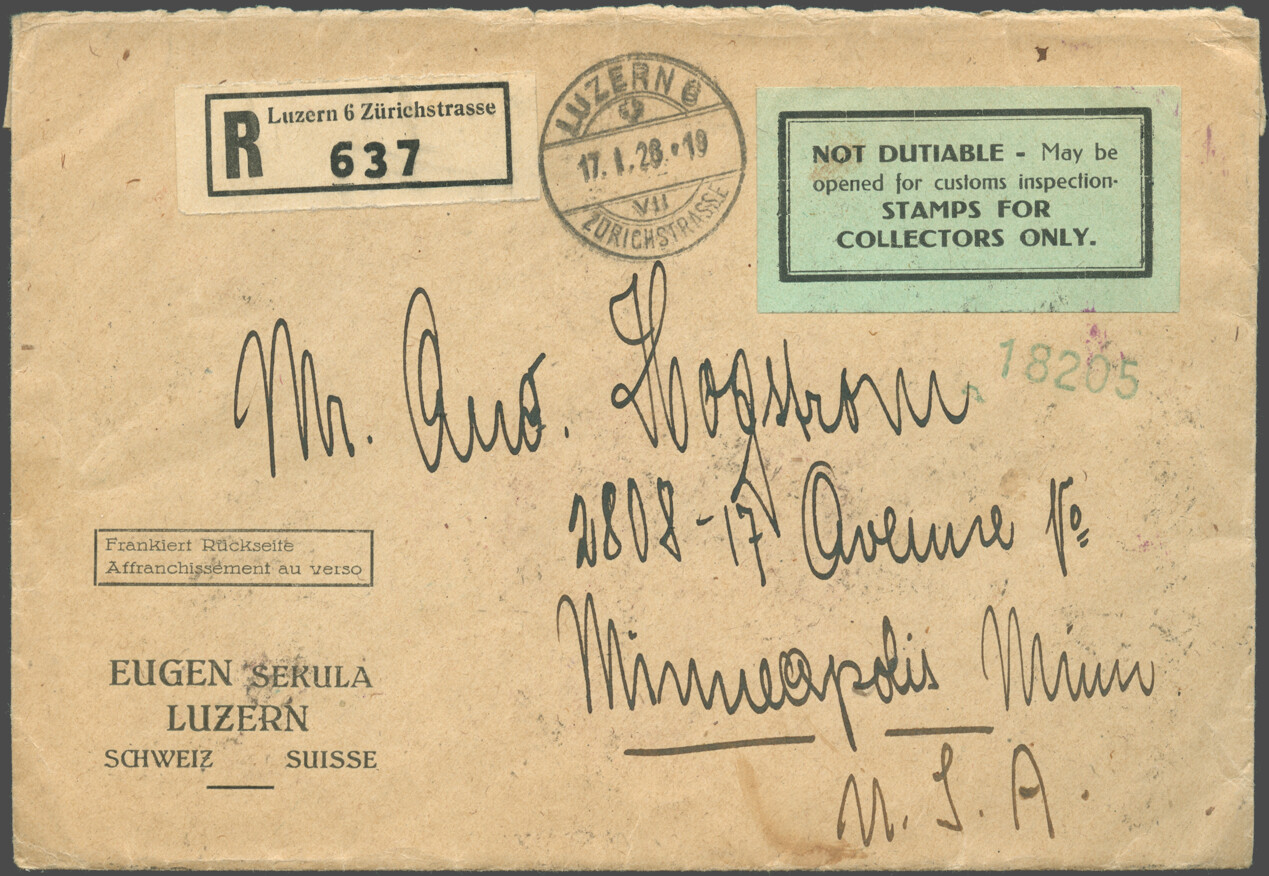
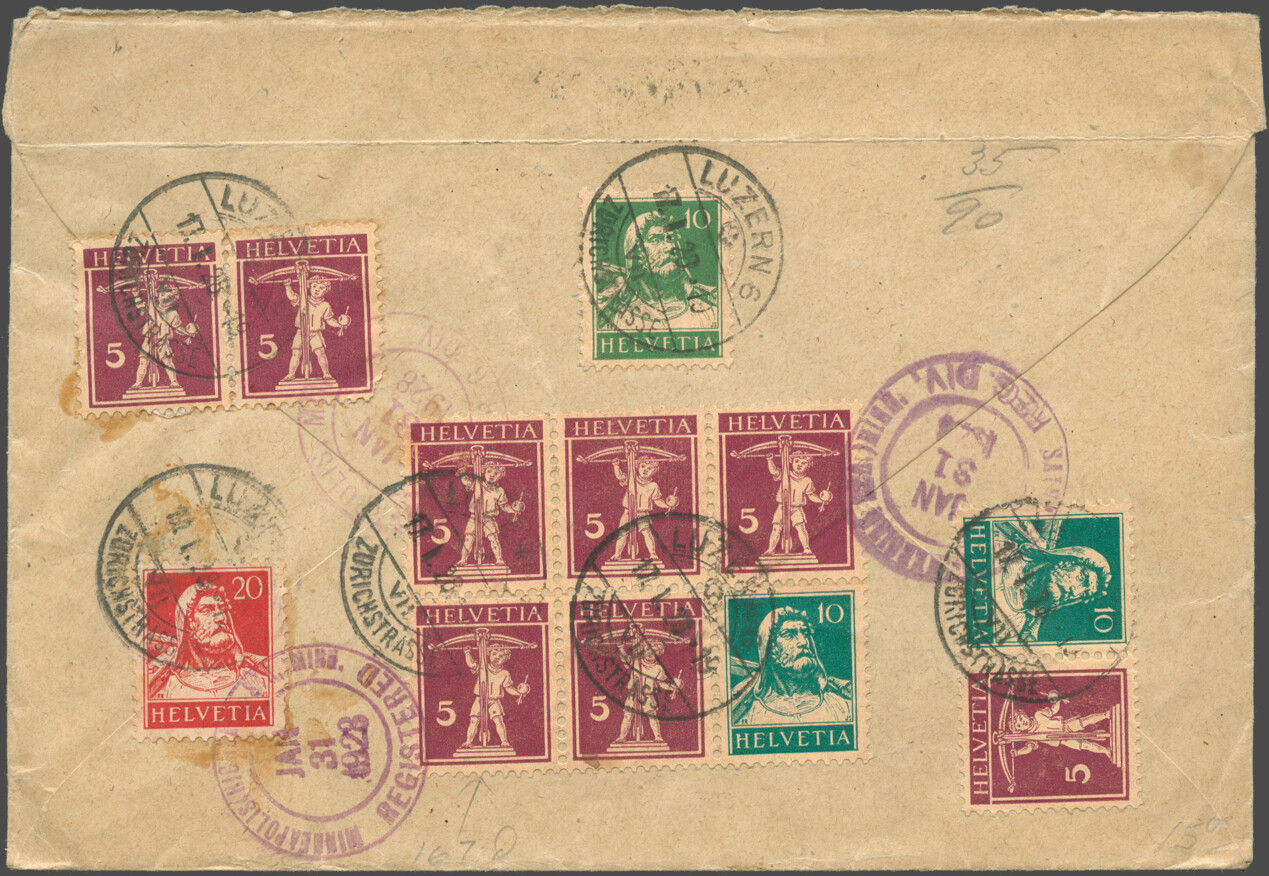
Cover — January 17, 1928
Registered mail sent on January 17, 1928, from Lucerne, Switzerland, to Minneapolis, Minnesota, United States. Arrived on January 31, 1928.
Cover — January 21, 1928
Registered cover sent on January 21, 1928 to Givet, France. Although it was sent anonymously without return address it is shown here as a possible forerunner to Eugen’s PO Box covers because of its typical Eugen Sekula franking and the fact that it was also posted registered at Luzern 6 Zürichstrasse.
Cover — March 1, 1928
Registered mail sent on March 1, 1928, from Lucerne, Switzerland, to Minneapolis, Minnesota, United States. Arrived on March 16, 1928.
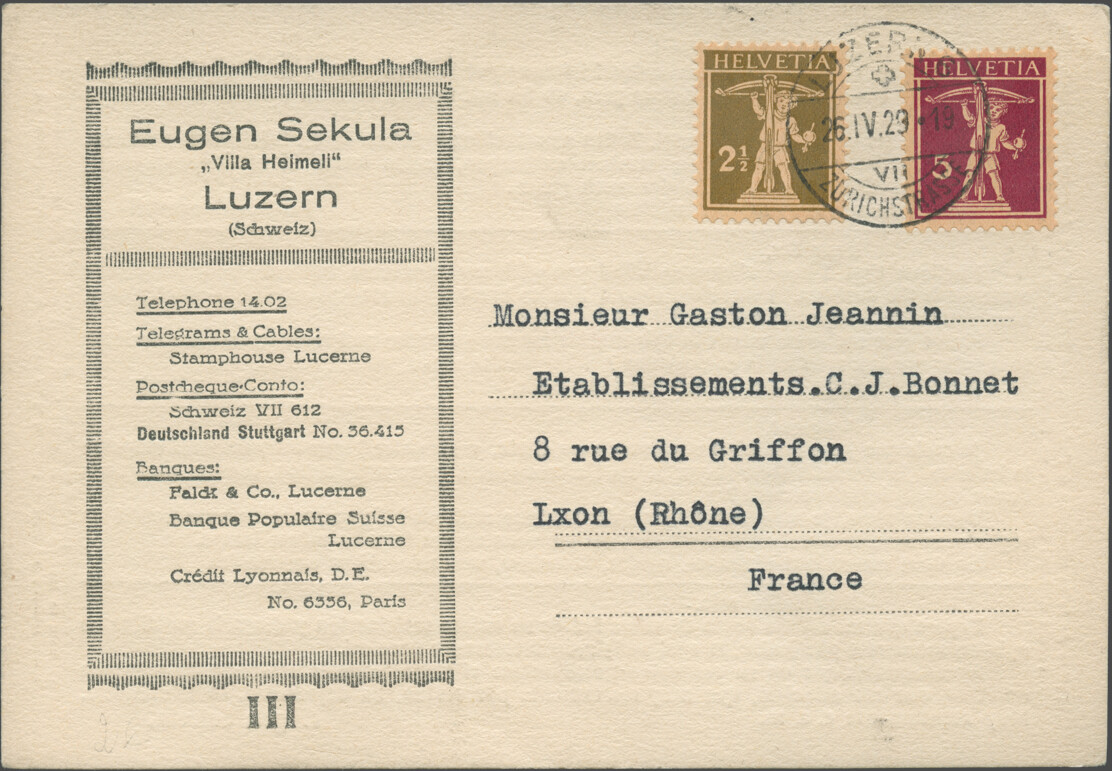
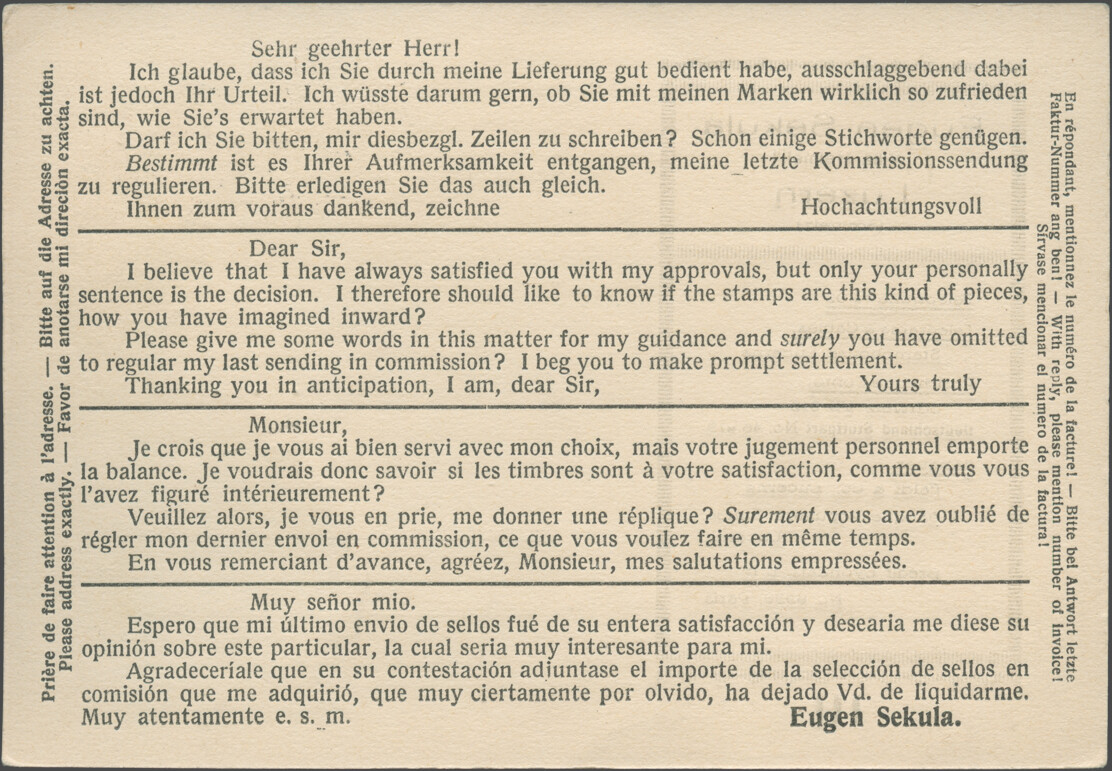
Postcard — April 26, 1928
Sent on April 26, 1928, from Lucerne, Switzerland, to Lyon, France.
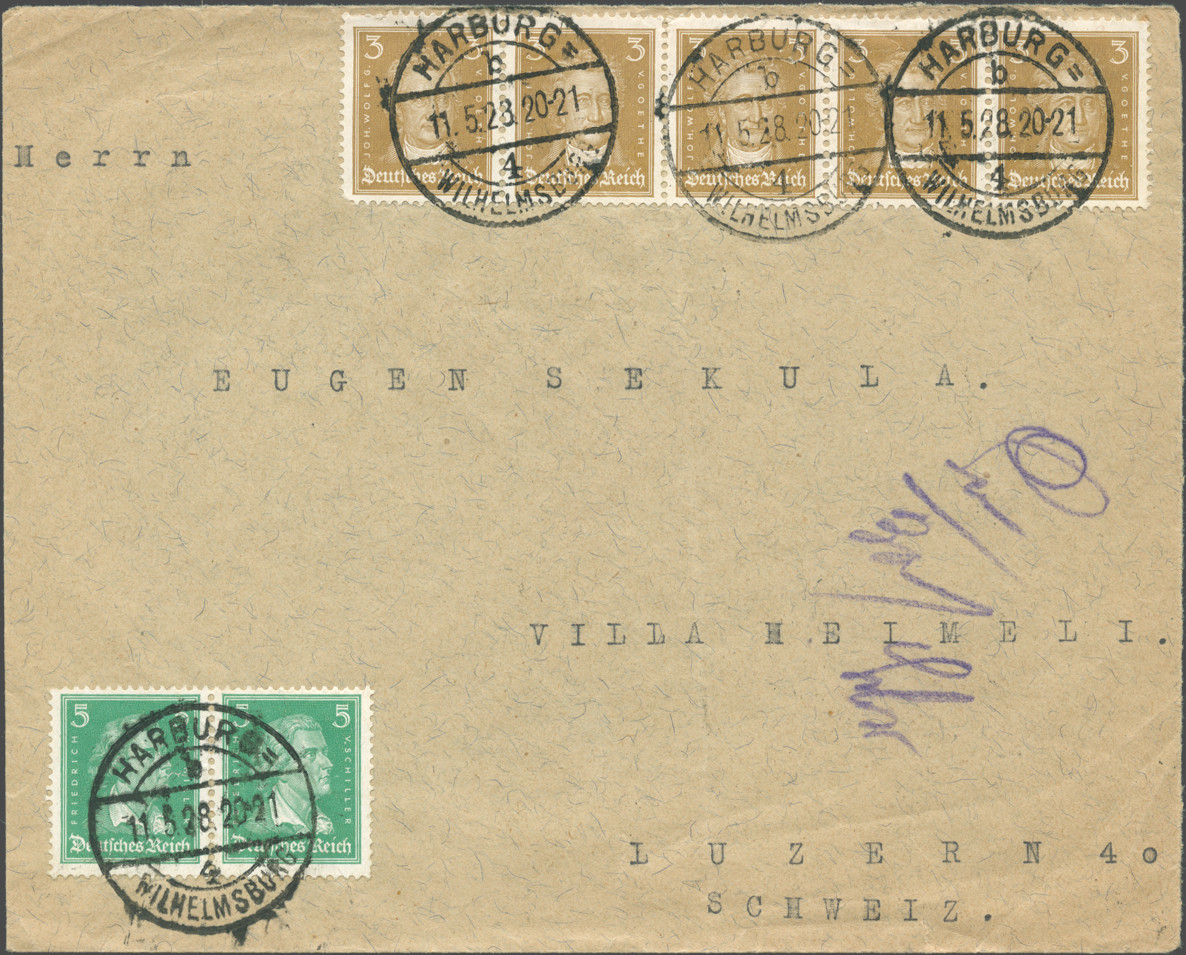
Cover — May 11, 1928
Sent on May 11, 1928, from Harburg-Wilhelmsburg (today part of Hamburg), Germany, to Lucerne, Switzerland. Arrived on May 14, 1928.
Cover — June 4, 1928
Registered mail sent on June 4, 1928, from Lucerne, Switzerland, to Mahajanga (fr. Majunga), Madagascar. Arrived on July 1, 1928.
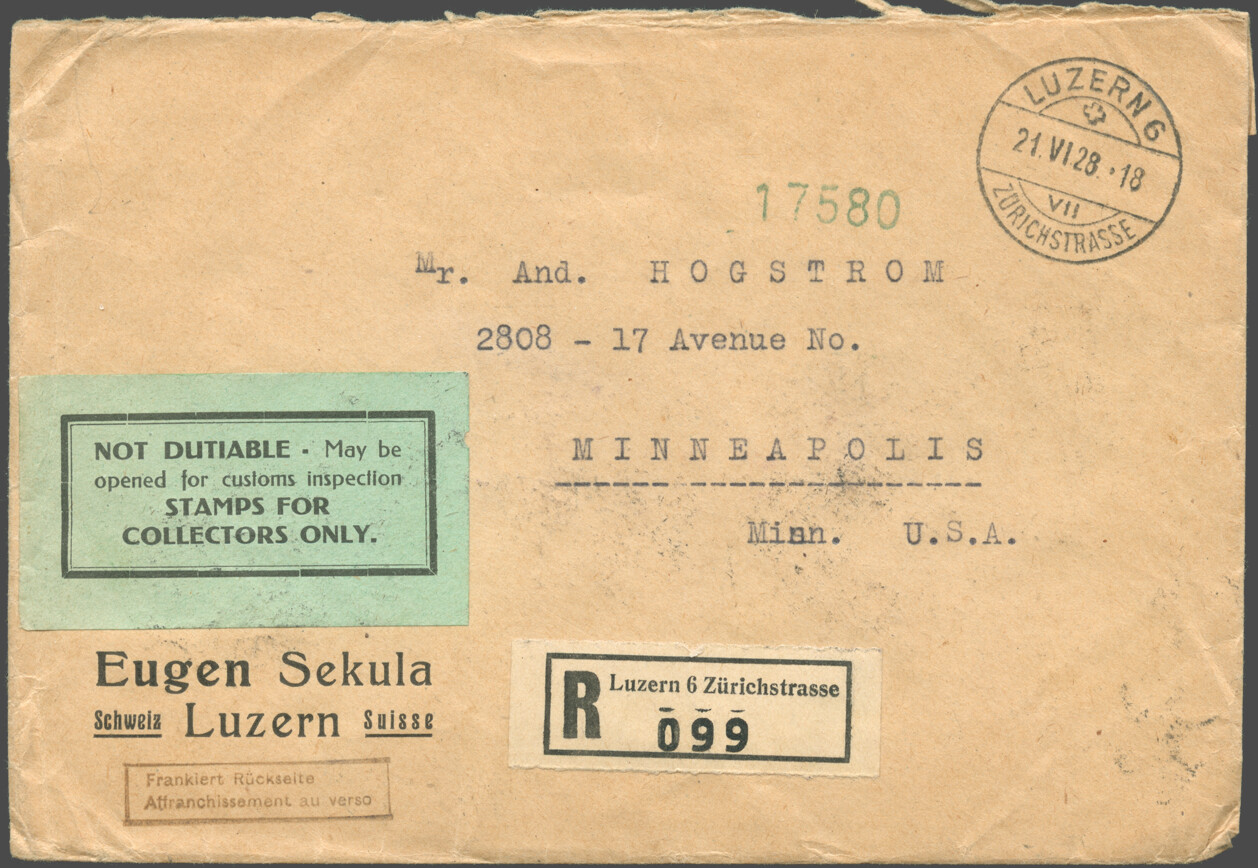
Cover — June 21, 1928
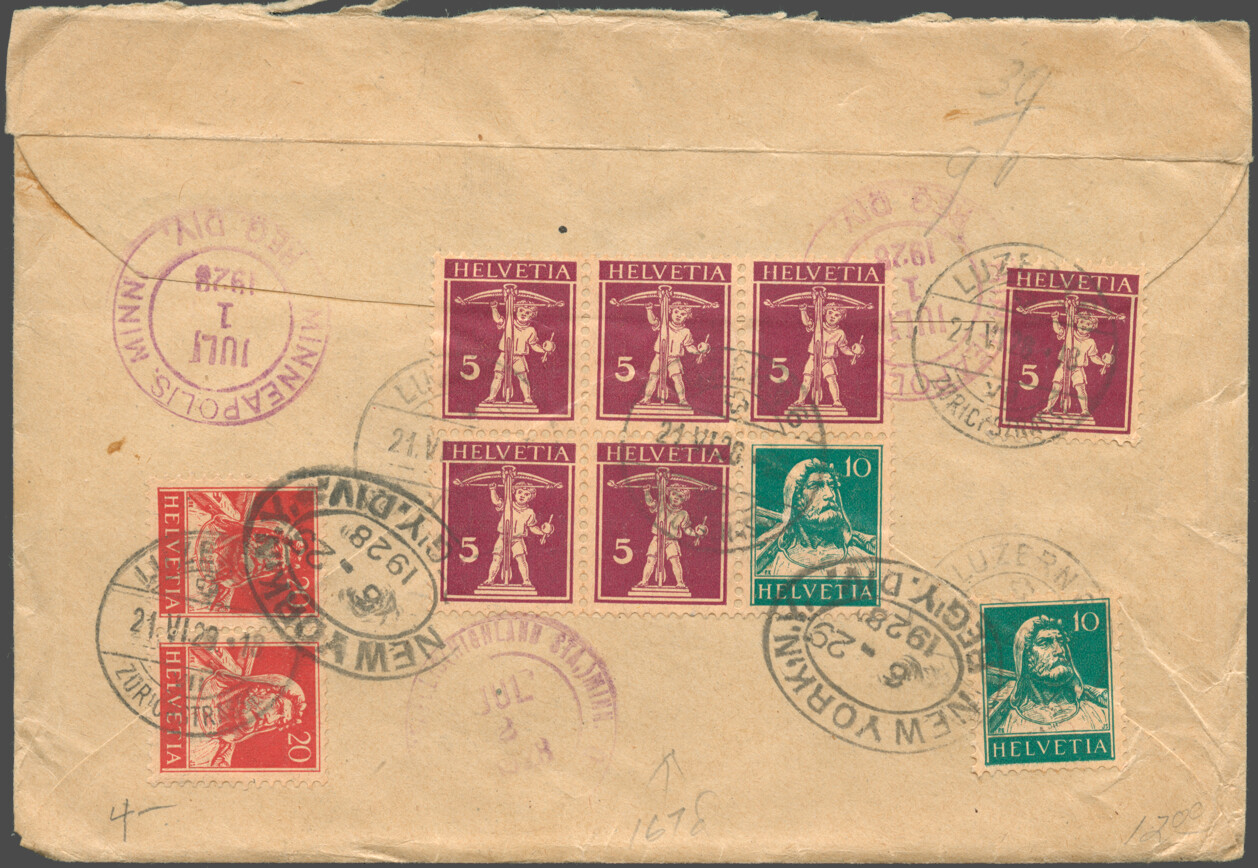
Registered mail sent on June 21, 1928, from Lucerne, Switzerland, to Minneapolis, Minnesota, United States. Arrived on July 2, 1928.
Cover — June 25, 1928
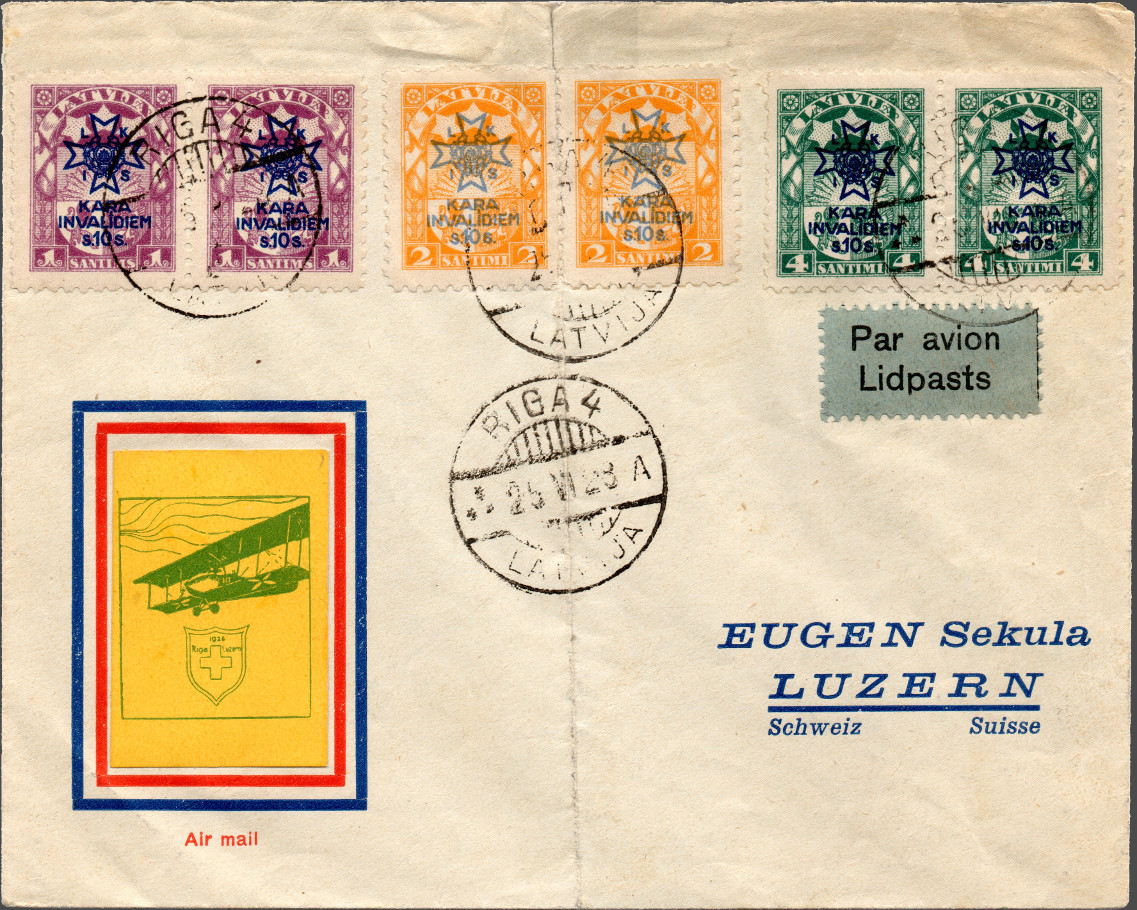
Special cacheted envelope for the benefit of war invalids traveled by airmail on June 25, 1928 from Riga, Latvia and adressed to Eugen Sekula.
Scan provided by Albert Little.
Postcard — July 4, 1928
Sent on July 4, 1928, from Lucerne, Switzerland, to Montréal, Canada.
Postcard — July 4, 1928
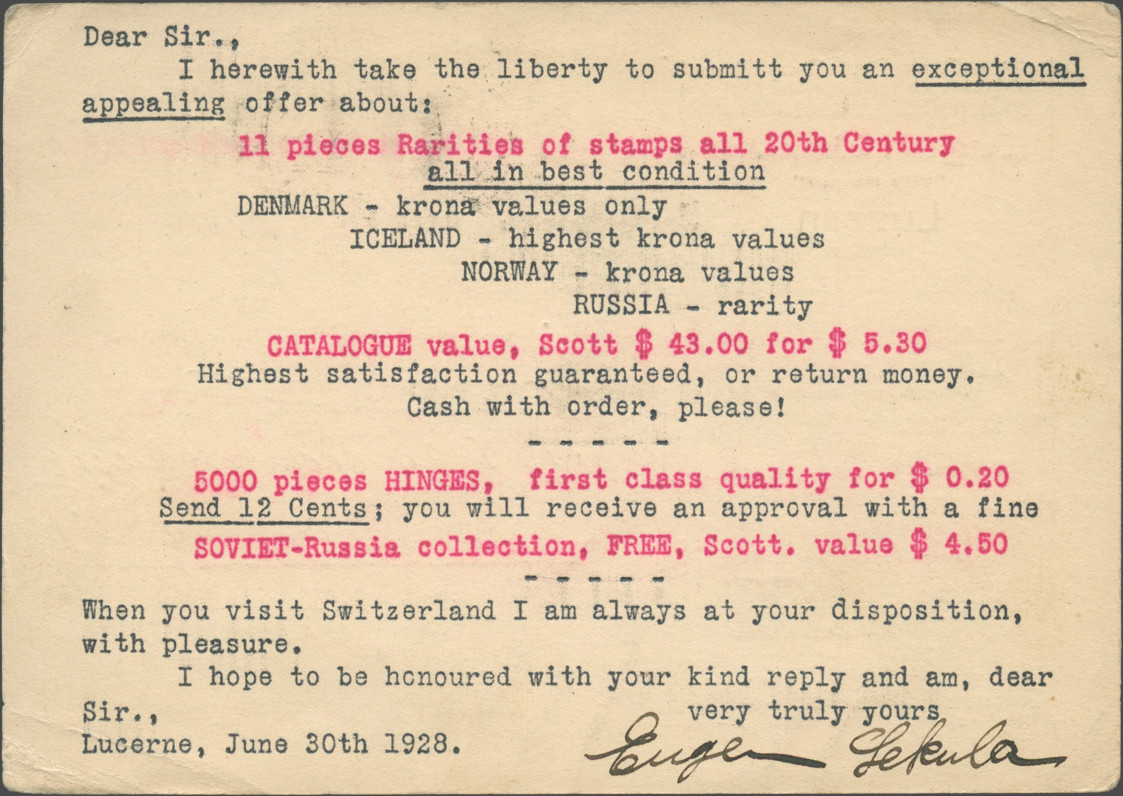
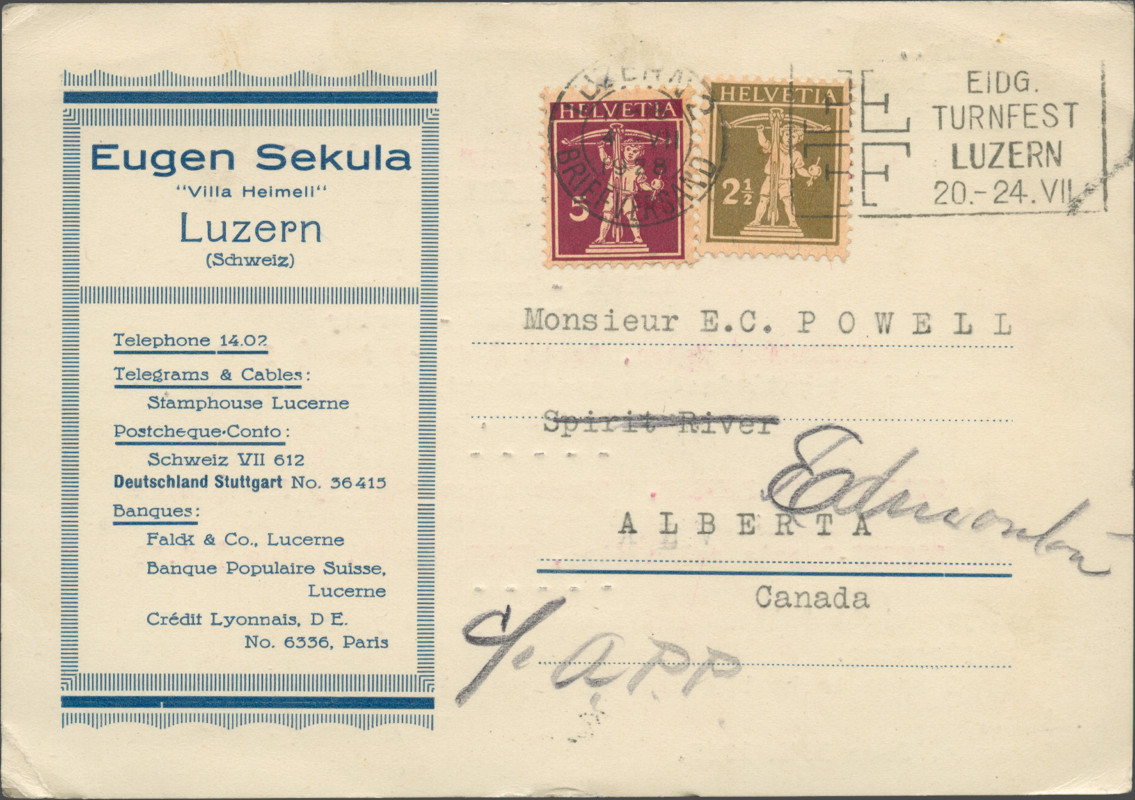
Sent on July 4, 1928, from Lucerne, Switzerland, to Edmonton, Albert, Canada.
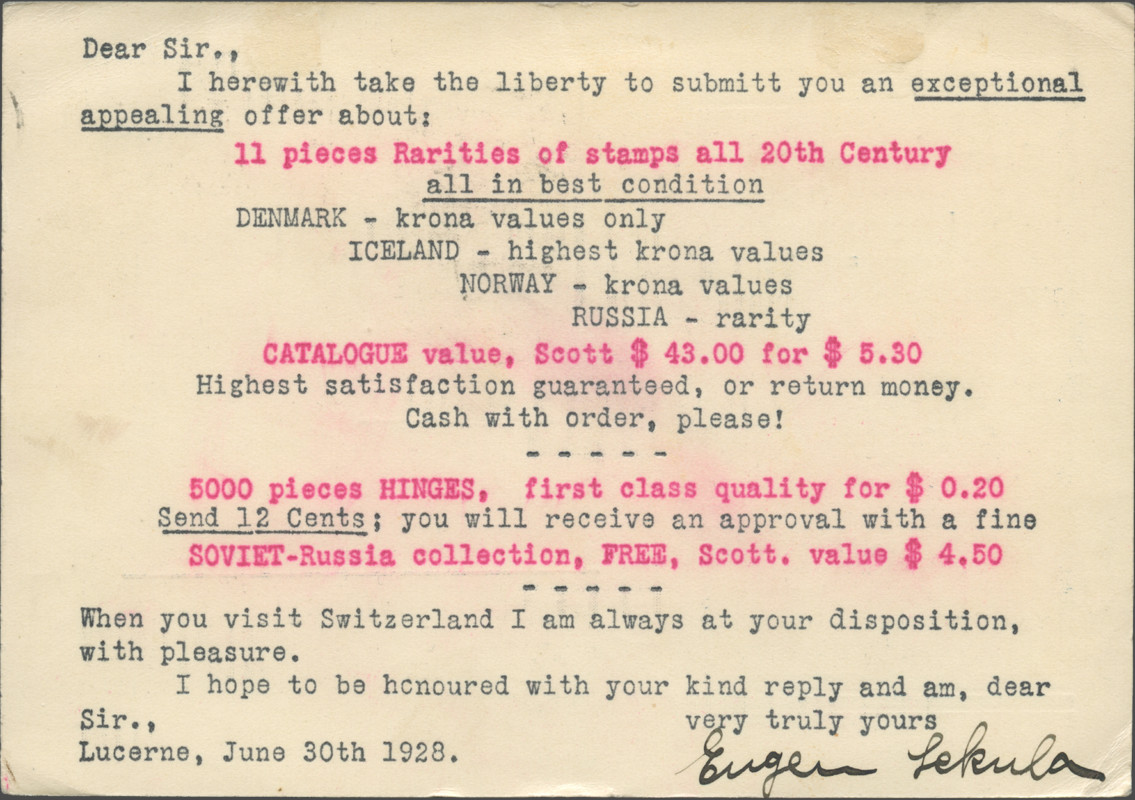
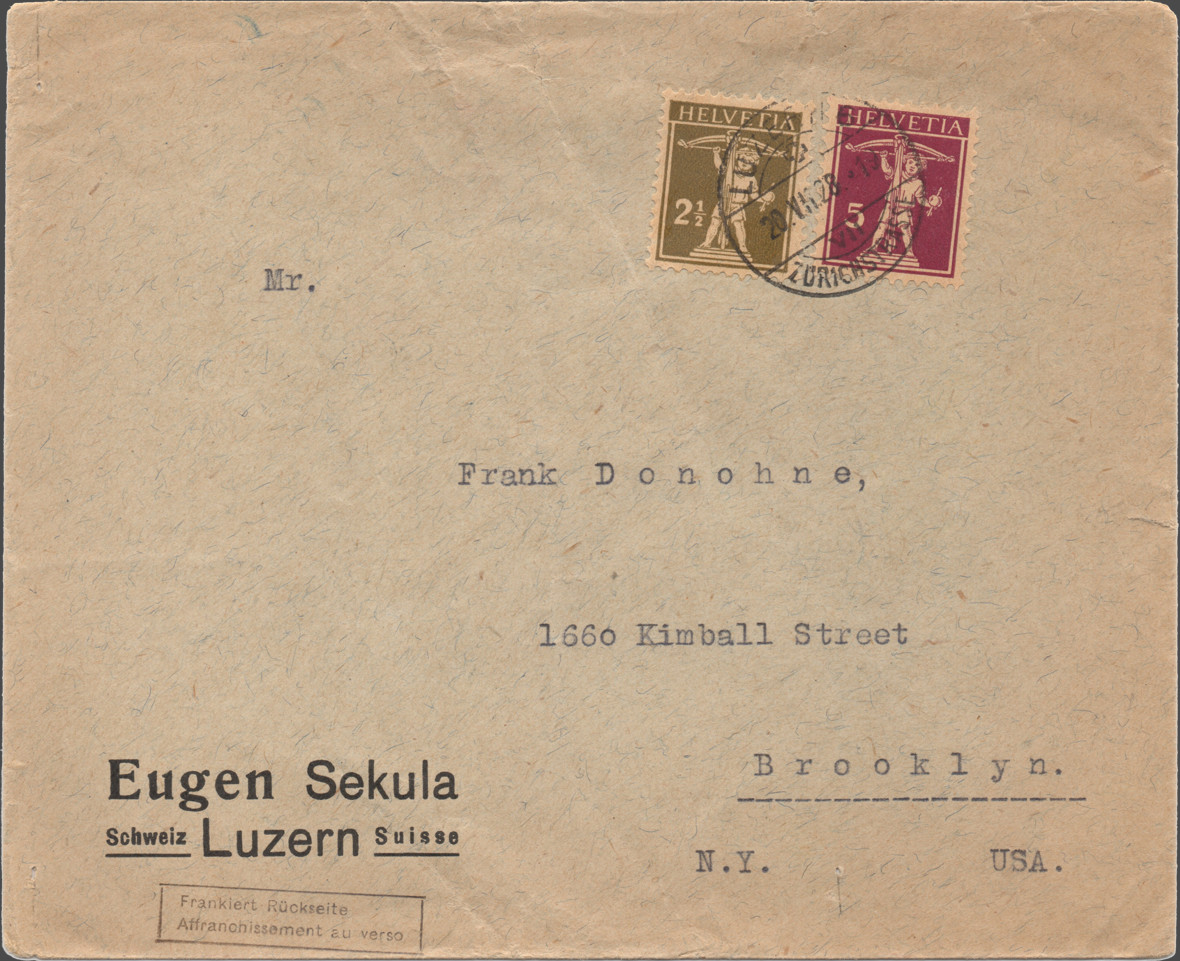
Cover — July 20, 1928
Sent on July 20, 1928, from Lucerne, Switzerland, to New York City, United States. Arrived on July 20, 1928.
Scan provided by Albert Little.
Cover — August 24, 1928
Oberländer Tagblatt April 5, 1927Neue Zürcher Zeitung May 27, 1932
In 1927, in addition to his usual advertisements in various newspapers Eugen Sekula began placing anonymous classified ads only disclosing his PO box number for contact.
These want ads promising guaranteed confidentiality were mainly targeted at private sellers who wished to monetize larger lots like entire stamp collections as discretely as possible.
From 1928 on he occasionally offered collections himself in this way.
Beside the general appearance of typical Eugen Sekula covers, correspondence relating to these confidential deals can be identified by their return address, either PO box 19041 (1927–1929) or PO box 19108 (1929–1933).
Registered PO box 19041 cover sent on August 24, 1928 to Épinay-sur-Seine, France, and forwarded to Arnouville-lès-Gonesse.
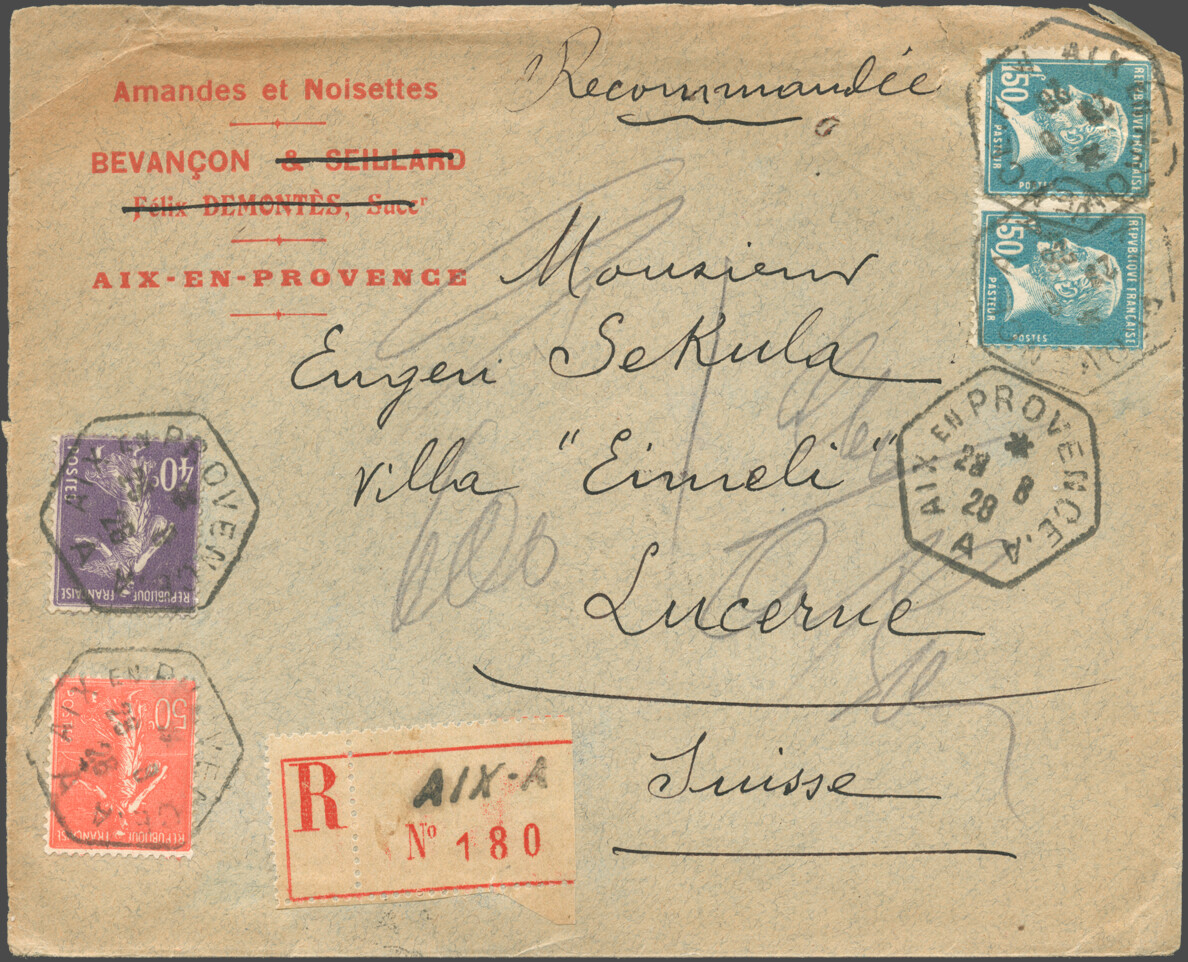
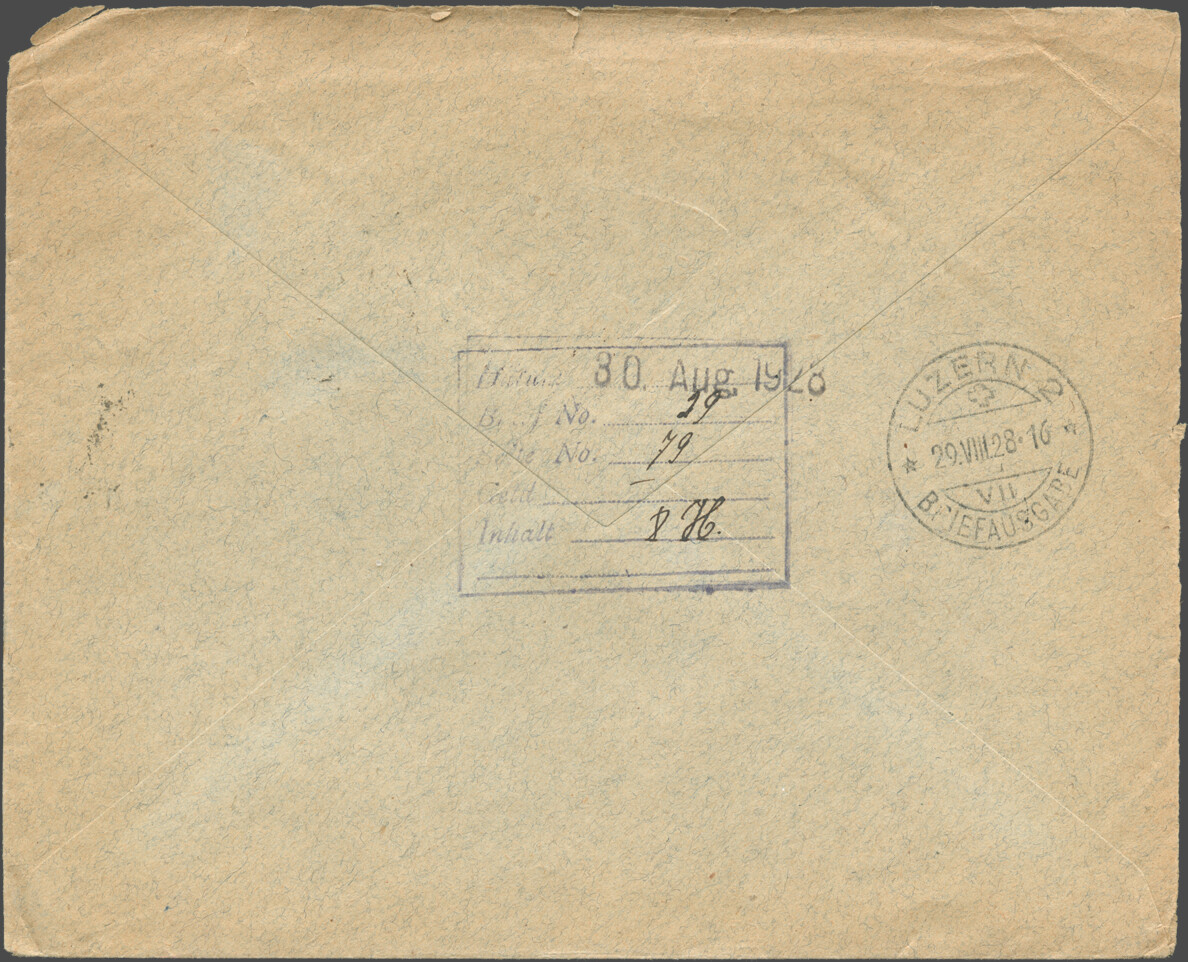
Cover — August 28, 1928
Registered mail sent on August 28, 1928, from Aix-en-Provence, France, to Lucerne, Switzerland. Arrived on August 29, 1928.
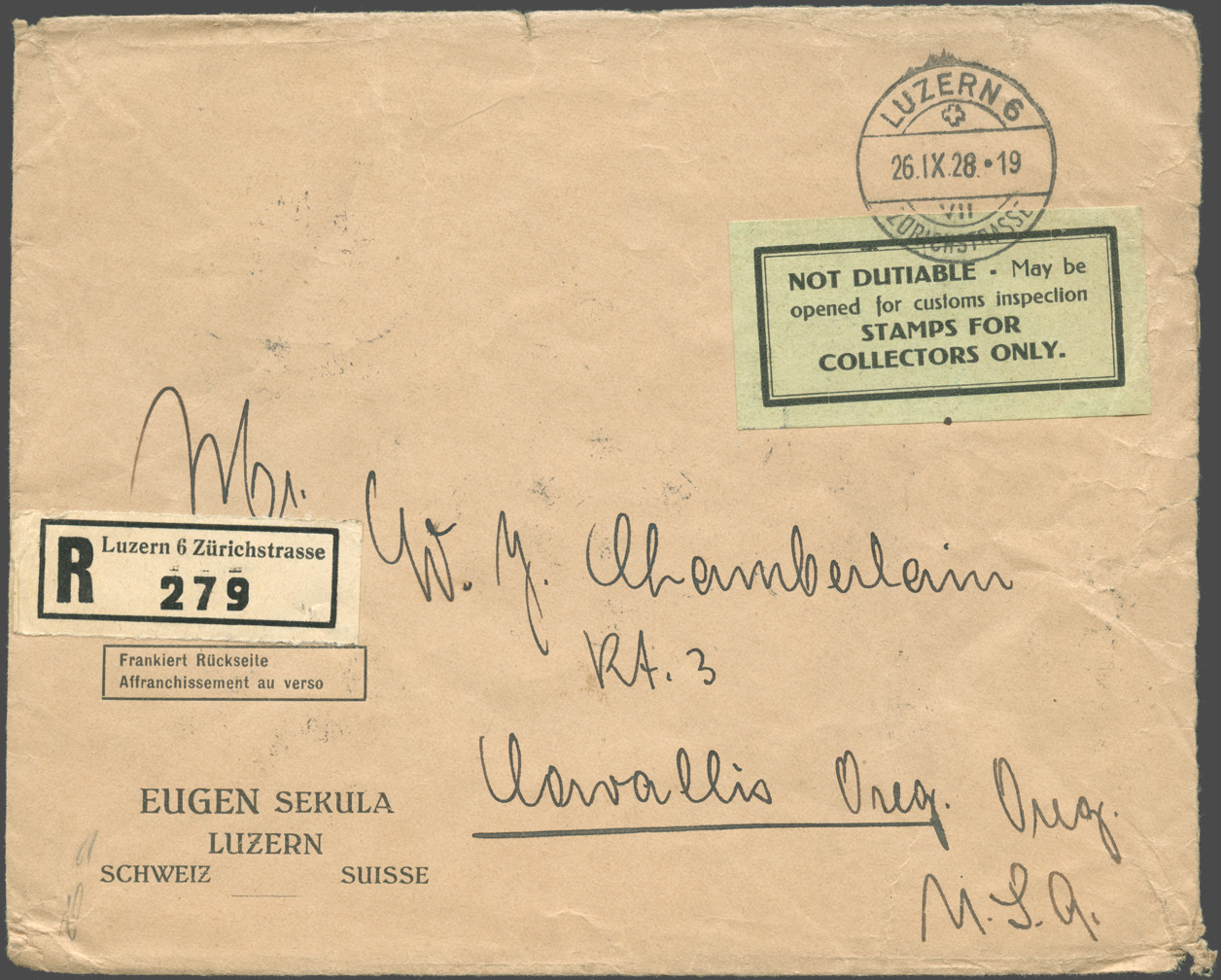
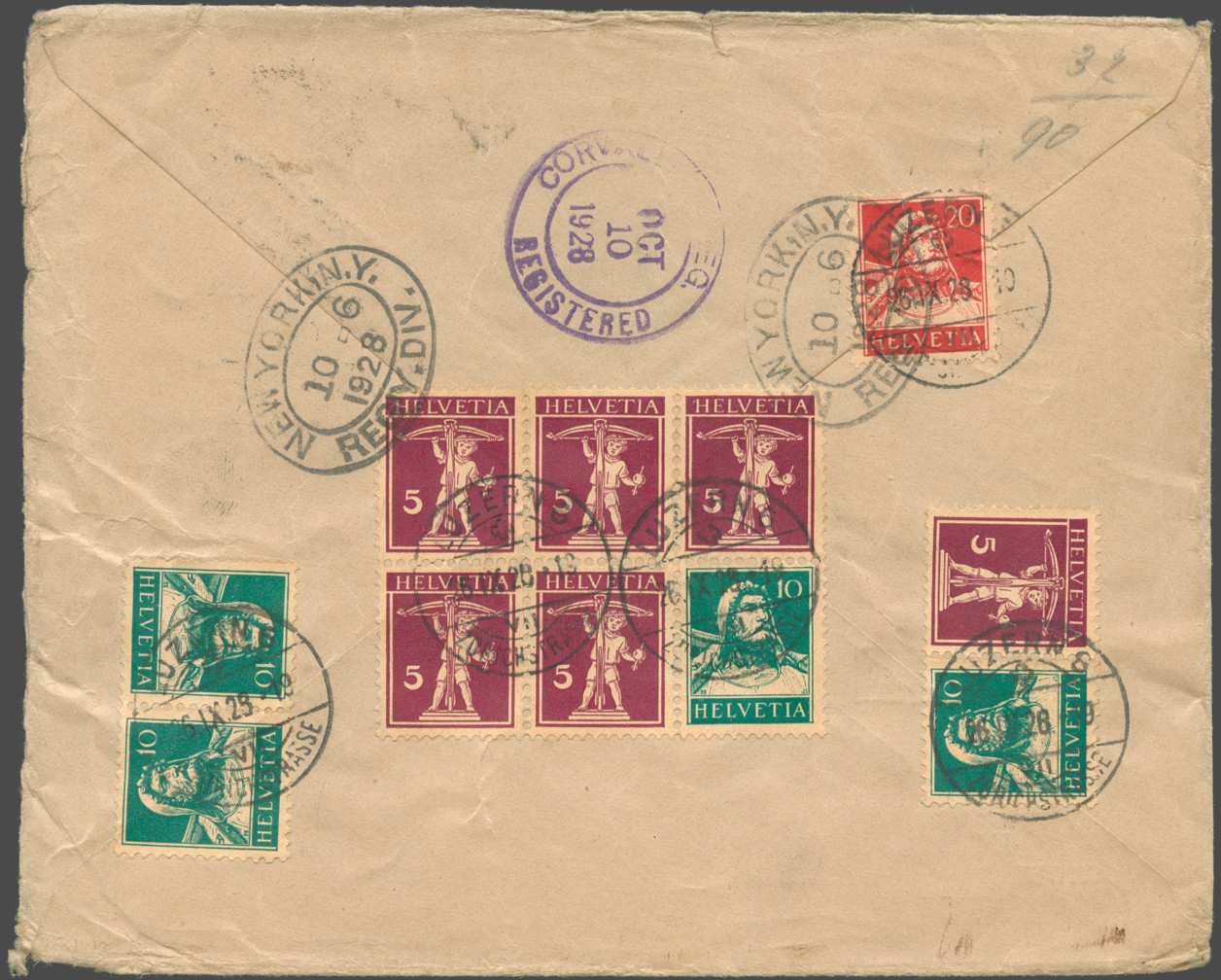
Cover — September 26, 1928
Registered mail sent on September 26, 1928, from Lucerne, Switzerland, to Corvallis, Oregon, United States. Arrived on October 10, 1928.
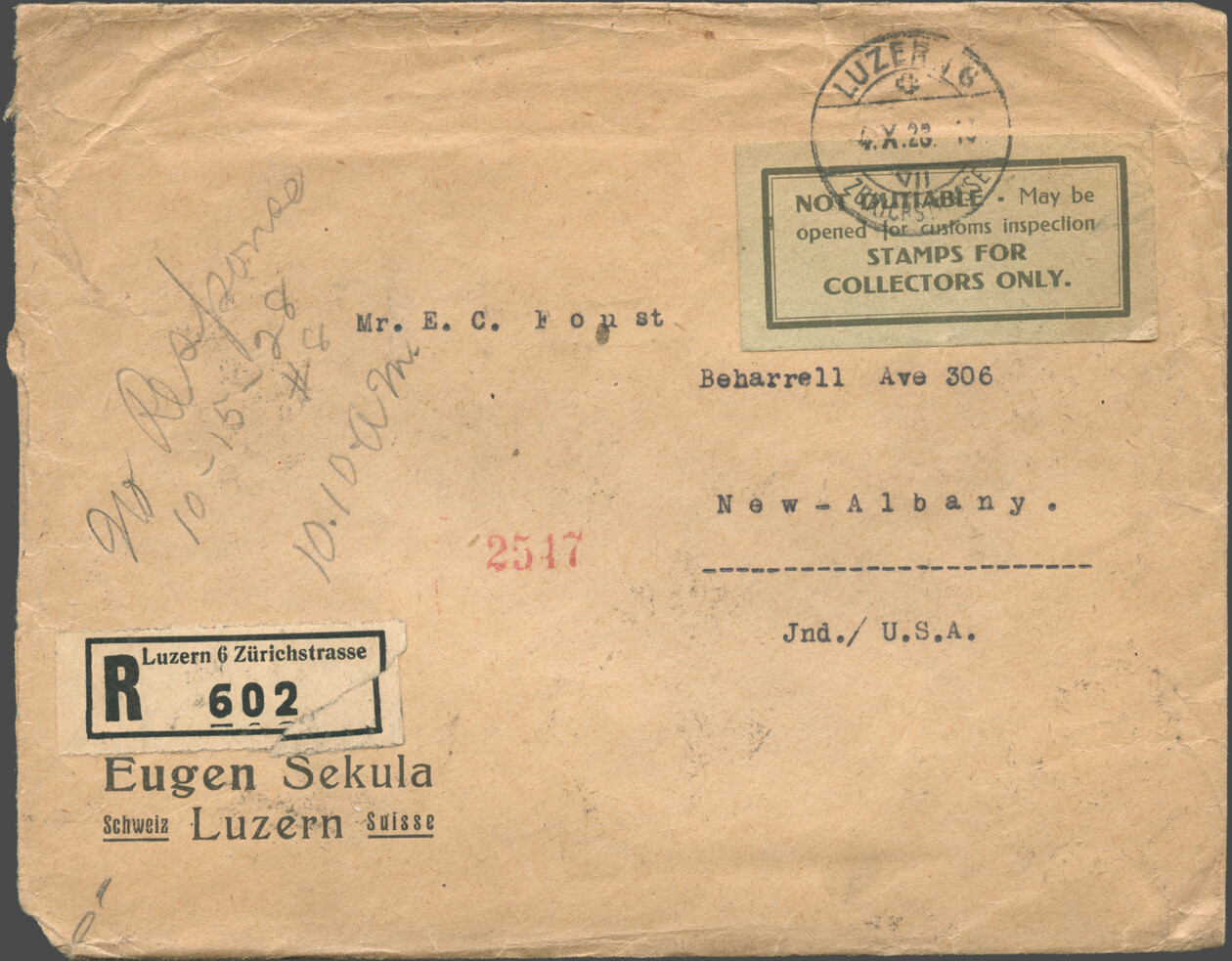
Cover — October 4, 1928
Registered mail sent on October 4, 1928, from Lucerne, Switzerland, to New Albany, Indiana, United States. Arrived on October 15, 1928.
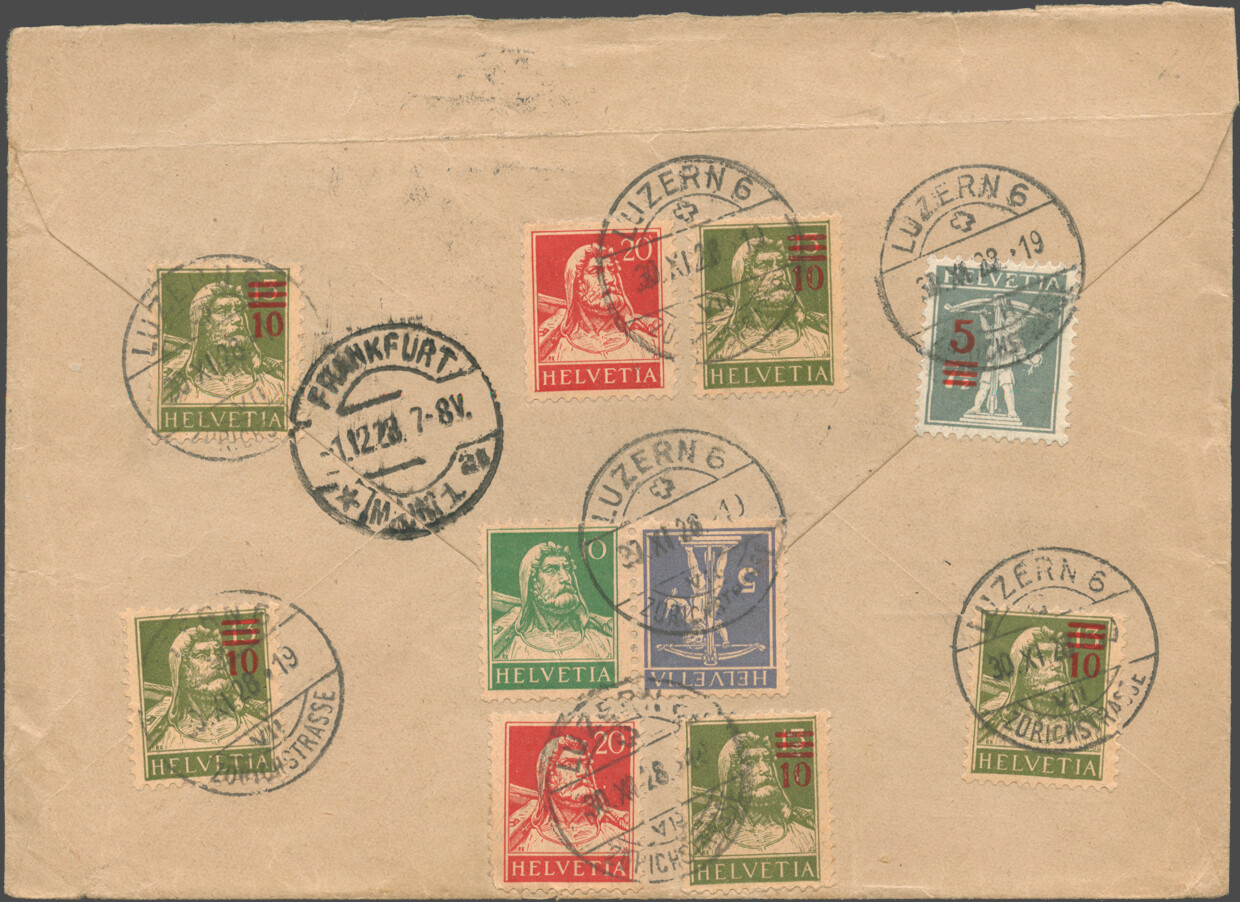
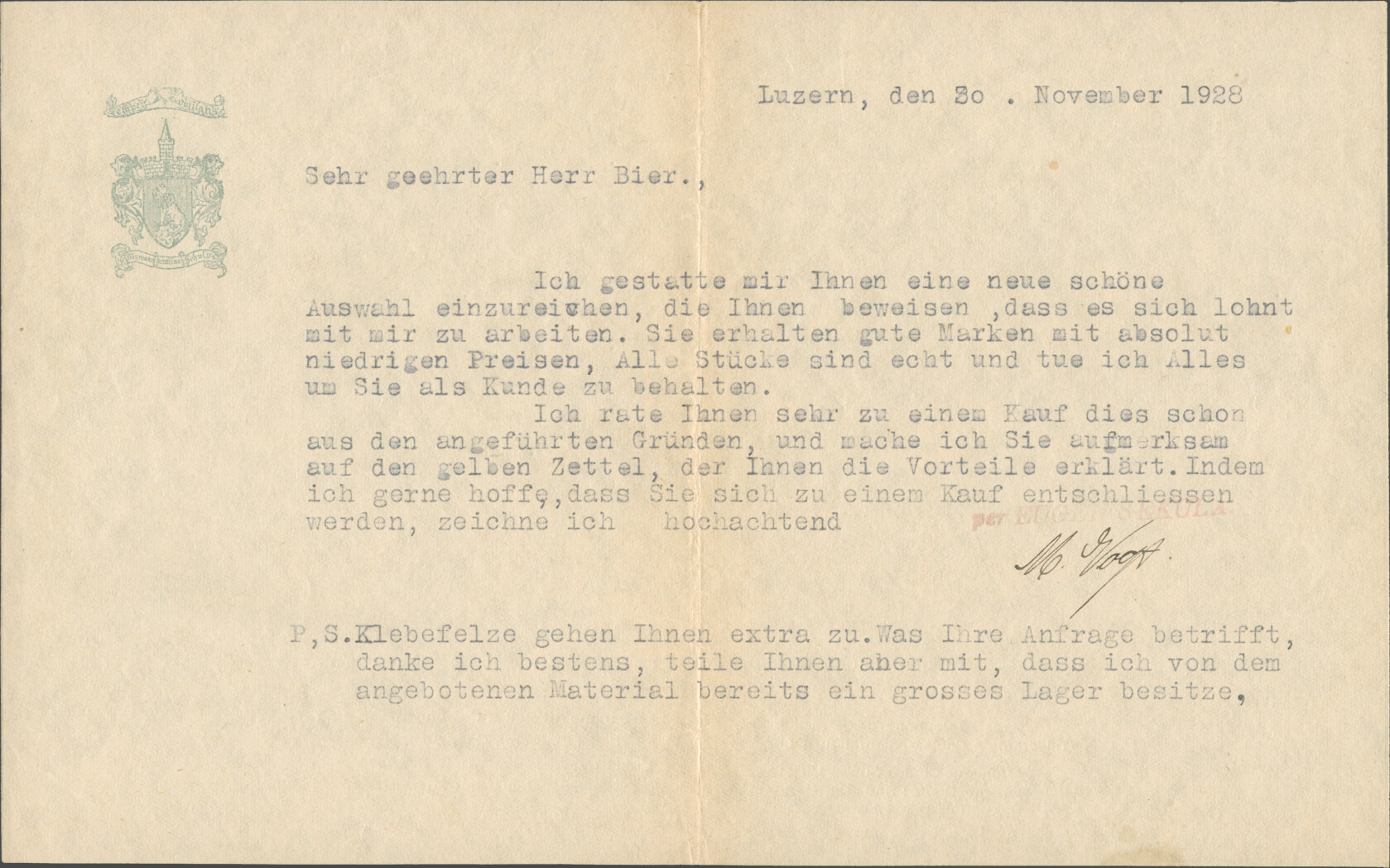
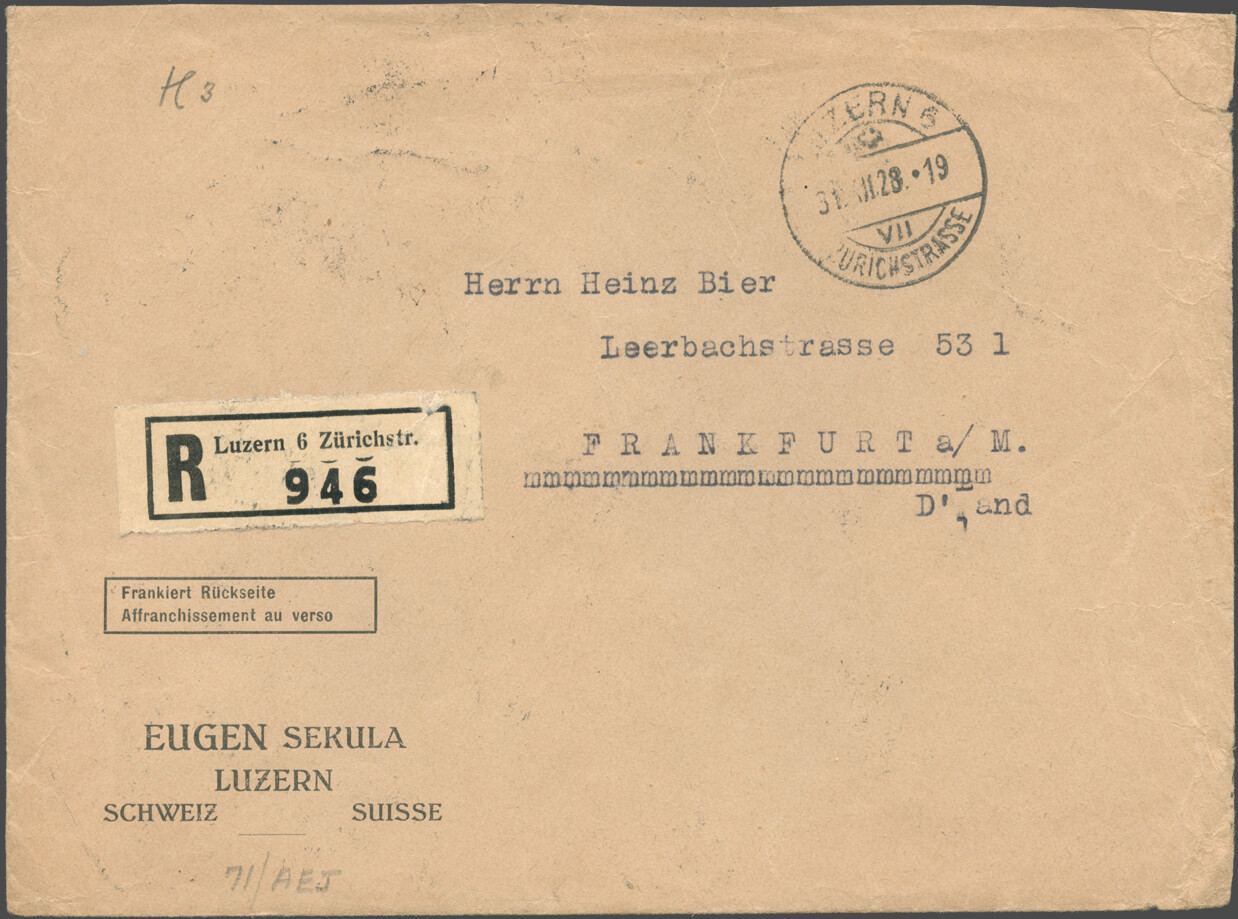
Cover — November 30, 1928
Registered mail sent on November 30, 1928, from Lucerne, Switzerland, to Frankfurt am Main, Germany. Arrived on December 1, 1928.
Cover — December 27, 1928
Printed matter sent on December 27, 1928, from Lucerne, Switzerland, to Philadelphia, Pennsylvania, United States.
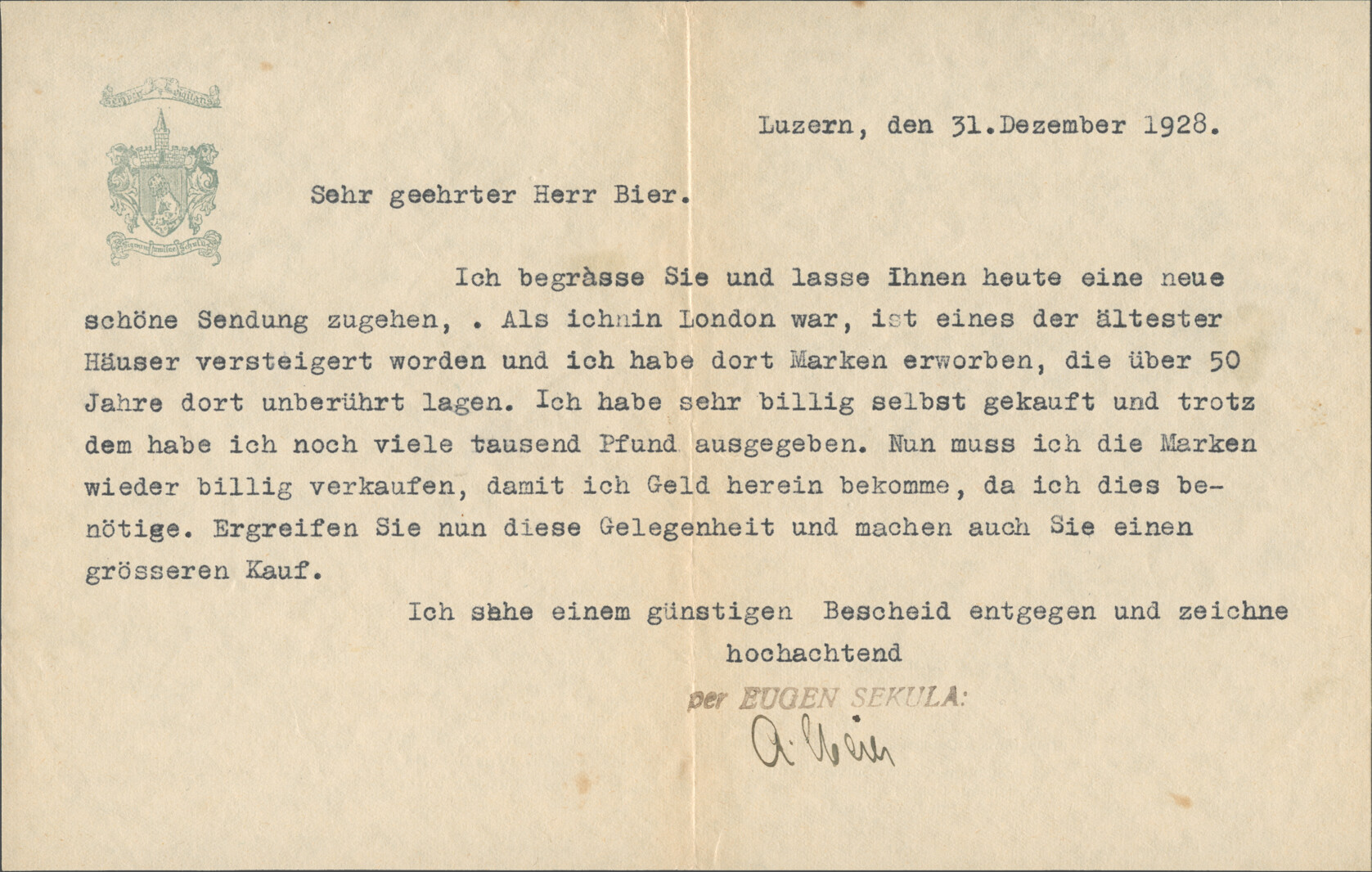
Cover — December 31, 1928
Registered mail sent on December 31, 1928, from Lucerne, Switzerland, to Frankfurt am Main, Germany. Arrived on January 1, 1929.
Airmail Rhine–Main 1912 Postcards — 1929
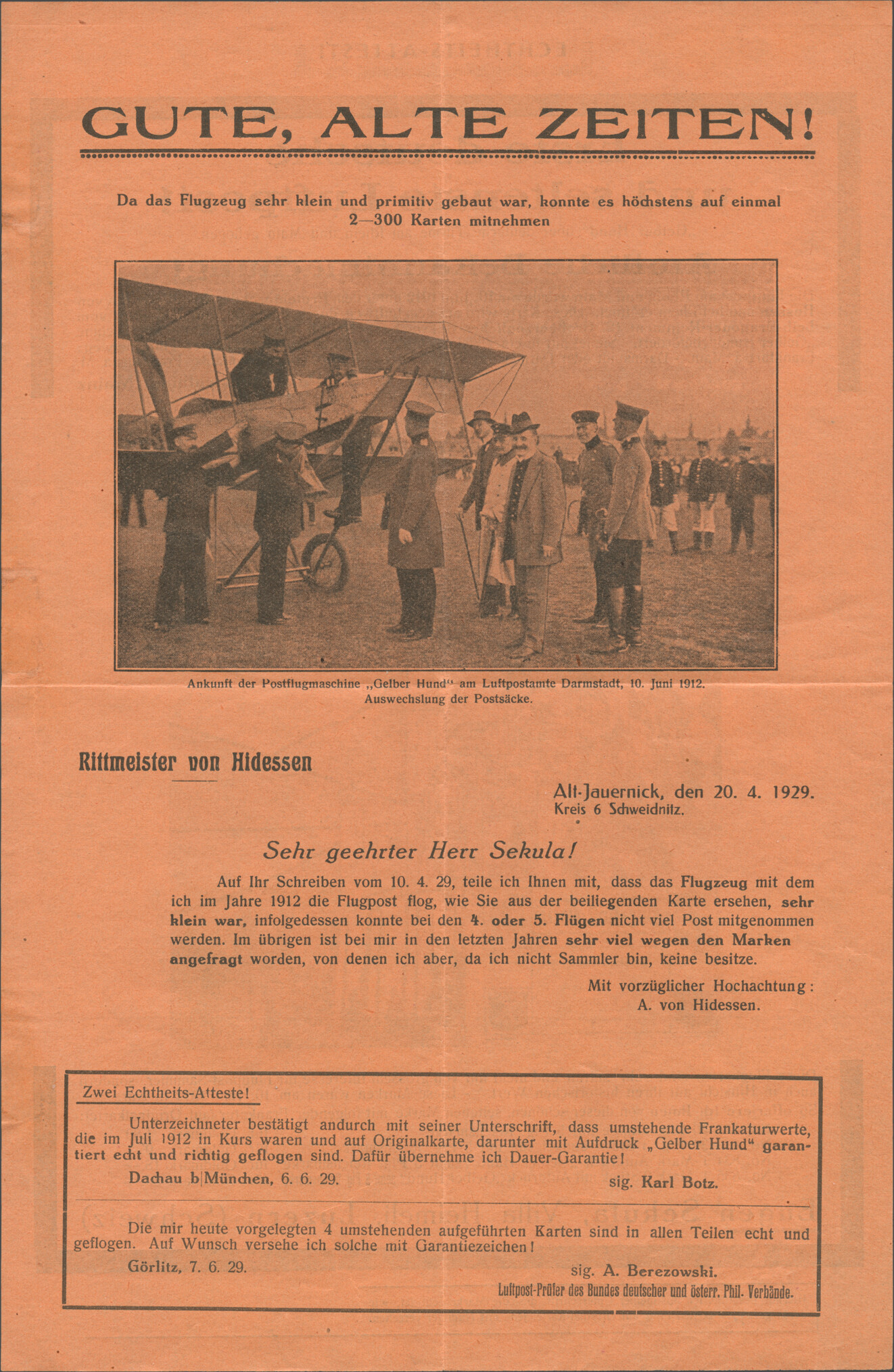
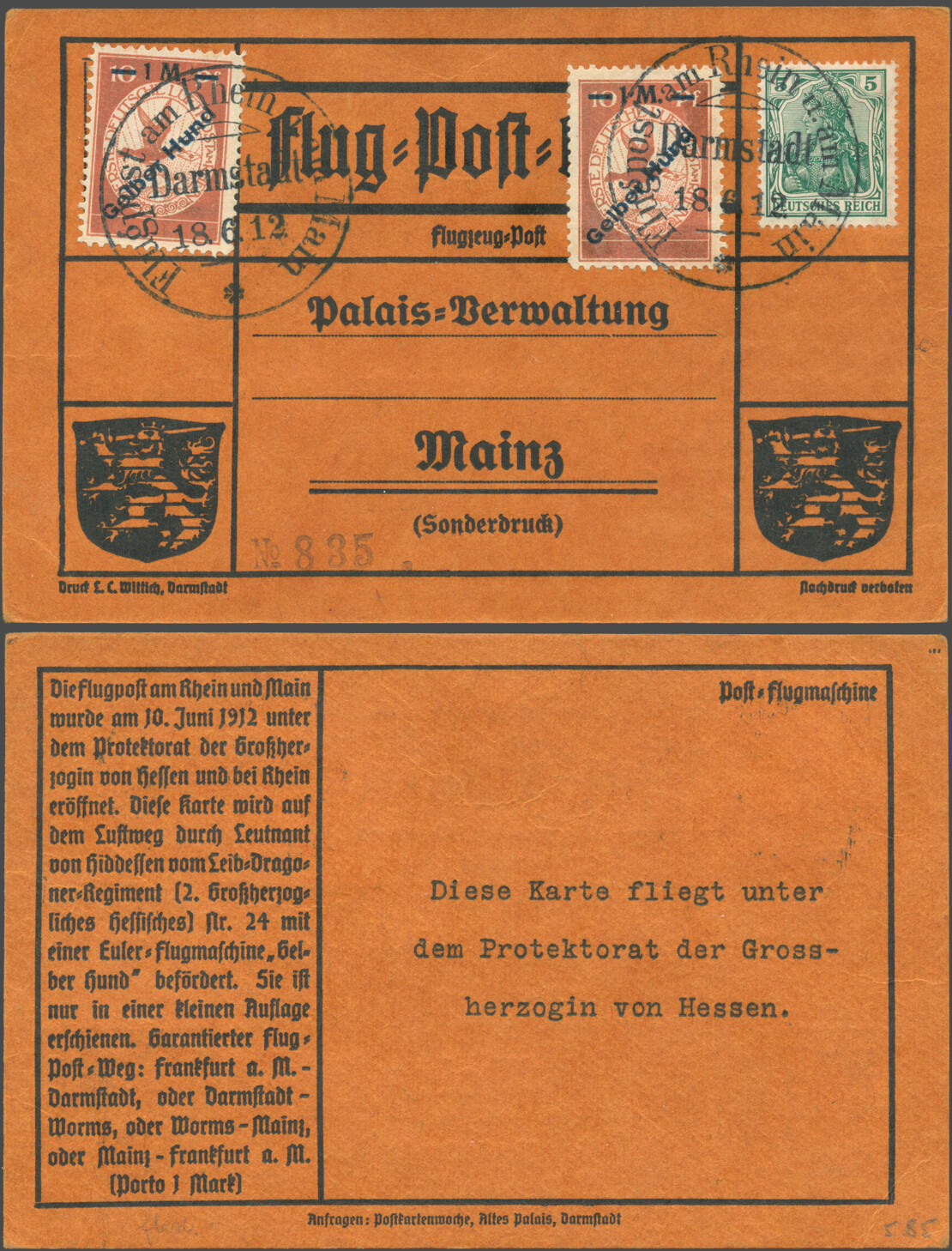
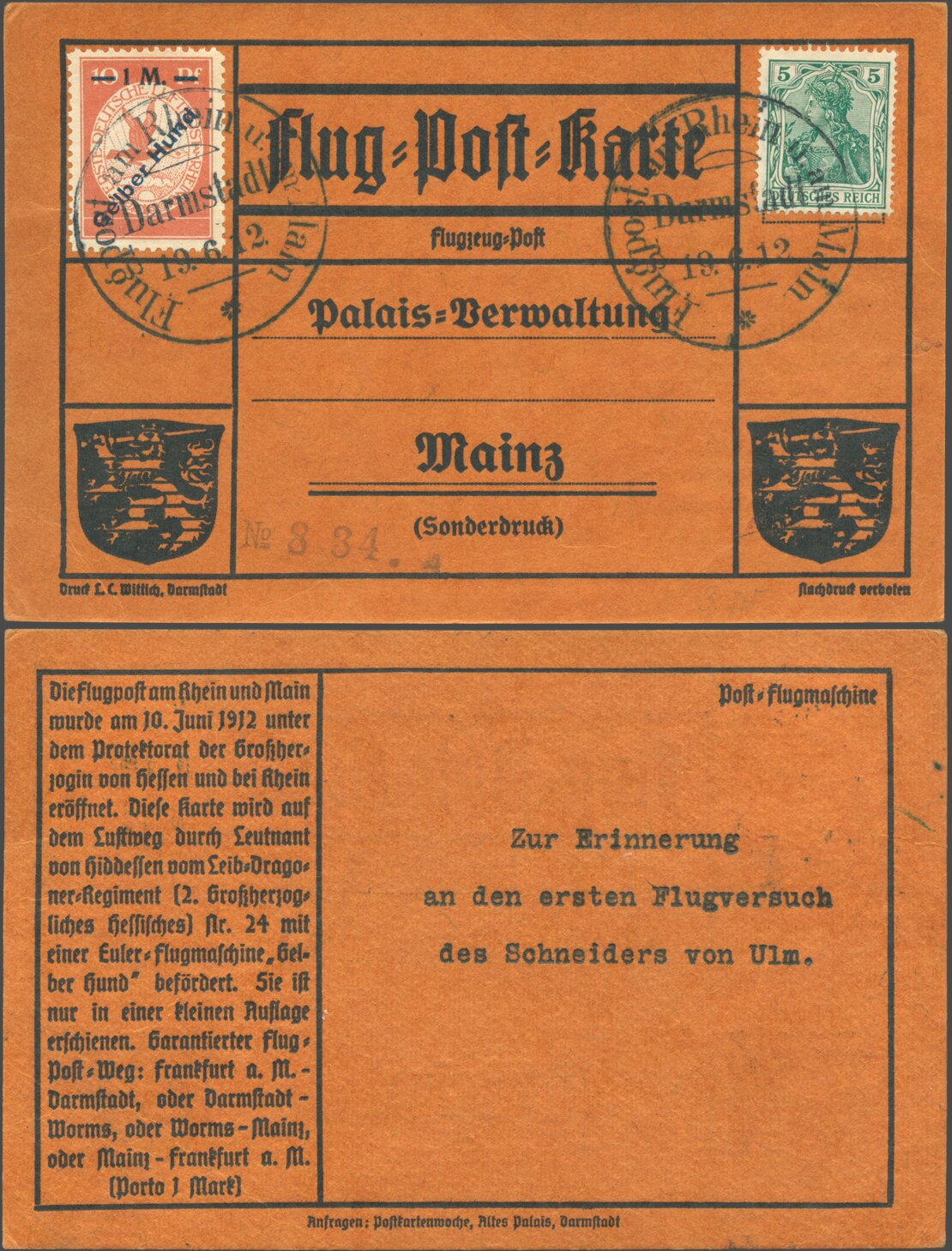
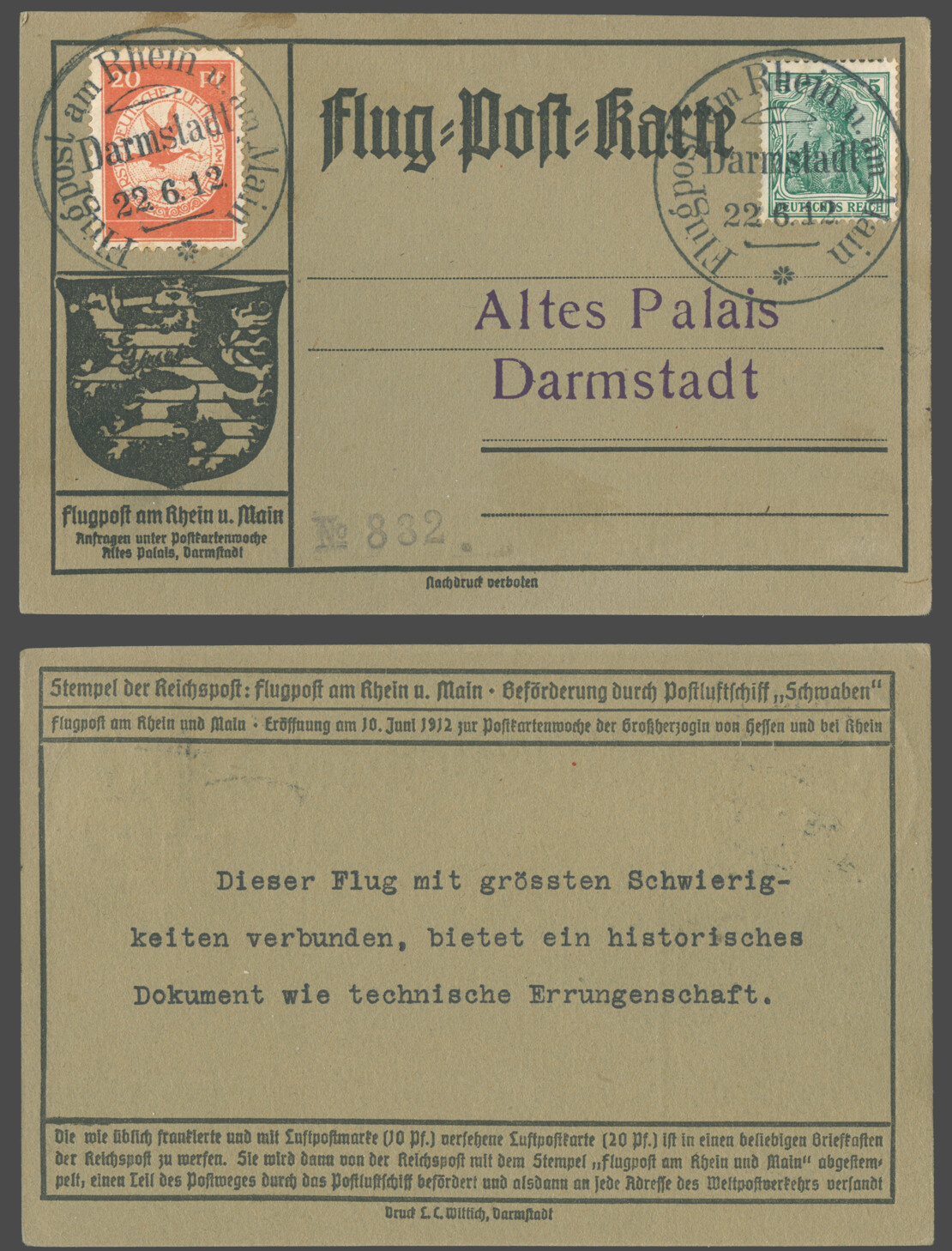
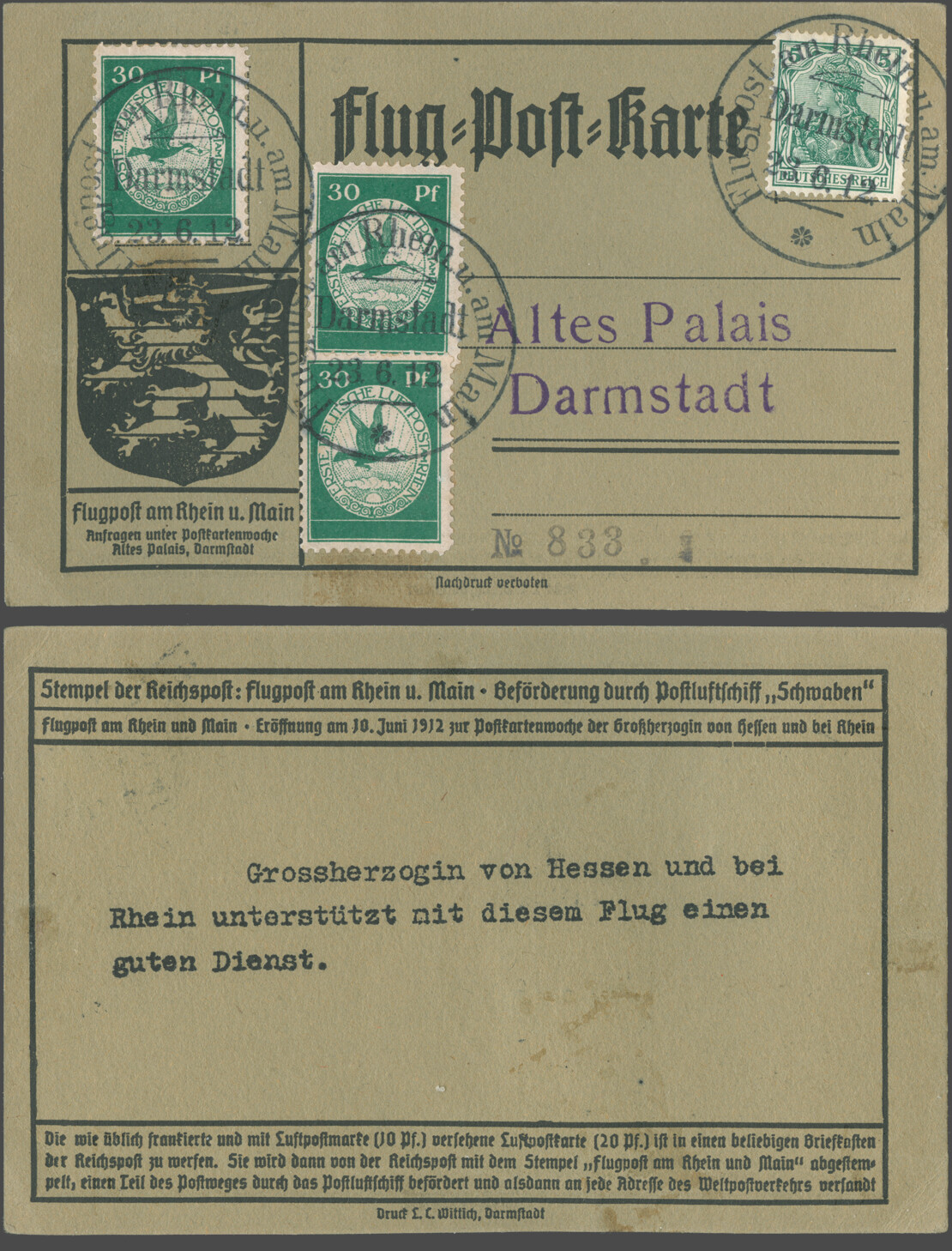
On June 1st, 1912, the Imperial Post Office granted permission for mail transport with a zeppelin and an airplane as part of a charity event for the benefit of the Grand Ducal Center for Mother and Infant Care in Hesse. The Postcard Week aka Airmail on the Rhine and Main (Ressource in German), one of the first flight events with official airmail transport worldwide, was scheduled to take place from June 9th to 16th. Airmail was transported between the cities of Frankfurt a.M., Offenbach a.M., Darmstadt, Worms and Mainz. Postcards meant to travel by aircraft could be placed in any street mailbox of the participating cities during the event, but in addition to regular stamps paying the actual postage (e.g. 5 Pf for a postcard) they had to be franked with semi-official stamps issued by the organizer. Although these so-called flight stamps had no postal value, they also received a post office cancellation. On Sunday, June 9th, air post offices began selling official charity postcards and stamps. Military bands providing a respectable supporting program turned the Postcard Week into a folk festival which was publicly observed far beyond the guild of stamp collectors. On June the 10th the first airmail was transported from Frankfurt to Darmstadt by the Gelber Hund (Yellow Dog), a double-decker with yellow wings built by August Euler. Two days later, the airship Schwaben (Swabia) arrived at Frankfurt for a roundtrip with stops at Offenbach, Darmstadt und Mainz. At each stop, mail bags were dropped on parachutes and new mail was picked up with ropes and hooks while the airship stayed hovering about 50 m above the ground. Several more flights took place during the following days. Due to delays caused by technical problems and the weather leading to undelivered mail, but also to increase sales of charity postcards, the fair was extended to Sunday, the 23rd. However, delivery of the mail lasted beyond the end of the fair. The Schwaben, already back at her home base in Baden-Oos, had to return to Frankfurt, and on June 24th (according to some sources June 27th) she carried out the final flight, transporting mail that had actually been intended for the – now defective – Gelber Hund plus last-minute postcards quickly prepared by the patronage and addressed to Altes Palais Darmstadt. Unsold remainders eventually ended up with stamp dealers like the Senf brothers, Leipzig, and Eugen Sekula, Lucerne. It is important to note that all these postcards were actually flown and thus qualify as airmail.
Eugen Sekula acquired his stock of postcards long after the event, around 1929, when they were already classic items. The flyer below promoting their sale also served as certificate of authenticity.
Sekula postcards can be identified by a hand-stamped number on the front (№ 832 … № 835) and the presence of one of several short typewritten messages on the back.
Registered mail sent on January 10, 1929, from Lucerne, Switzerland, to Rohrbach-lès-Bitche, France. Arrived on January 11, 1929.
Cover — February 28, 1929
Registered PO box 19108 cover sent on February 28, 1929, from Lucerne, Switzerland, to San Rafael, California, USA. Arrived on March 13, 1929.
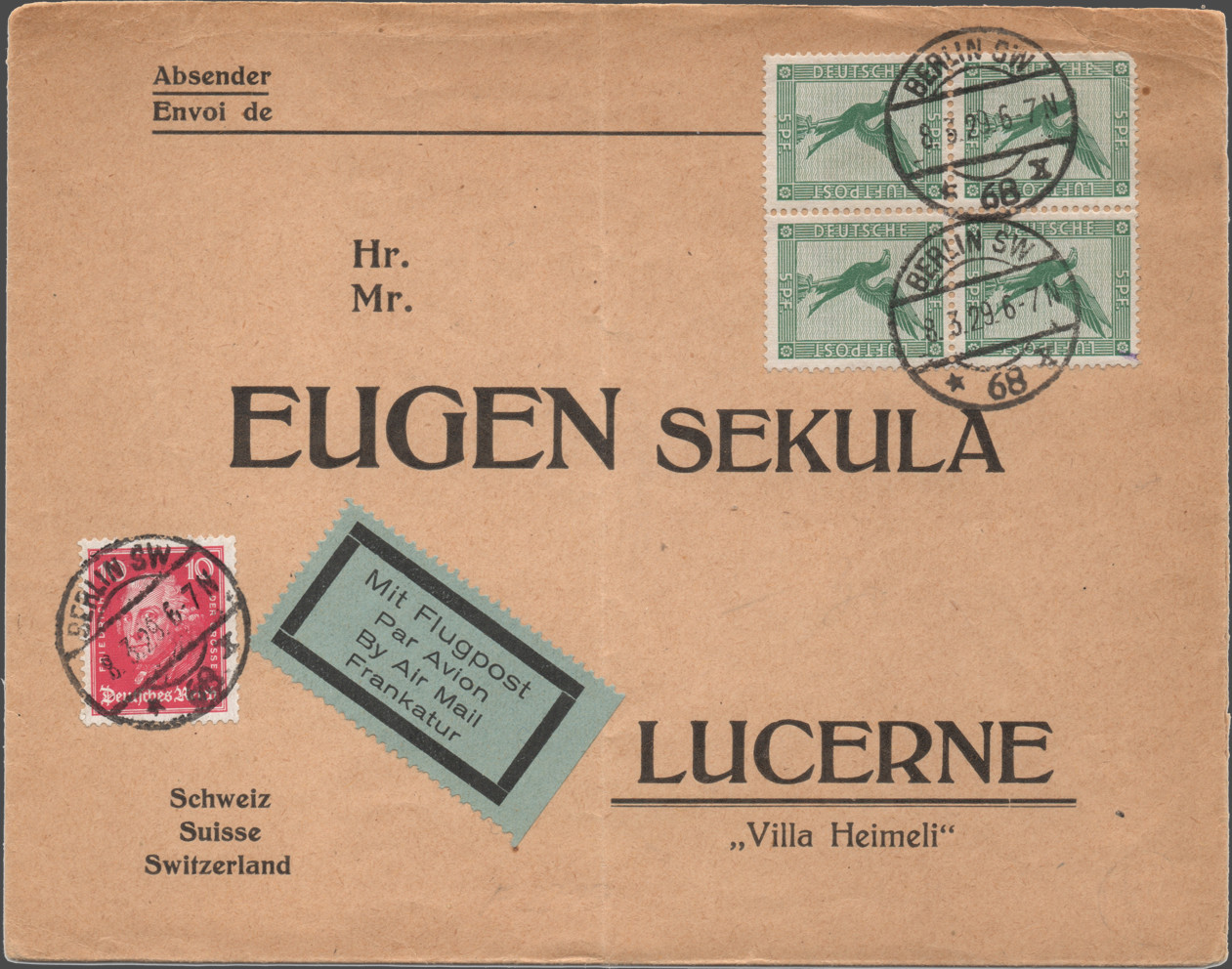
Return Envelope — March 8, 1929
Airmail sent on March 8, 1929, from Berlin, Germany, to Lucerne, Switzerland.
Scan provided by Albert Little.
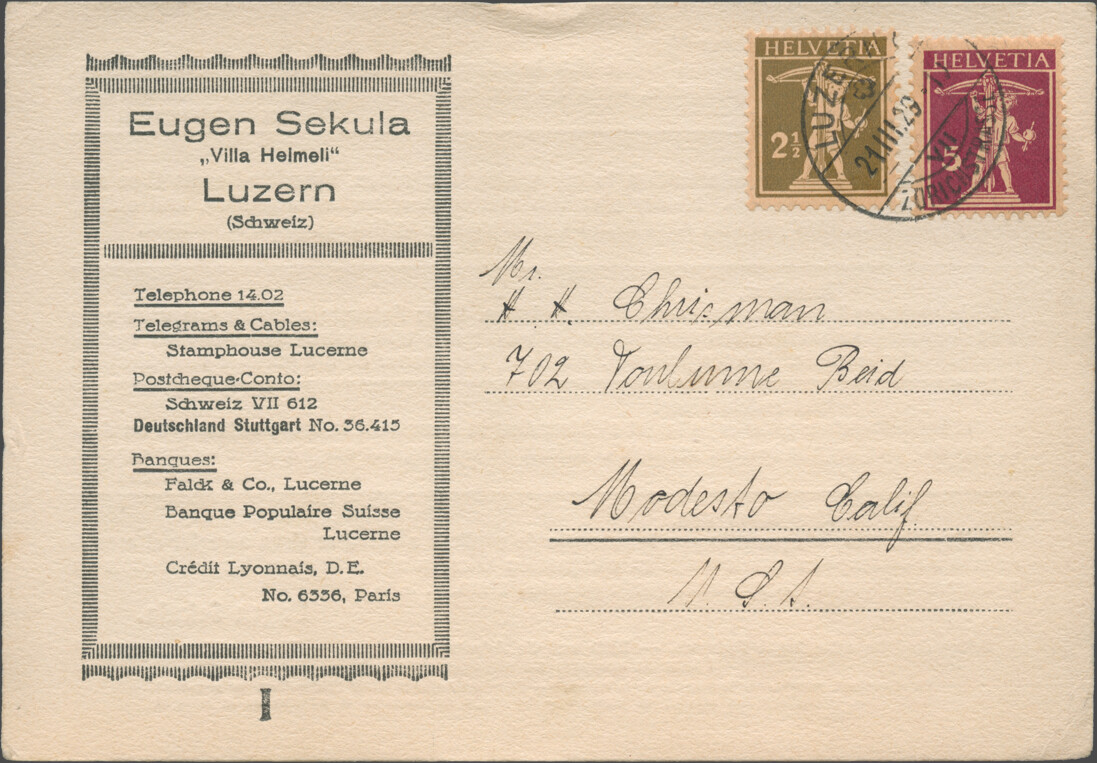
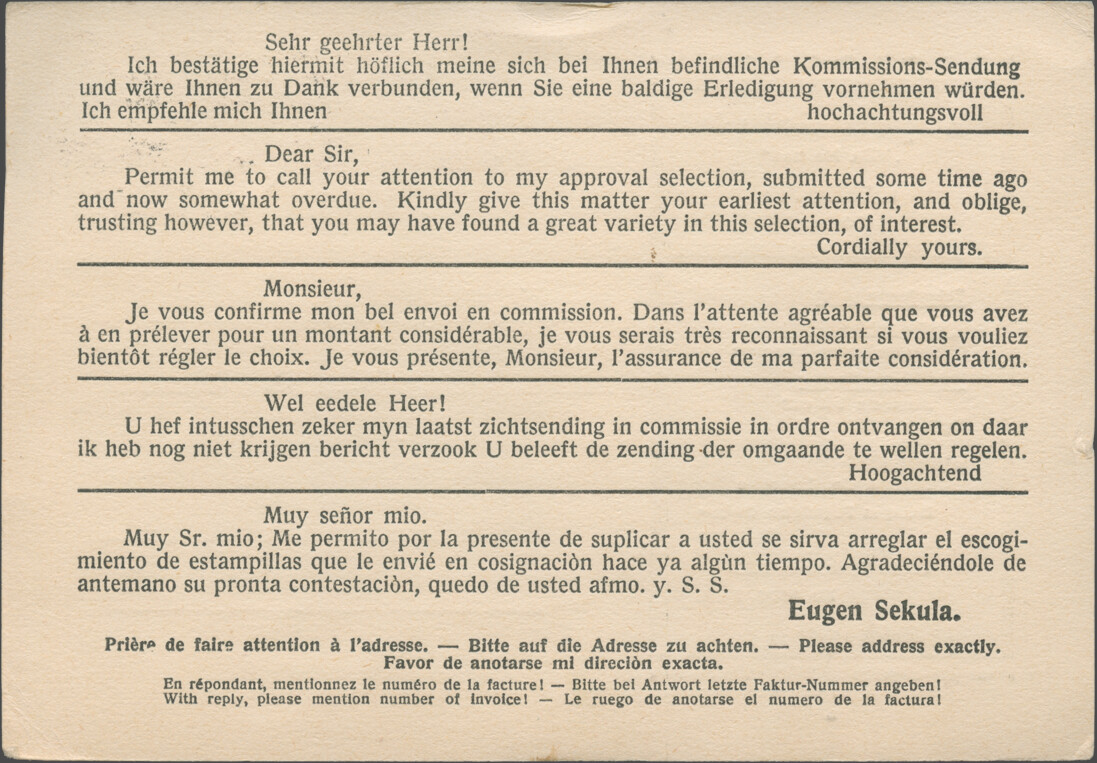
Postcard — March 21, 1929
Sent on March 21, 1929, from Lucerne, Switzerland, to Modesto, California, United States.
Return Receipt — April 19, 1929
Sent on April 19, 1929, from Lucerne, Switzerland, to Bridgeport, Connecticut, United States.
Cover — May 20, 1929
Registered mail sent on May 20, 1929, from Lucerne, Switzerland, to Rohrbach-lès-Bitche, France. Arrived on May 21, 1929.
Cover — July 13, 1929
Registered mail sent on July 13, 1929, from Lucerne, Switzerland, to Rohrbach-lès-Bitche, France. Arrived on July 14, 1929.
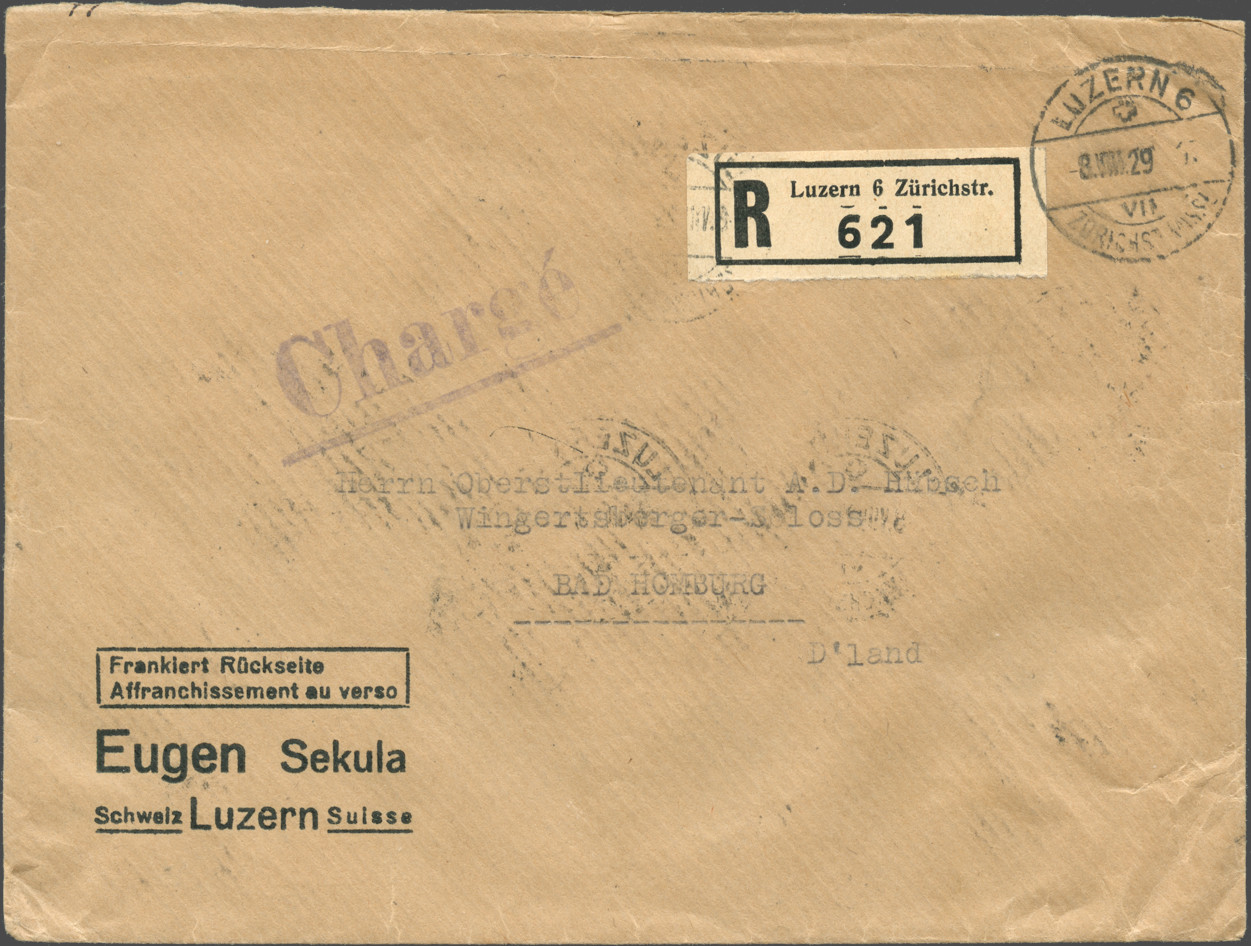
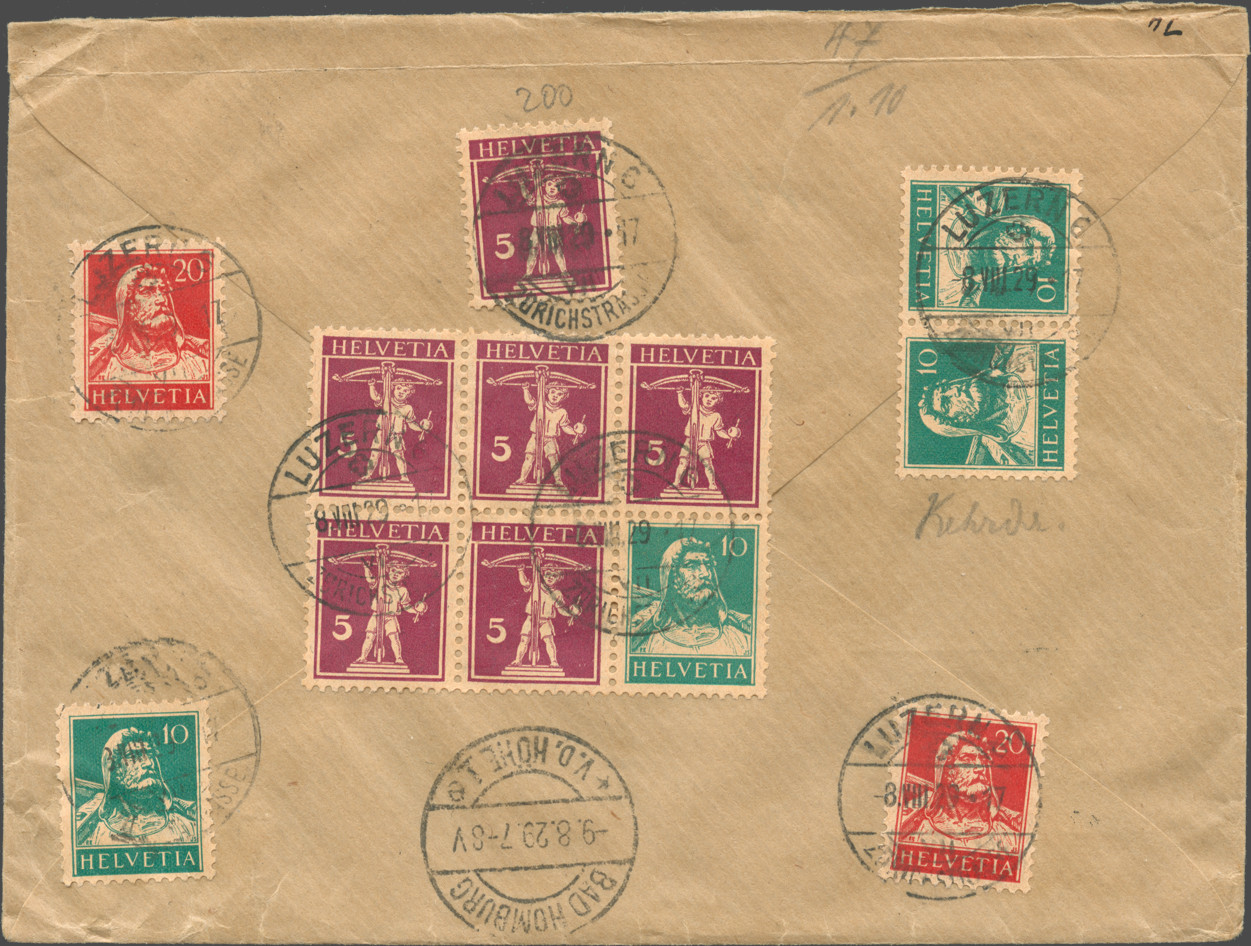
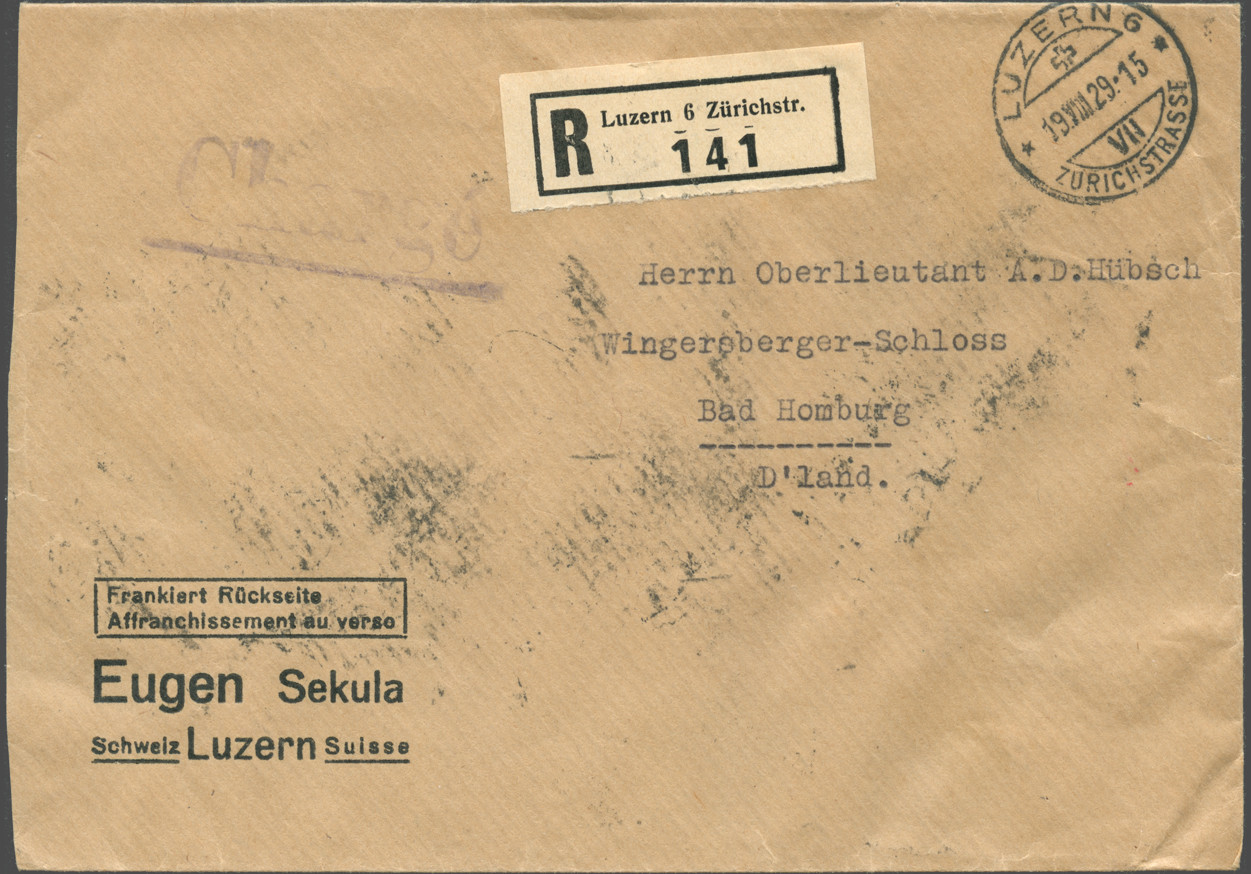
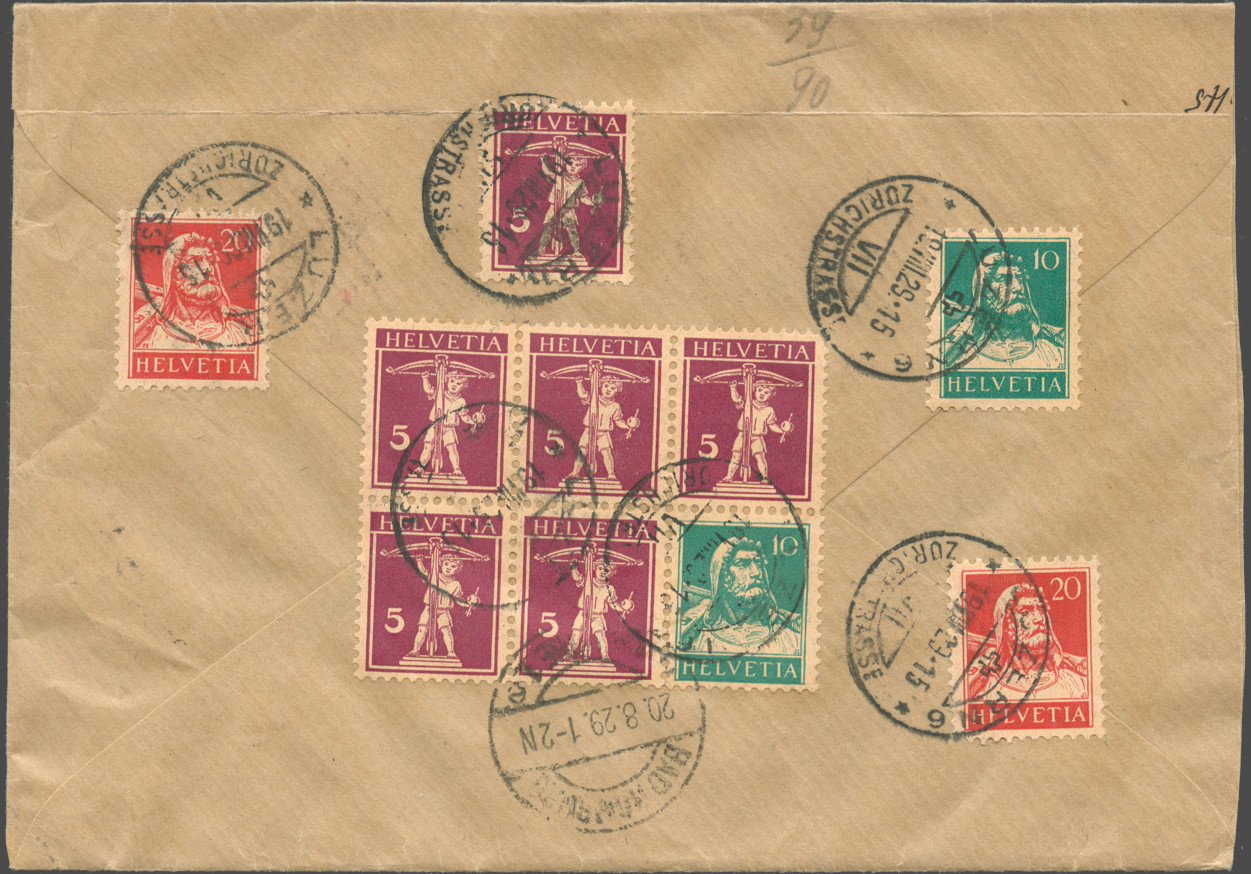
Covers — August 8, 1929
Two registered covers sent in August 1929 from Lucerne, Switzerland, to Bad Homburg, Germany.
August 9, 1929.
August 20, 1929.
Cover — August 19, 1929
Registered mail sent on August 19, 1929, from Lucerne, Switzerland, to Rohrbach-lès-Bitche, France. Arrived on August 20, 1929.
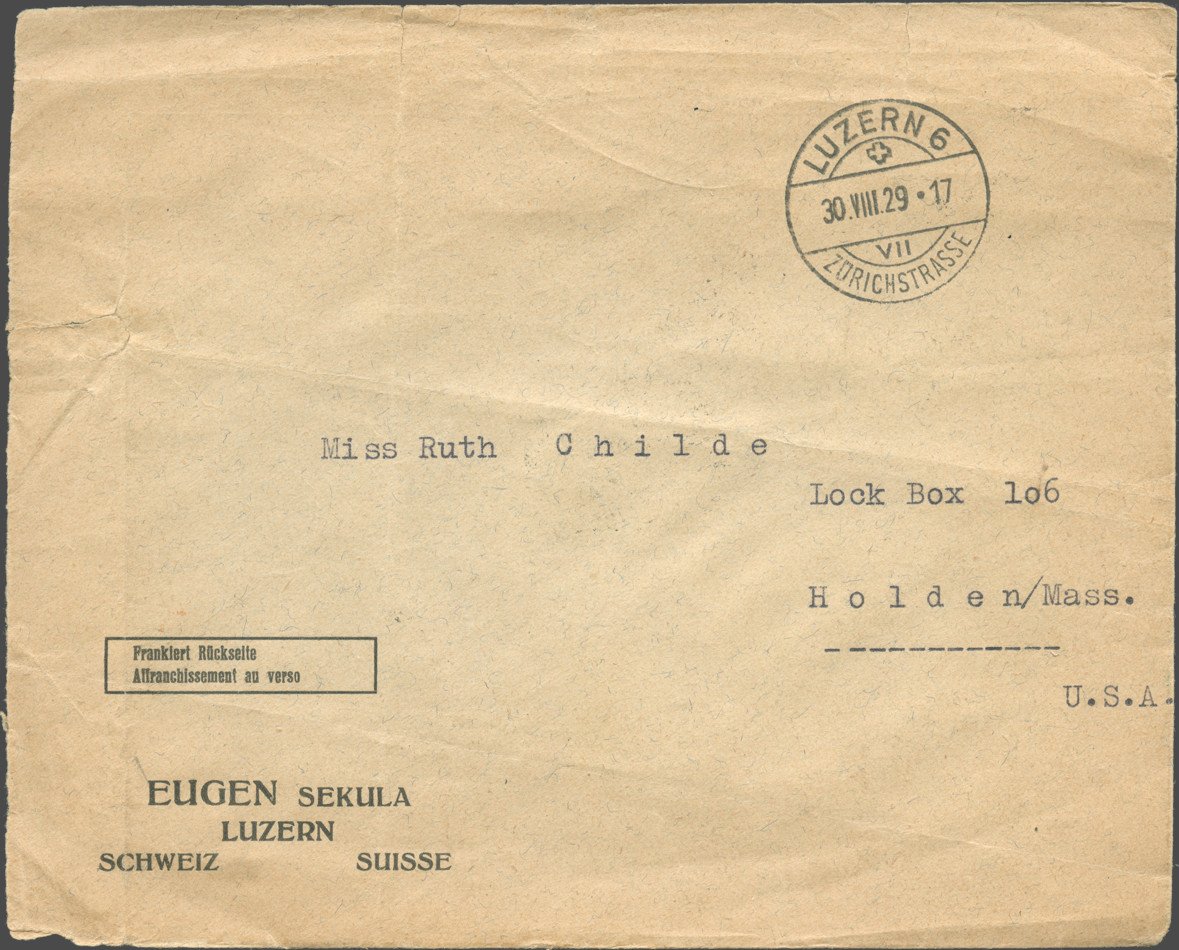
Cover — August 30, 1929
Sent on August 30, 1929, from Lucerne, Switzerland, to Holden, Massachusetts, United States.
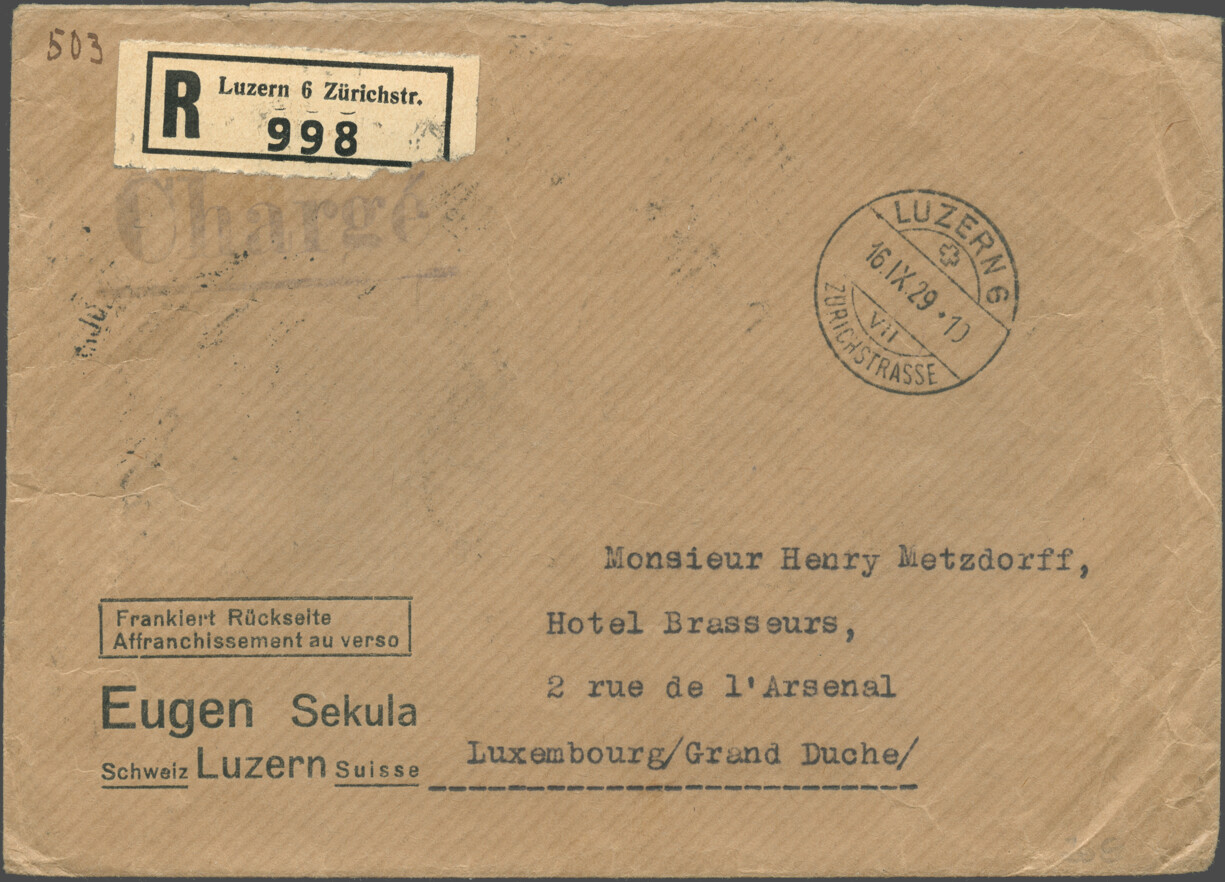
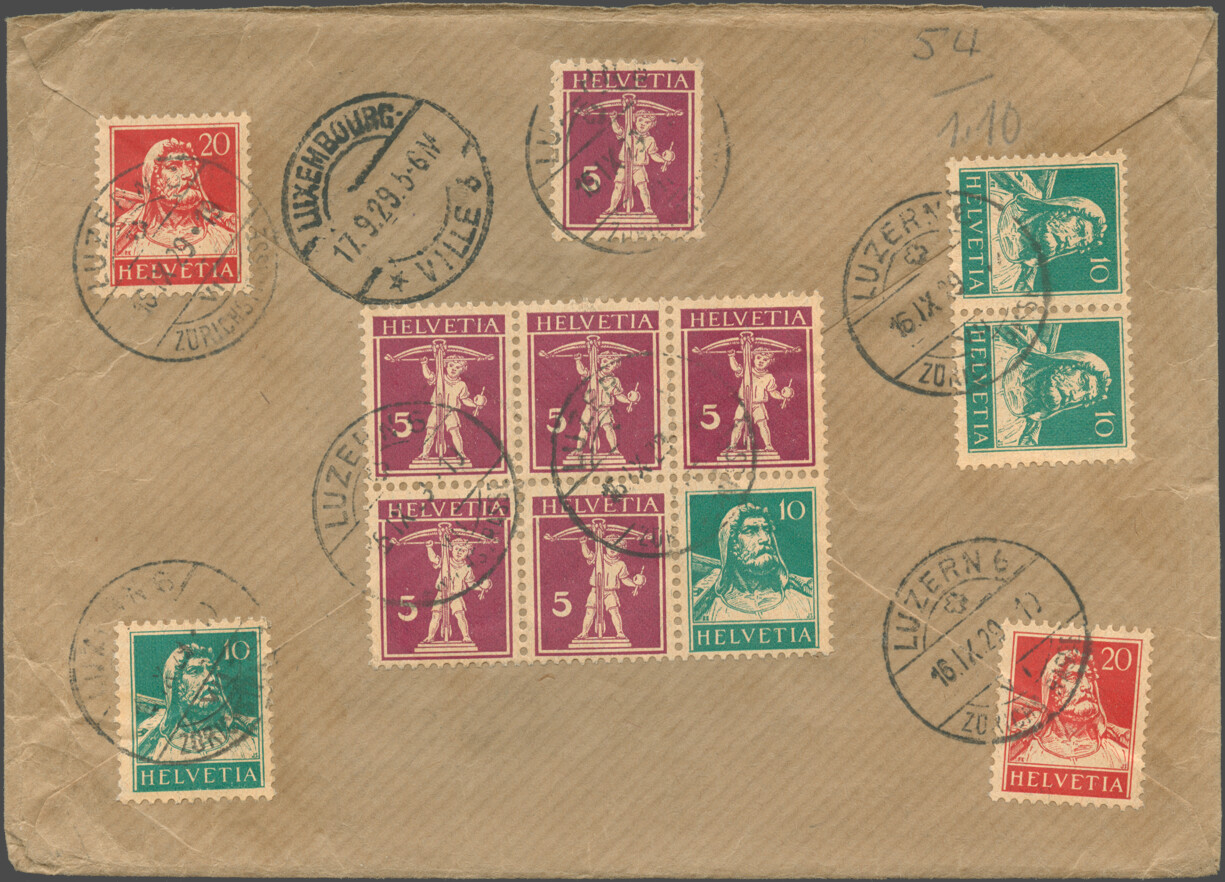
Cover — September 16, 1929
Registered mail sent on September 16, 1929, from Lucerne, Switzerland, to Luxembourg, Luxembourg. Arrived on September 17, 1929.
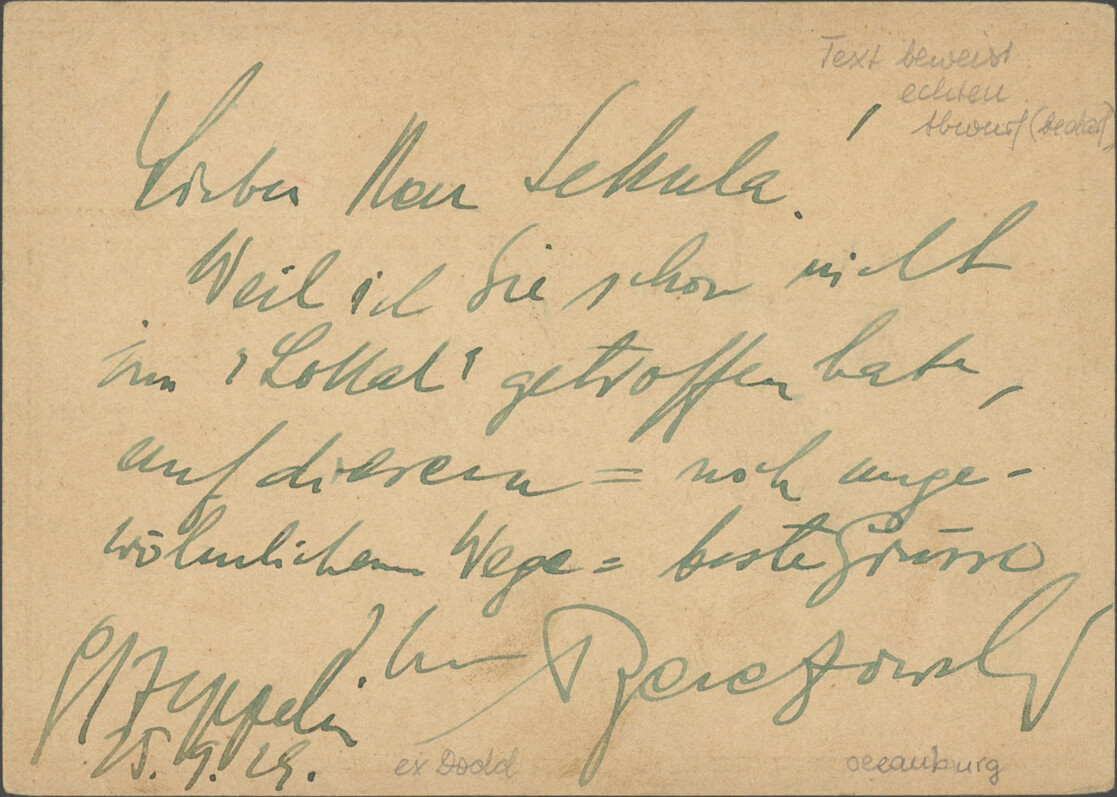
Airship Graf Zeppelin 2nd Trip to Switzerland — September 27, 1929
The second flight of the airship LZ 127 Graf Zeppelin to Switzerland took place on September 27, 1929. Departing from Friedrichshafen (Lake Constance), the route passed — among other places — over the Bernese Oberland (Interlaken), Geneva, and the Valais Alps, reaching as far as the Einsiedeln region, where this Swiss 10 Rp postal stationery card from Alexander Berezowski to Eugen Sekula in Lucerne was dropped.
Auction scans.
Cover — October 7, 1929
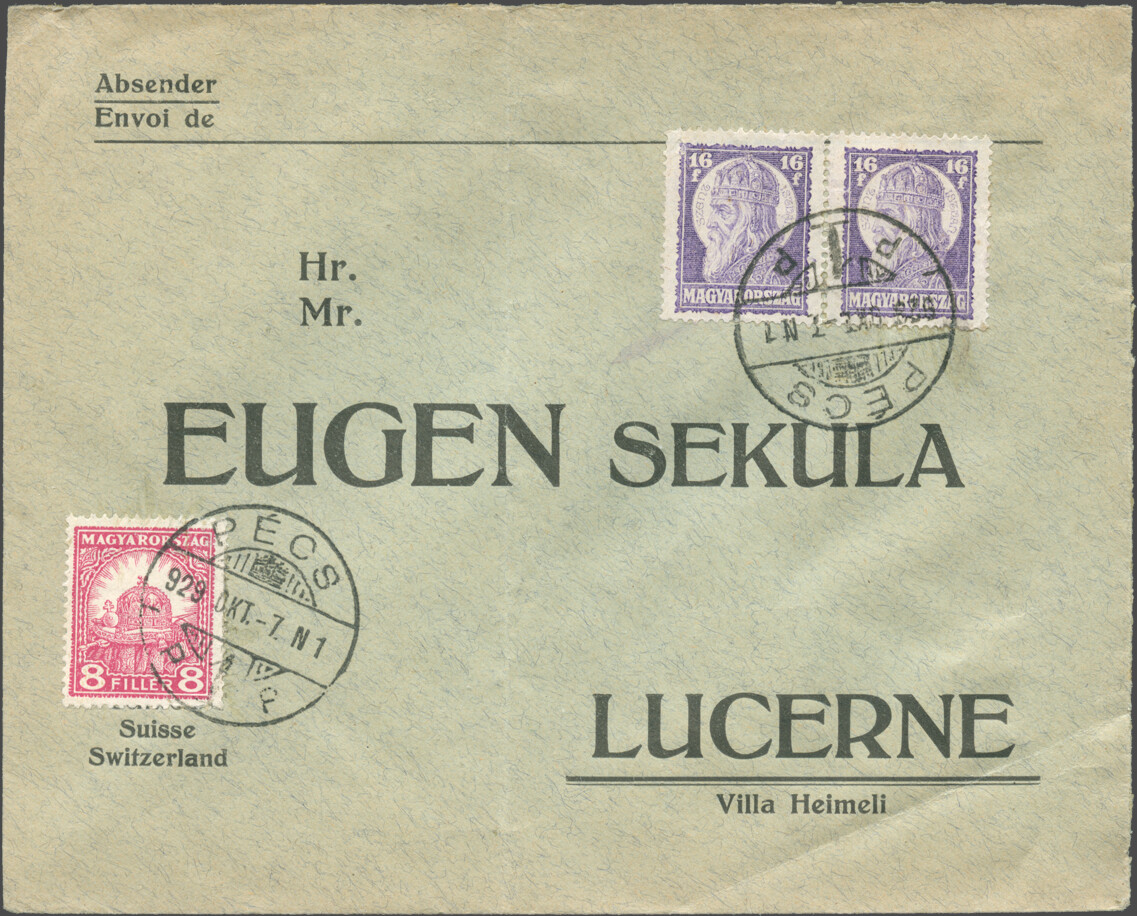
Sent on October 7, 1929, from Pécs, Hungary, to Lucerne, Switzerland.
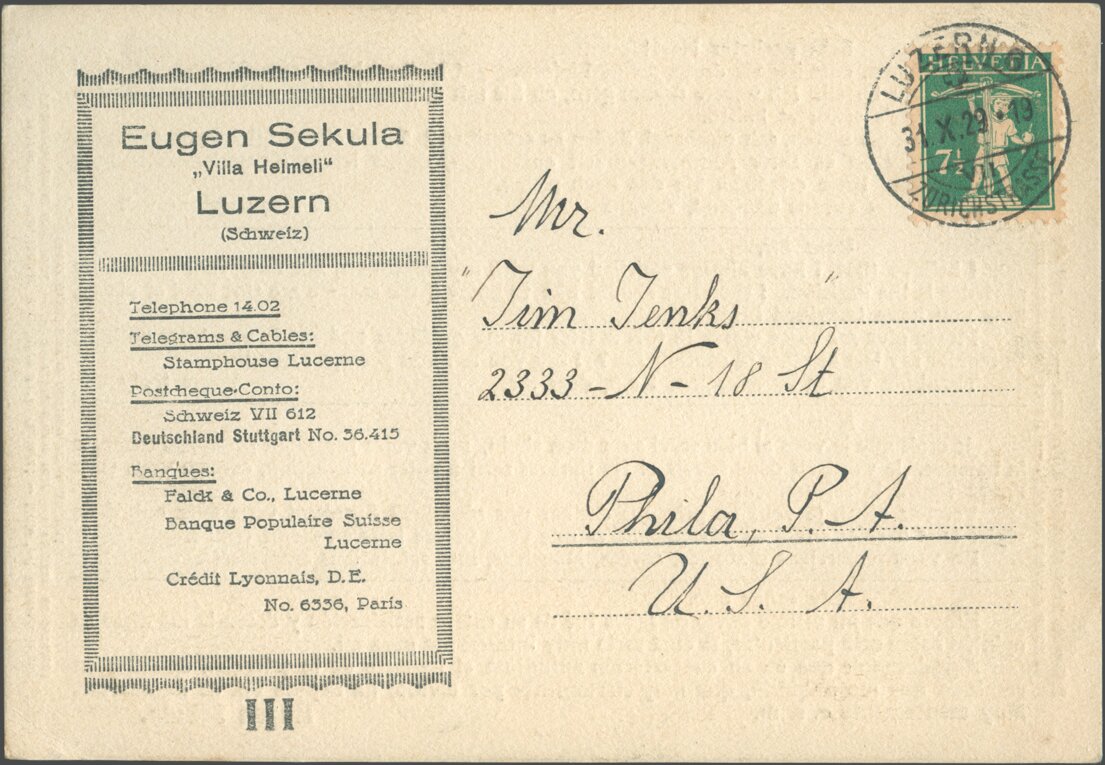
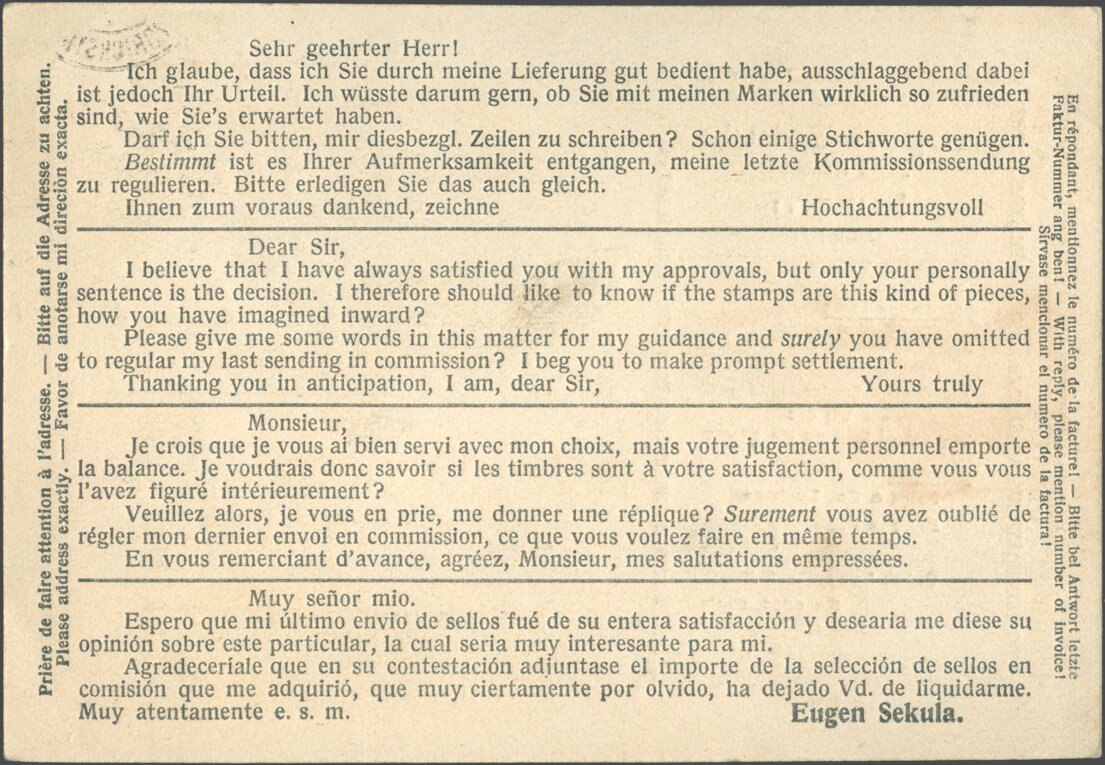
Postcard — October 31, 1929
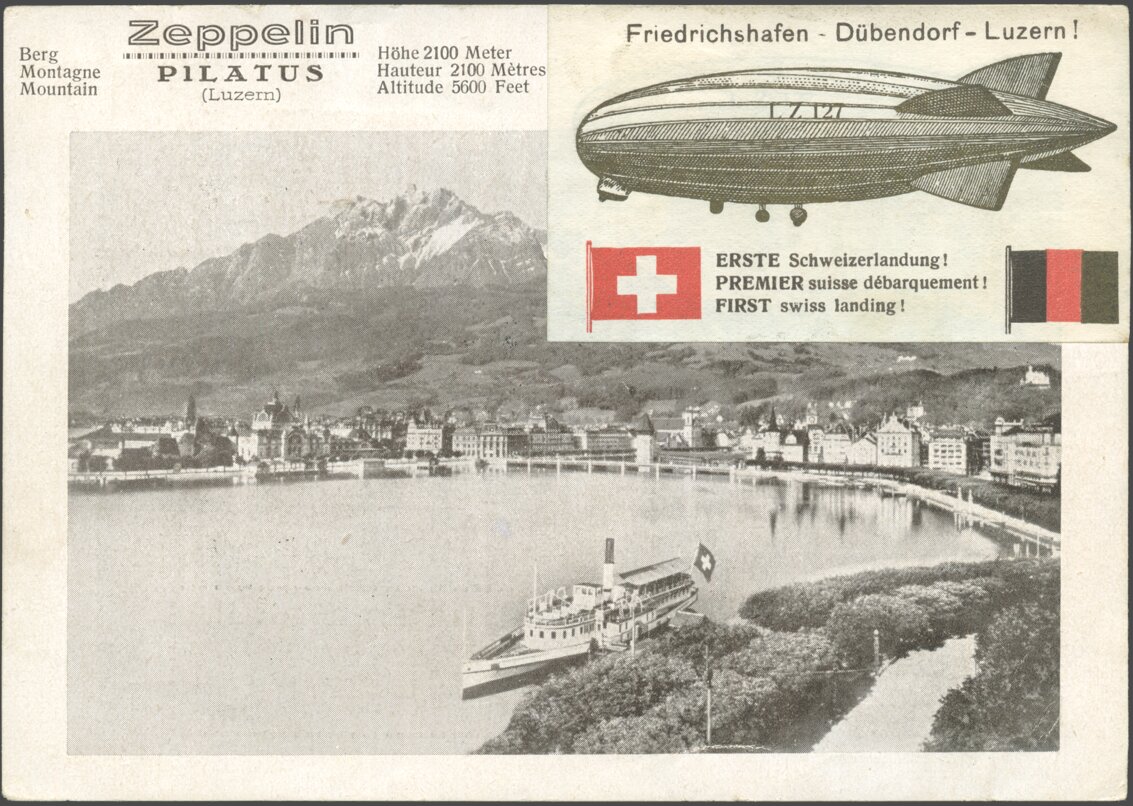
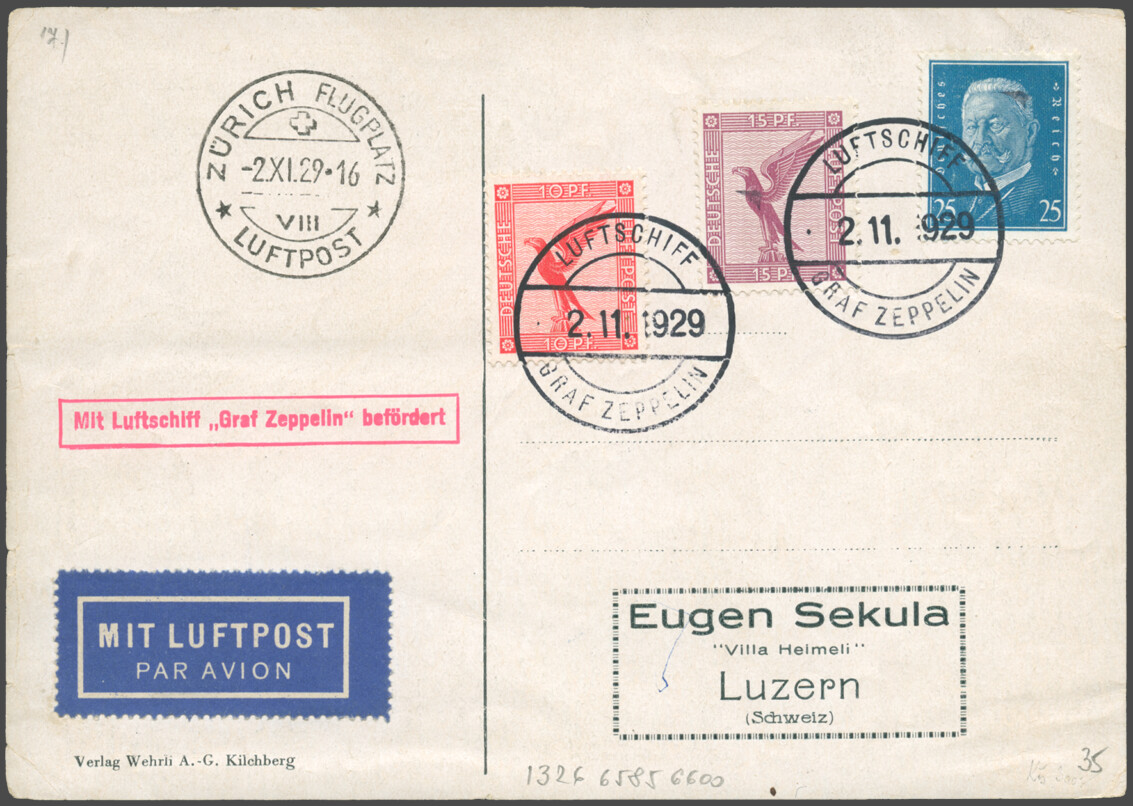
Airship Graf Zeppelin Dübendorf Trip — November 2, 1929
Carried by the airship L.Z. 127 Graf Zeppelin on flight No 44 for her first landing in Switzerland.
The flight started in Friedrichshafen, Germany, at 10 am on November 2nd and ended after a flying time of 5 hours and 2 minutes in Dübendorf (near Zurich).
Mail was dropped en route at St. Gallen, Winterthur and Zurich.
The Sekula postcards were printed on thick paper rather than cardboard to reduce the weight.
Posted at Friedrichshafen, dropped at Zurich.
Posted on board the “Graf Zeppelin,” dropped at St. Gallen.
Posted on board the “Graf Zeppelin,” dropped at Zurich.
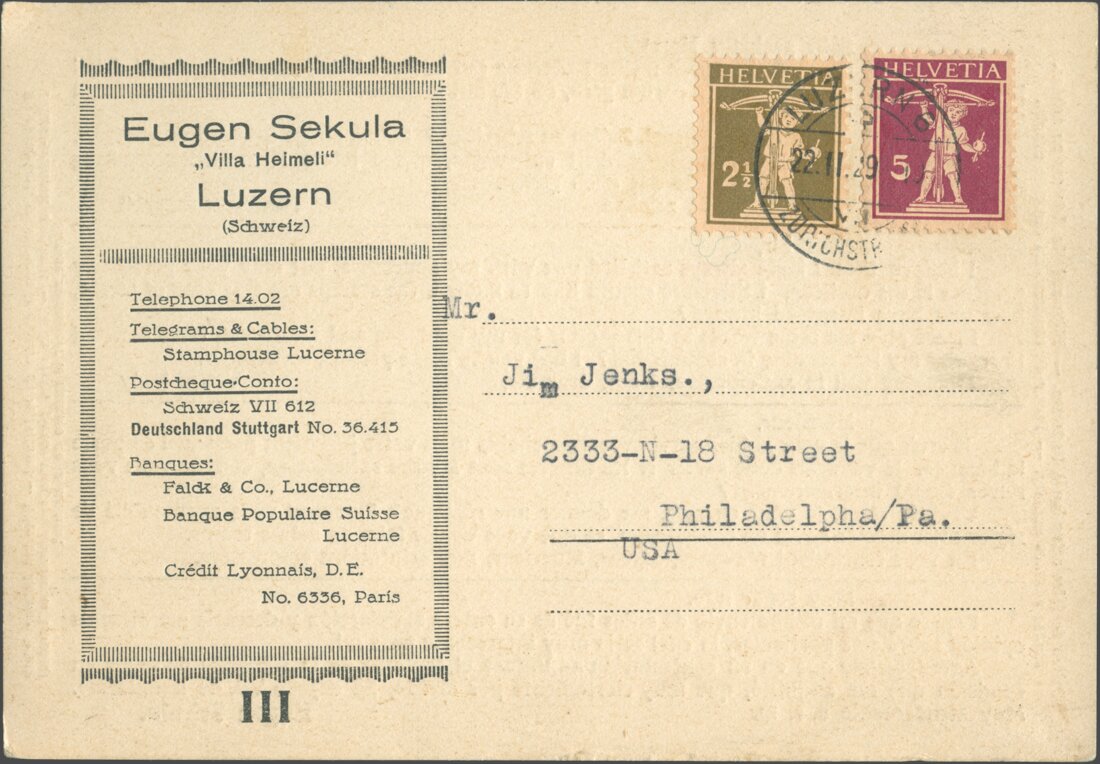
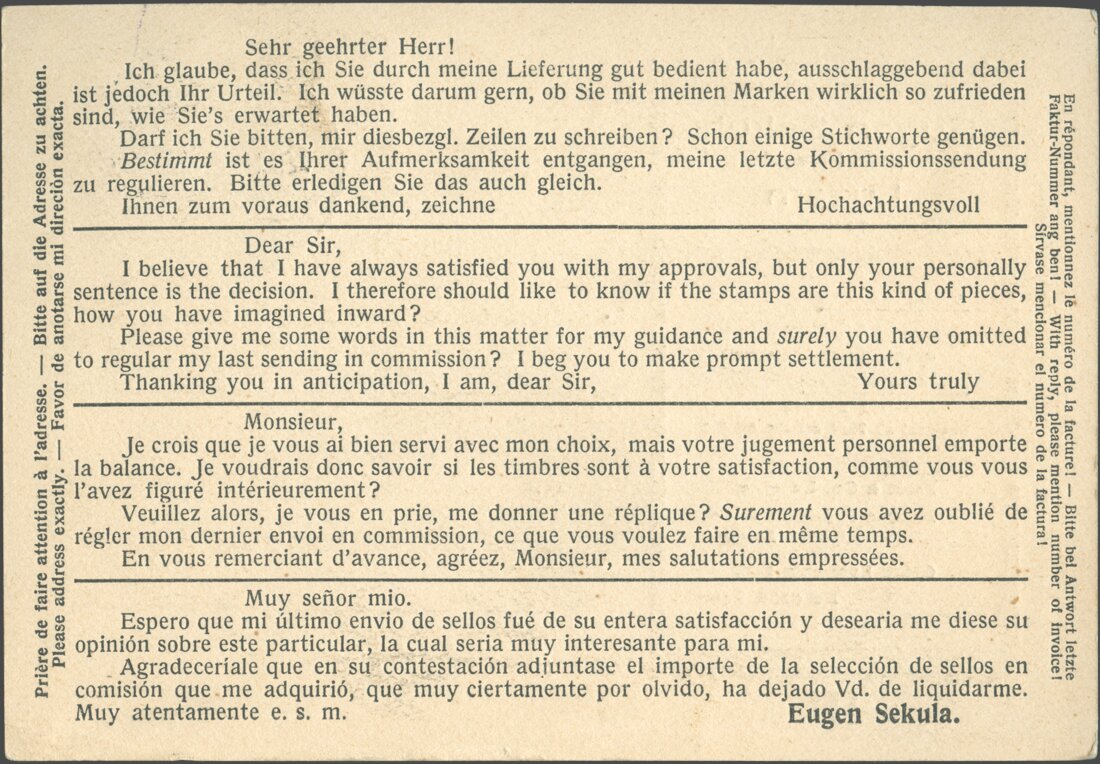
Postcard — November 22, 1929
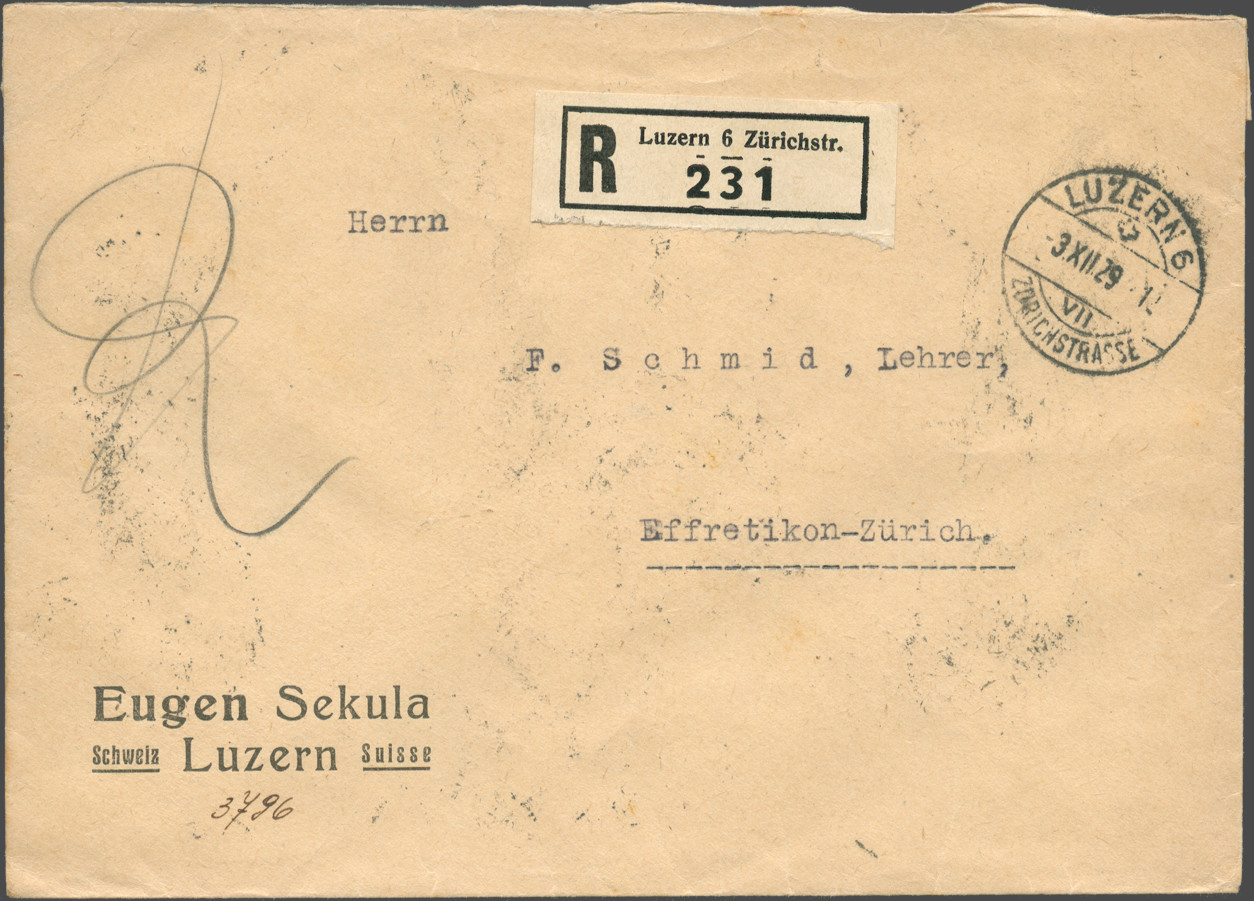
Cover — December 3, 1929
Registered mail sent on December 3, 1929, from Lucerne, Switzerland, to Effretikon. Arrived on December 3, 1929.
Cover — December 7, 1929
Registered mail sent on December 7, 1929, from Lucerne, Switzerland, to Paris, France.
Cover — December 31, 1929
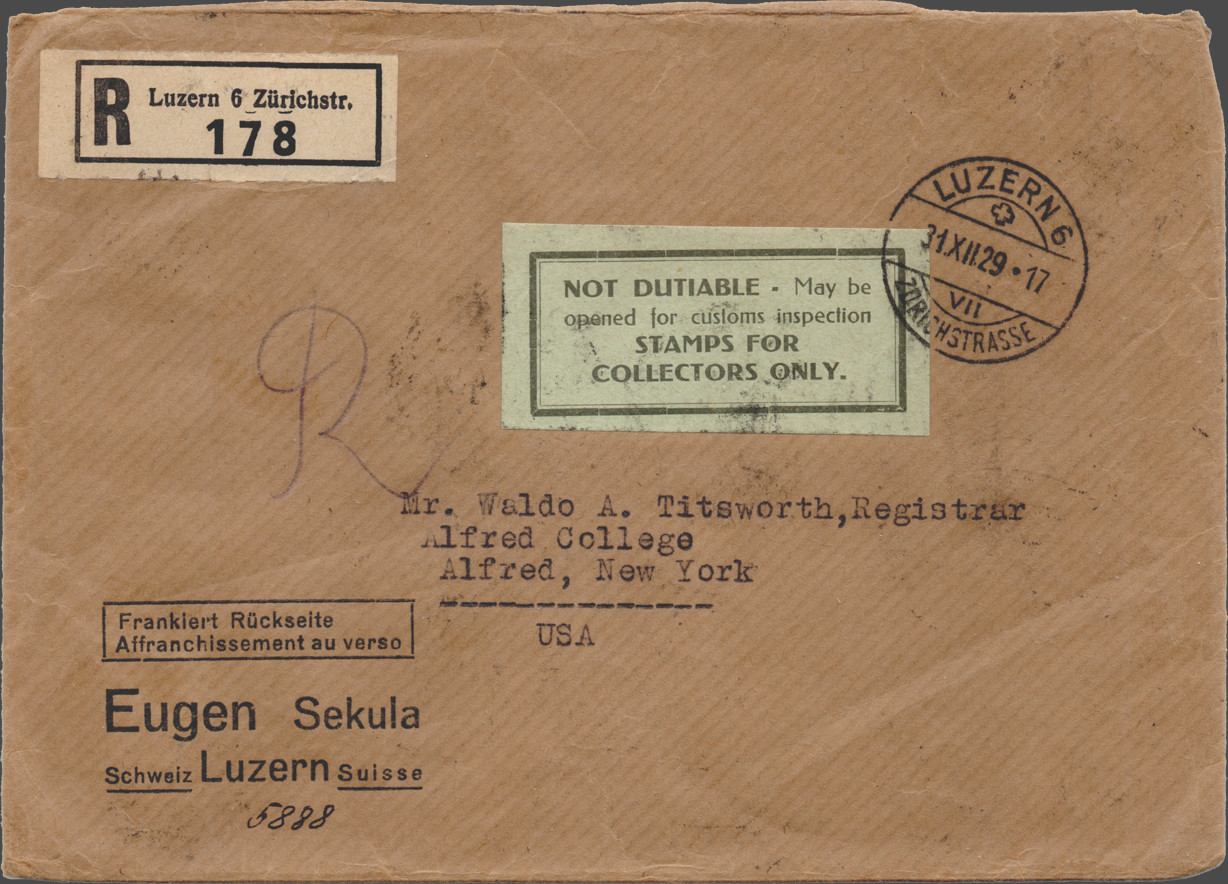
Sent on December 31, 1929, from Lucerne, Switzerland, to Alfred, New York, United States. Arrived on December 31, 1929.
Scans provided by Albert Little.
Cover — January 15, 1930
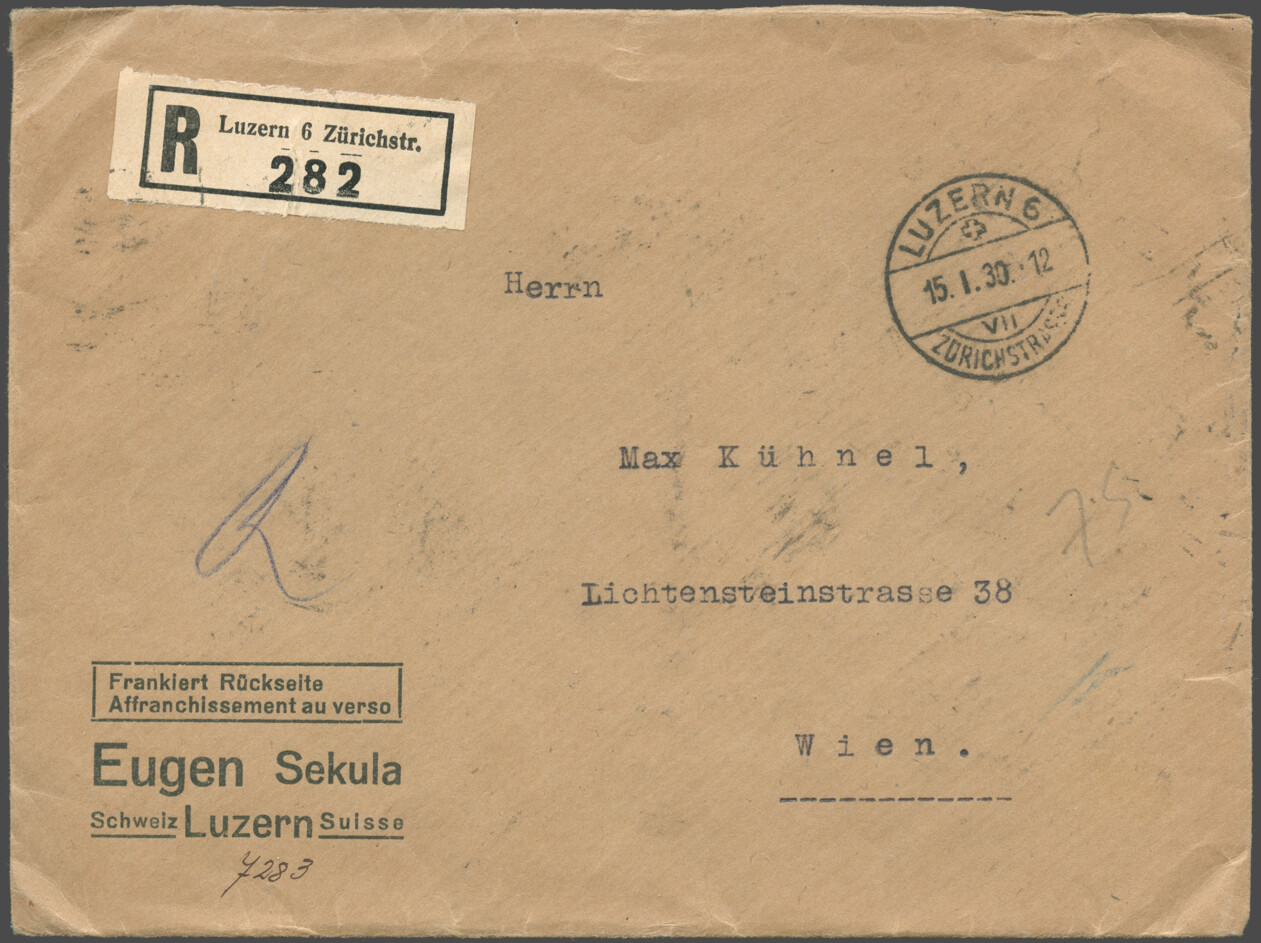
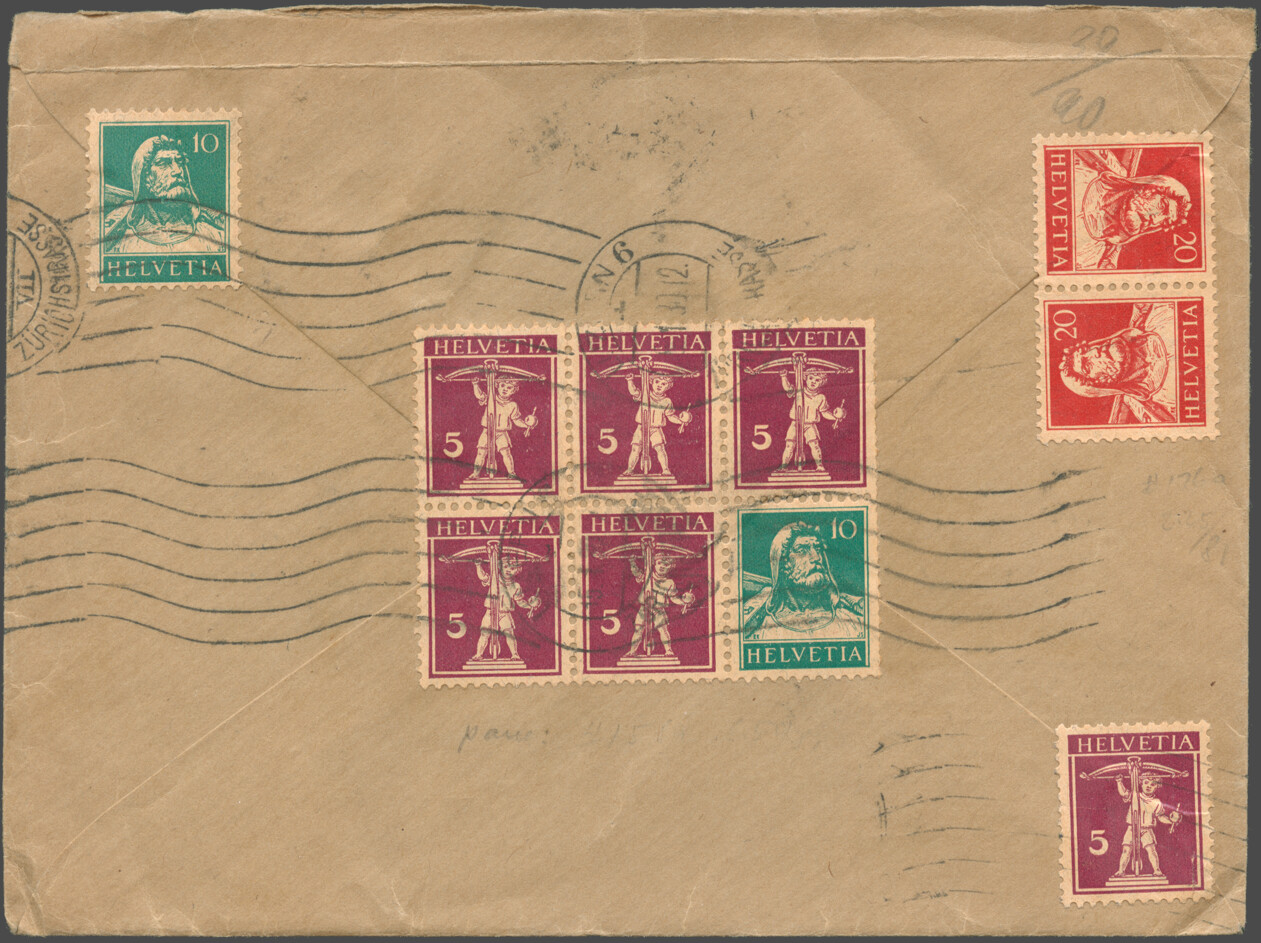
Registered mail sent on January 15, 1930, from Lucerne, Switzerland, to Vienna, Austria.
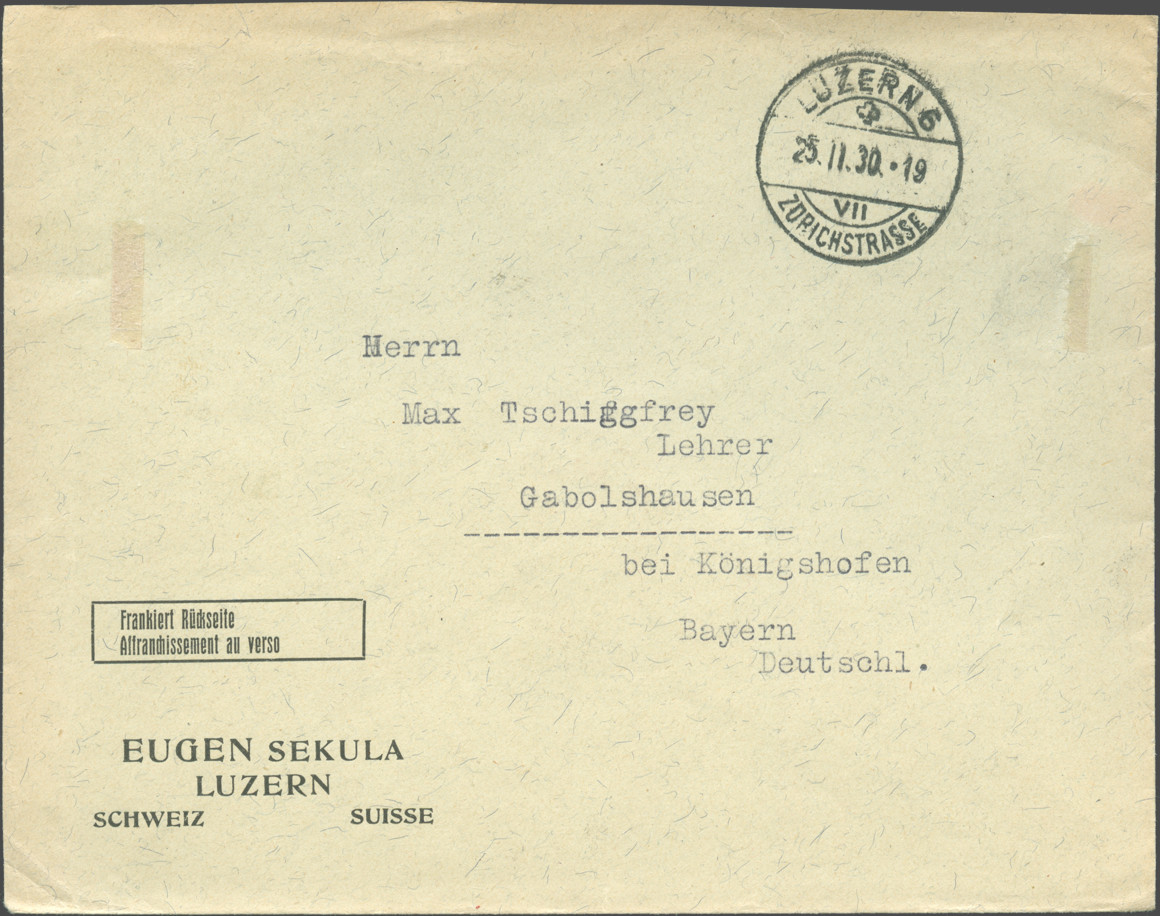
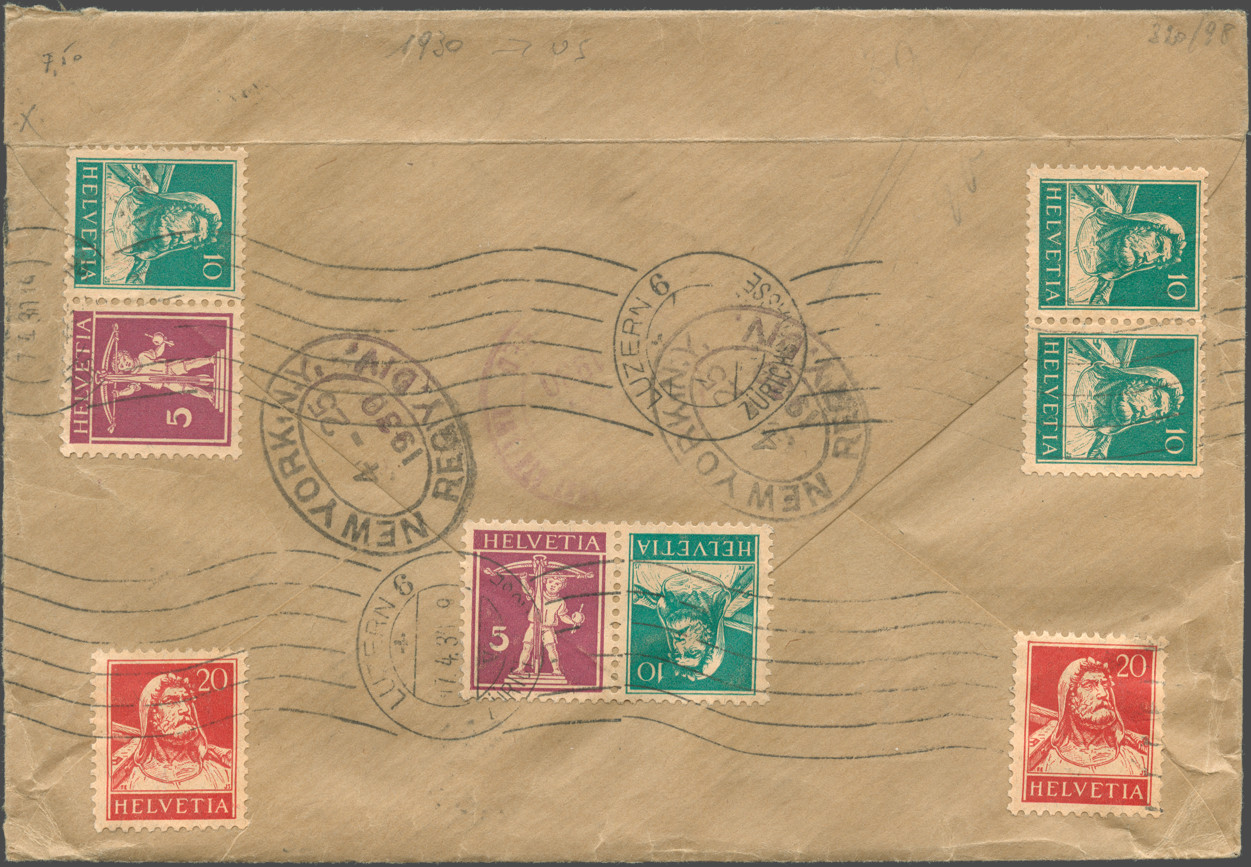
Cover — February 25, 1930
Sent on February 25, 1930, from Lucerne, Switzerland, to Gabolshausen (today part of Bad Königshofen, Bavaria), Germany.
Cover — March 3, 1930
Registered mail sent on March 3, 1930, from Lucerne, Switzerland, to Frankfurt am Main, Germany. Arrived on March 3, 1930.
Cover — April 10, 1930
Registered mail sent on April 10, 1930, from Shanghai, China, to Lucerne, Switzerland.
Scan provided by Max Brack.
Cover — April 17, 1930
Sent on April 17, 1930, from Lucerne, Switzerland, to Baltimore, Maryland, United States. Arrived on April 17, 1930.
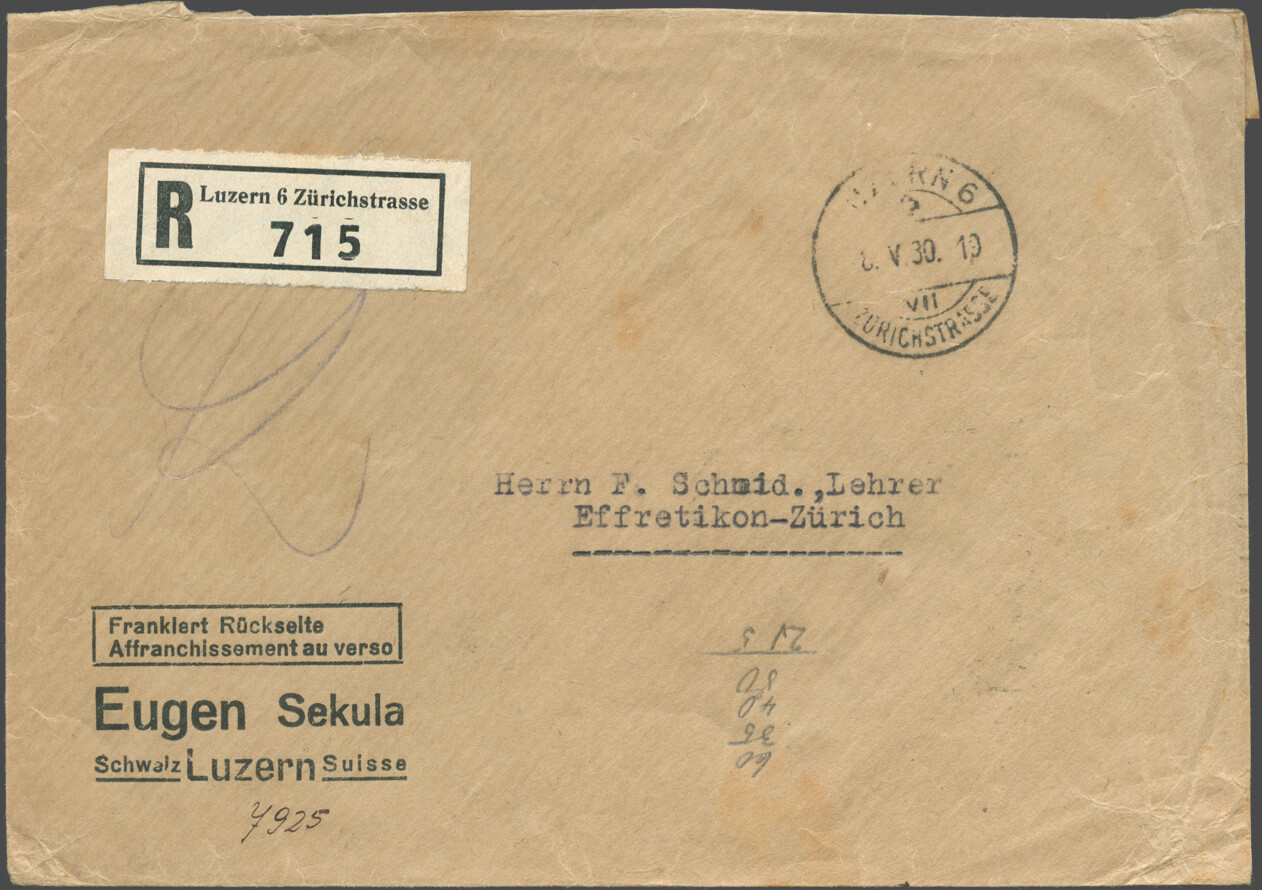
Cover — May 8, 1930
Registered mail sent on May 8, 1930, from Lucerne, Switzerland, to Effretikon. Arrived on May 9, 1930.
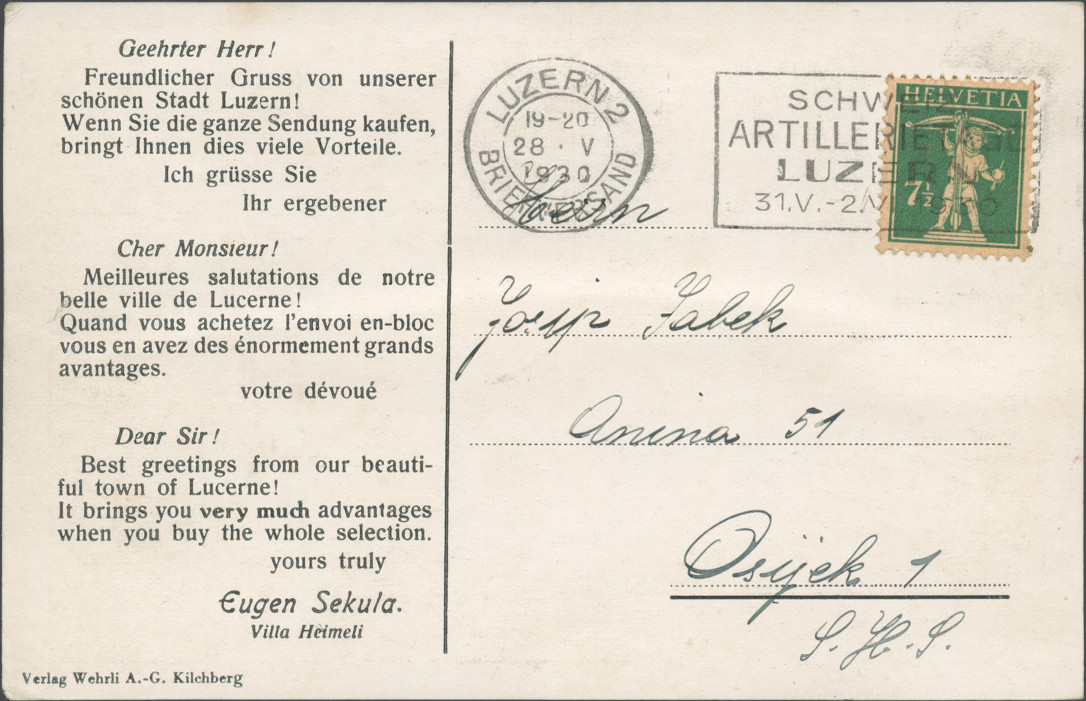
Postcard — May 28, 1930
Sent on May 28, 1930, from Lucerne, Switzerland, to Osijek, Yugoslavia (today Croatia).
Return Envelope — May 29, 1930
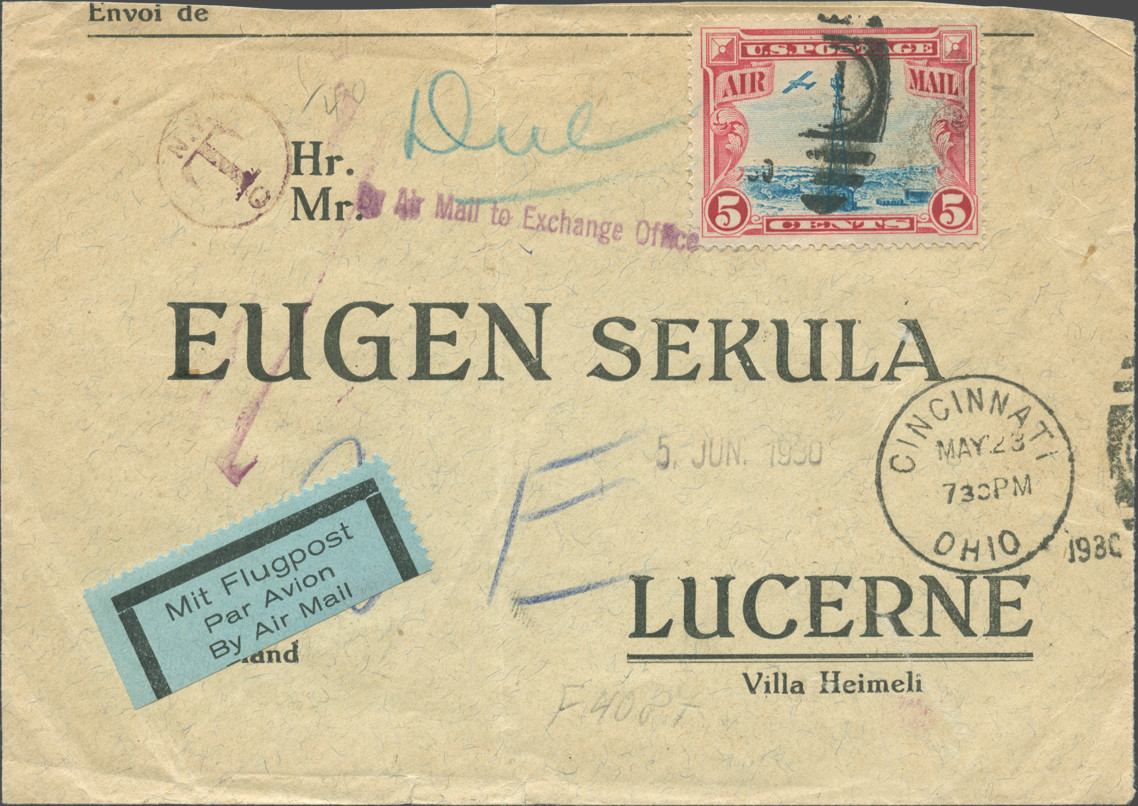
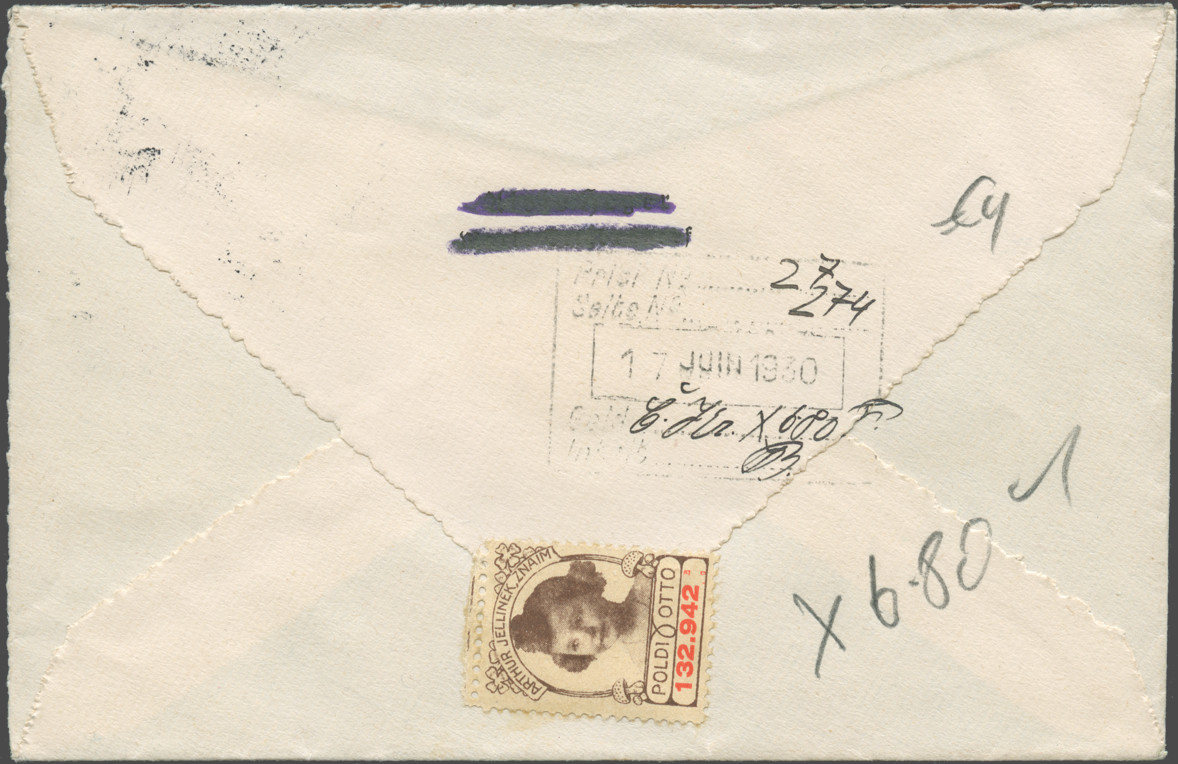
Sent on May 23, 1930, from Cincinnati, Ohio, United States, to Lucerne, Switzerland. Arrived on June 5, 1930.
Cover — June 1930
Sent in June 1930 from Triebendorf (=Třebařov), Czechoslovakia (today Czech Republic), to Lucerne, Switzerland. Arrived on June 17, 1930.
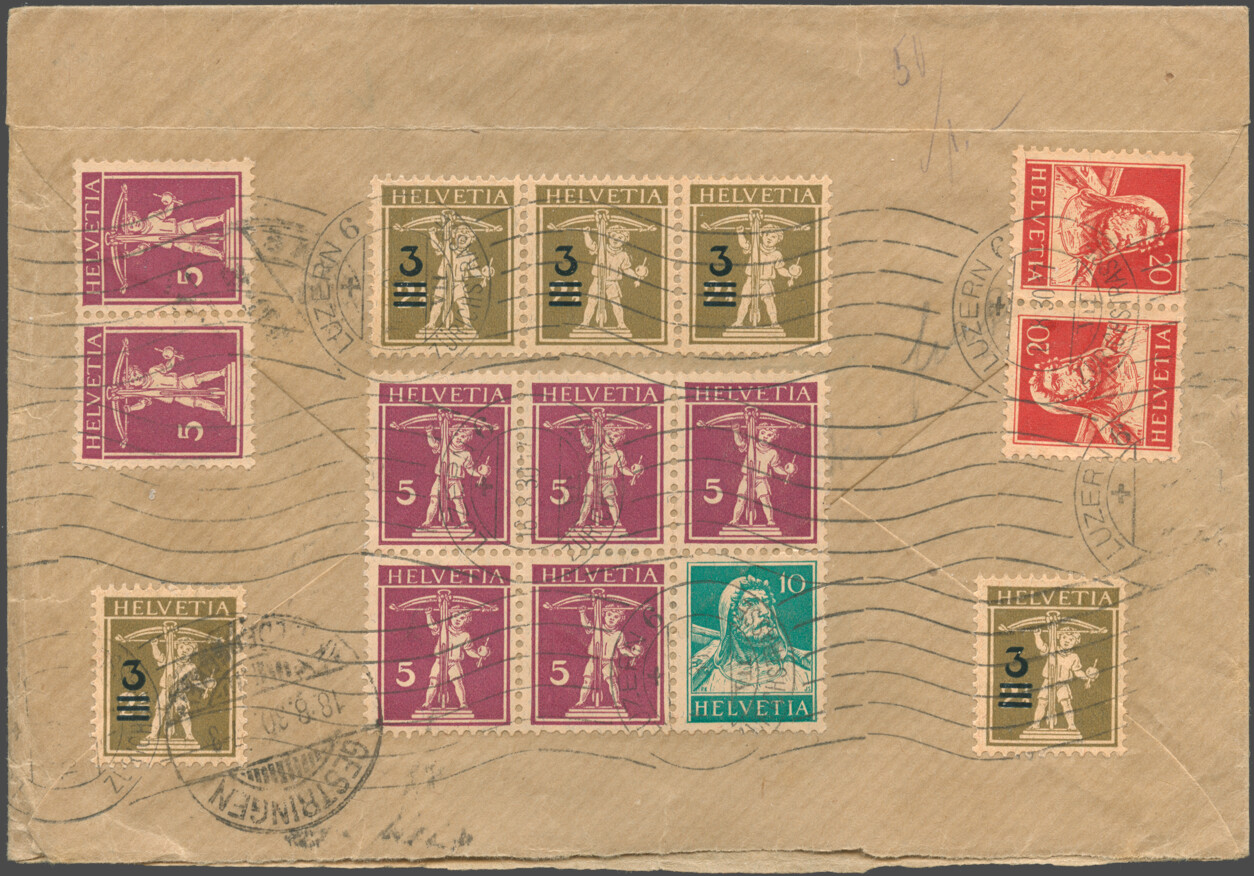
Cover — August 16, 1930
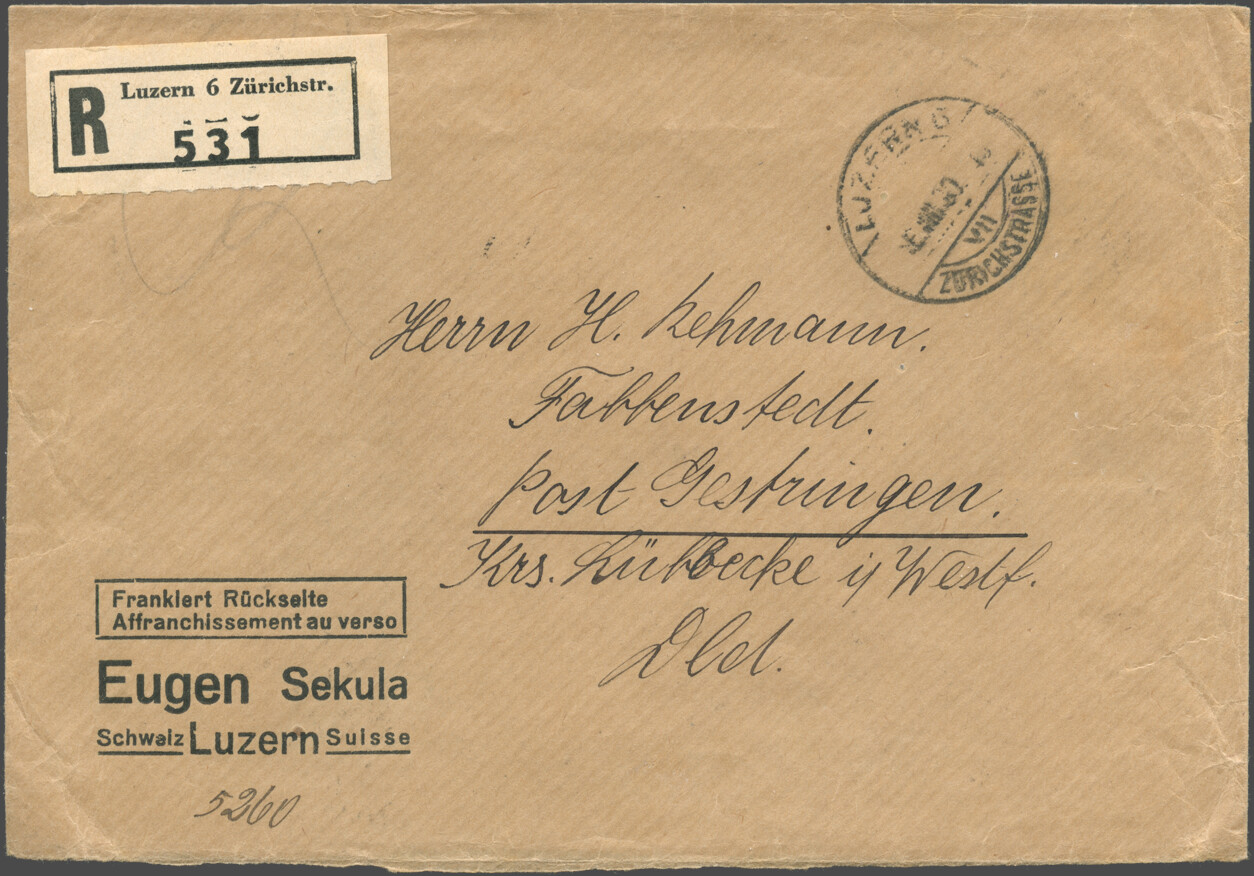
Registered mail sent on August 16, 1930, from Lucerne, Switzerland, to Fabbenstedt (today part of Espelkamp, North Rhine-Westphalia), Germany. Arrived on August 18, 1930.
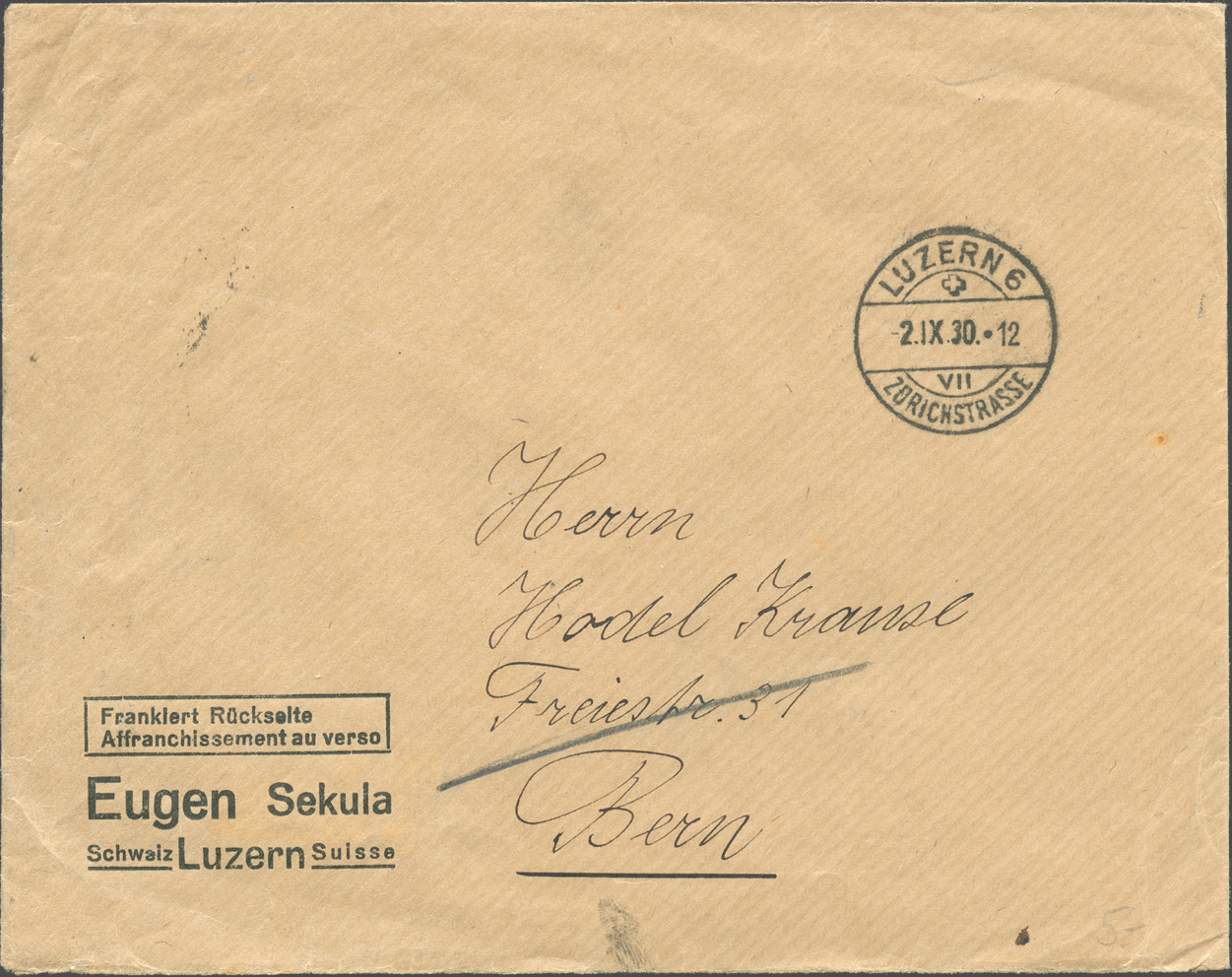
Cover — September 2, 1930
Sent on September 2, 1930, from Lucerne, Switzerland, to Bern. Arrived on September 2, 1930.
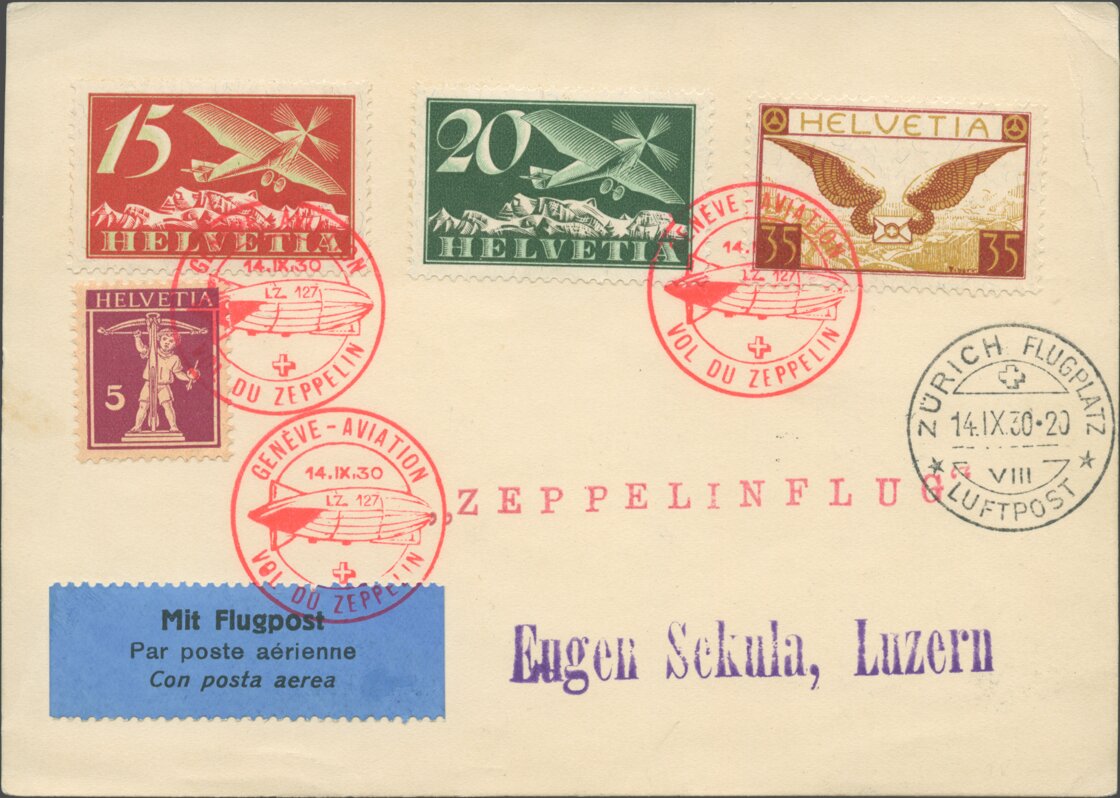
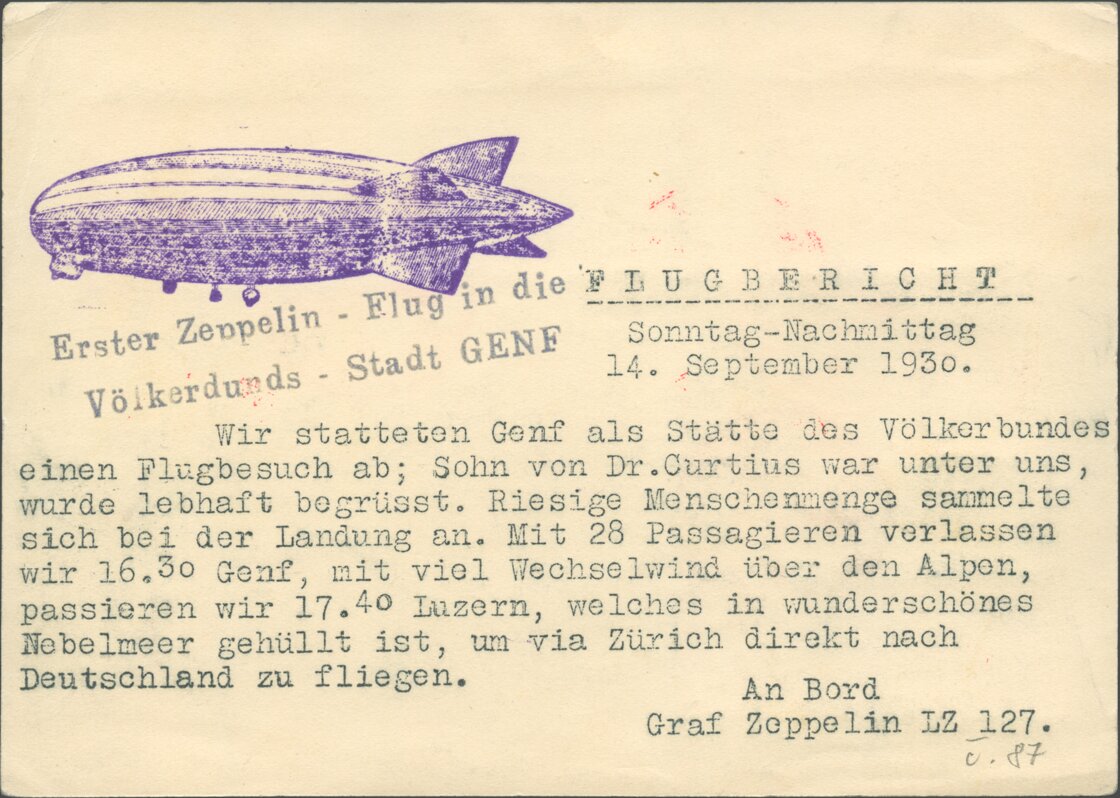
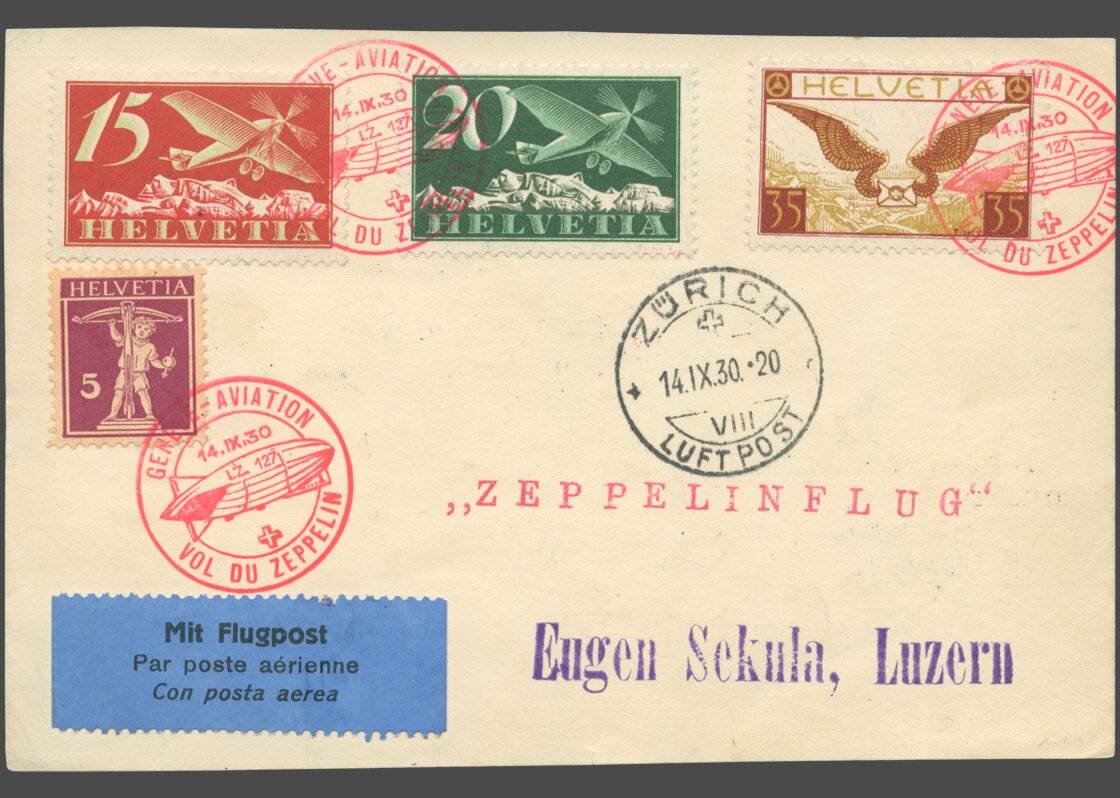
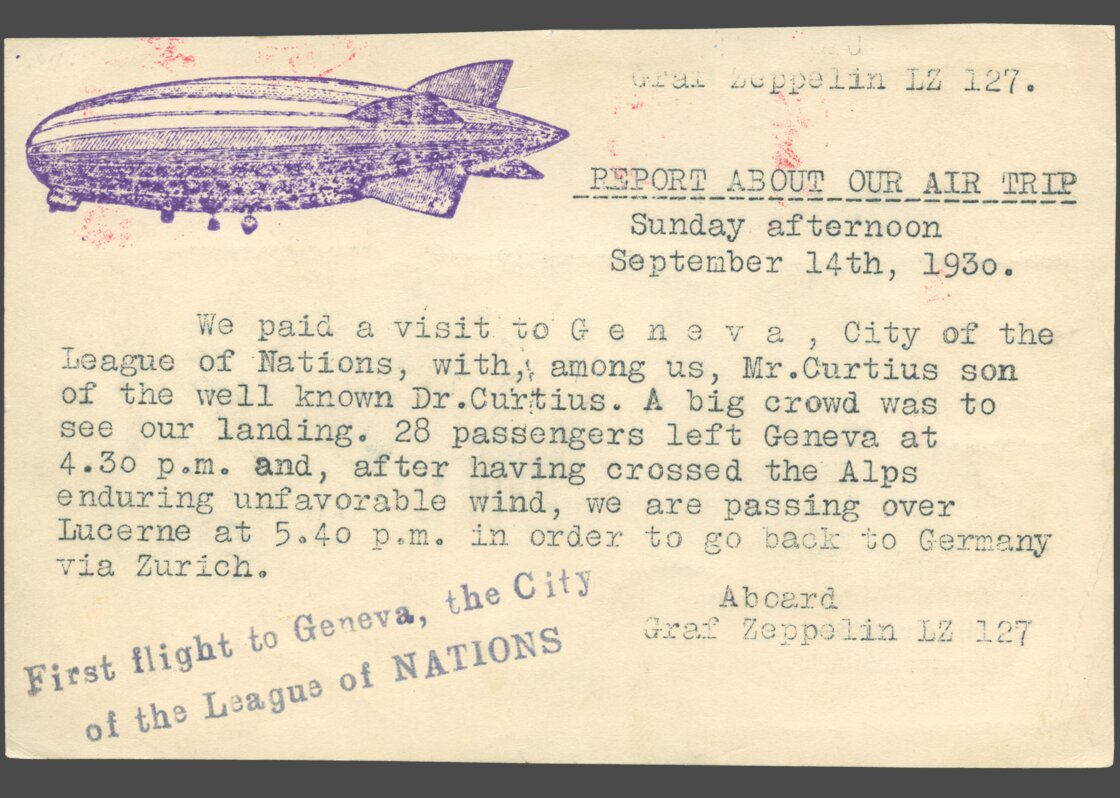
Postcard — September 14, 1930
Sent on November 14 from Geneva to Lucerne. Carried to Zurich by the airship Graf Zeppelin (LZ 127) on her way back from her first trip to Geneva. Report on back exists in German and English.
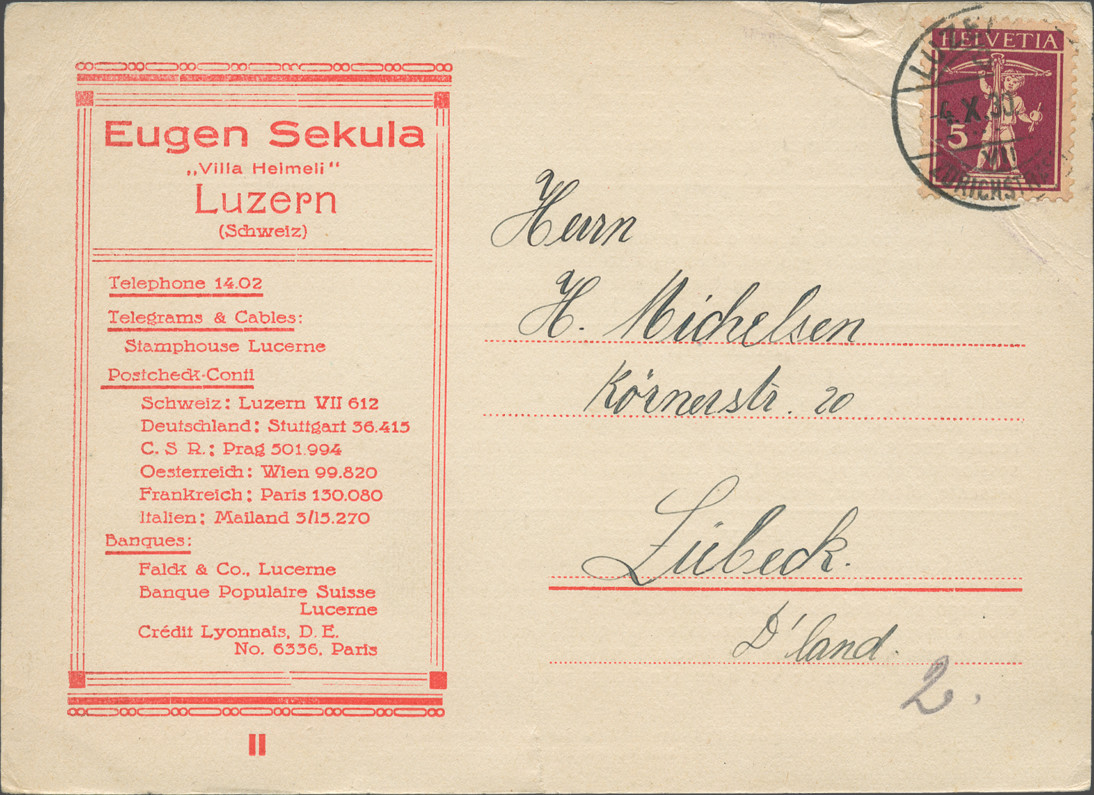
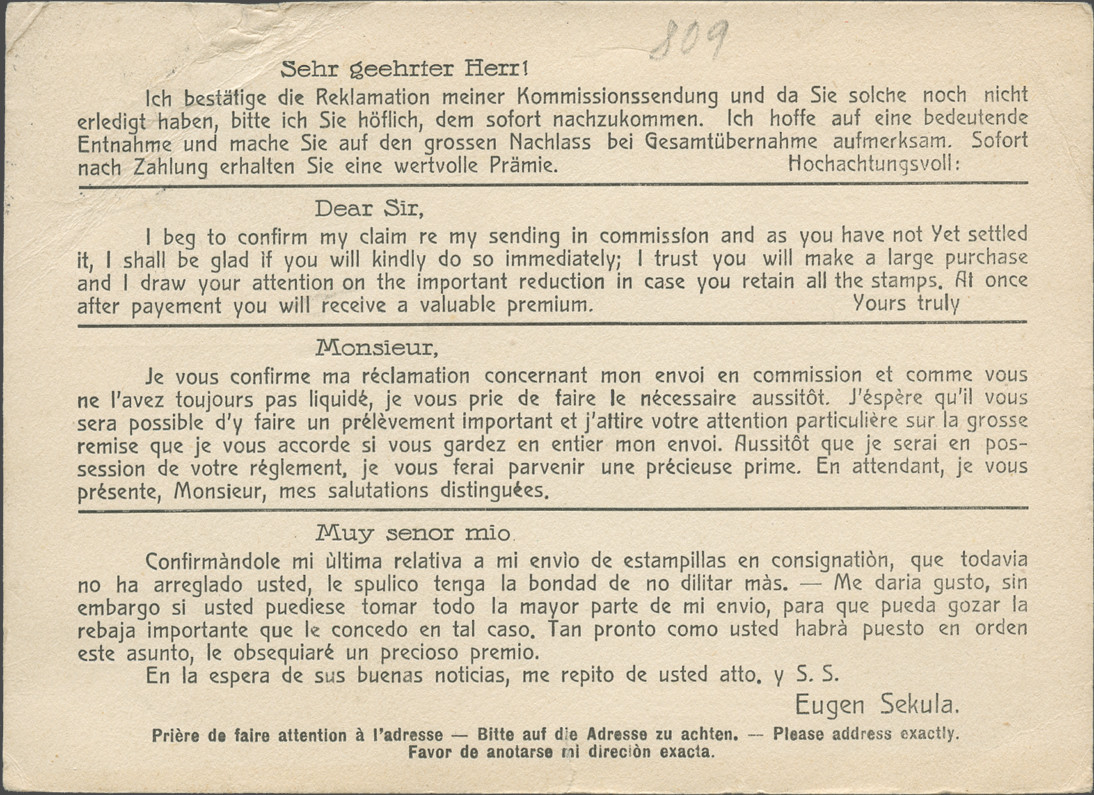
Postcard — October 4, 1930
Sent on October 4, 1930, from Lucerne, Switzerland, to Lübeck, Germany.
Vignettes — October 9, 1930 – October 20, 1930
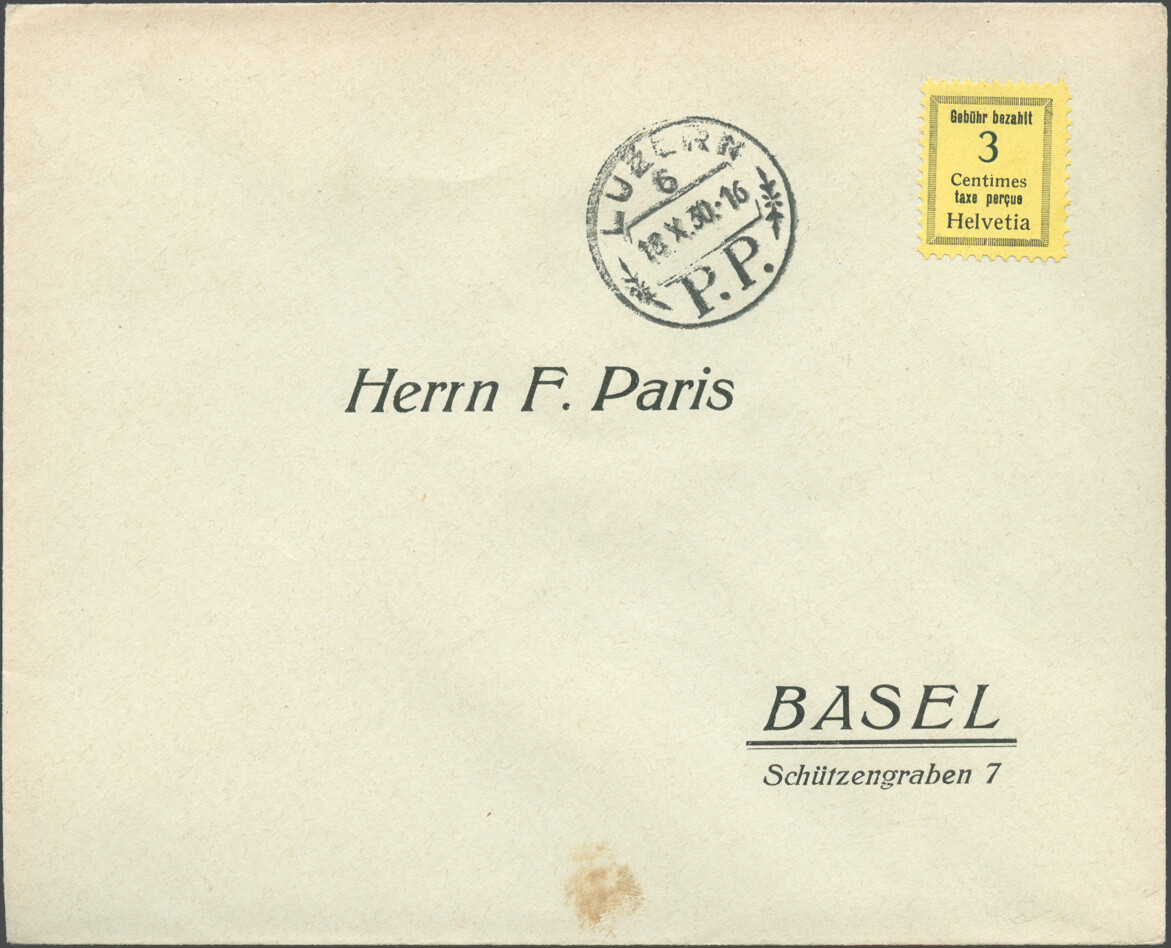
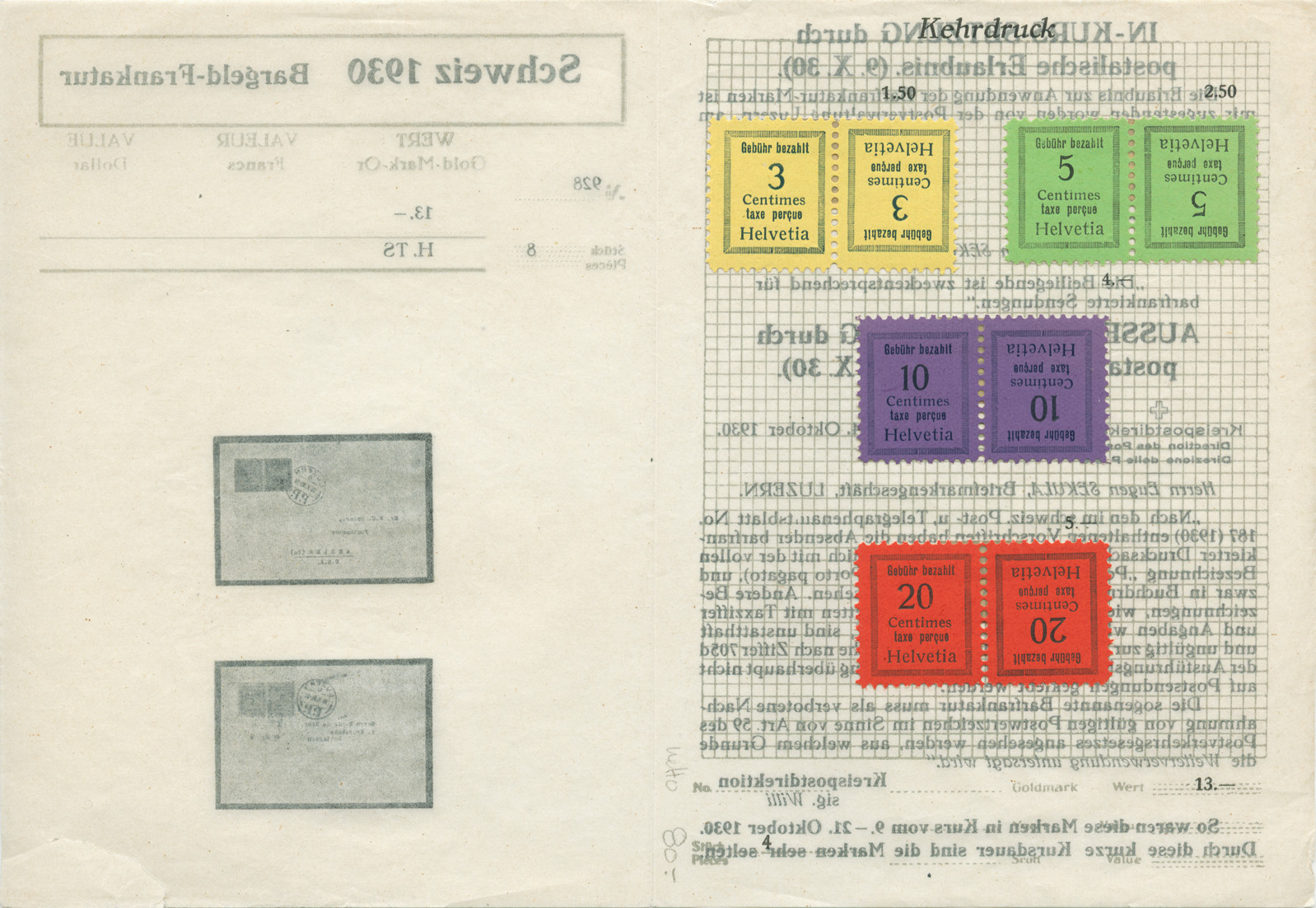
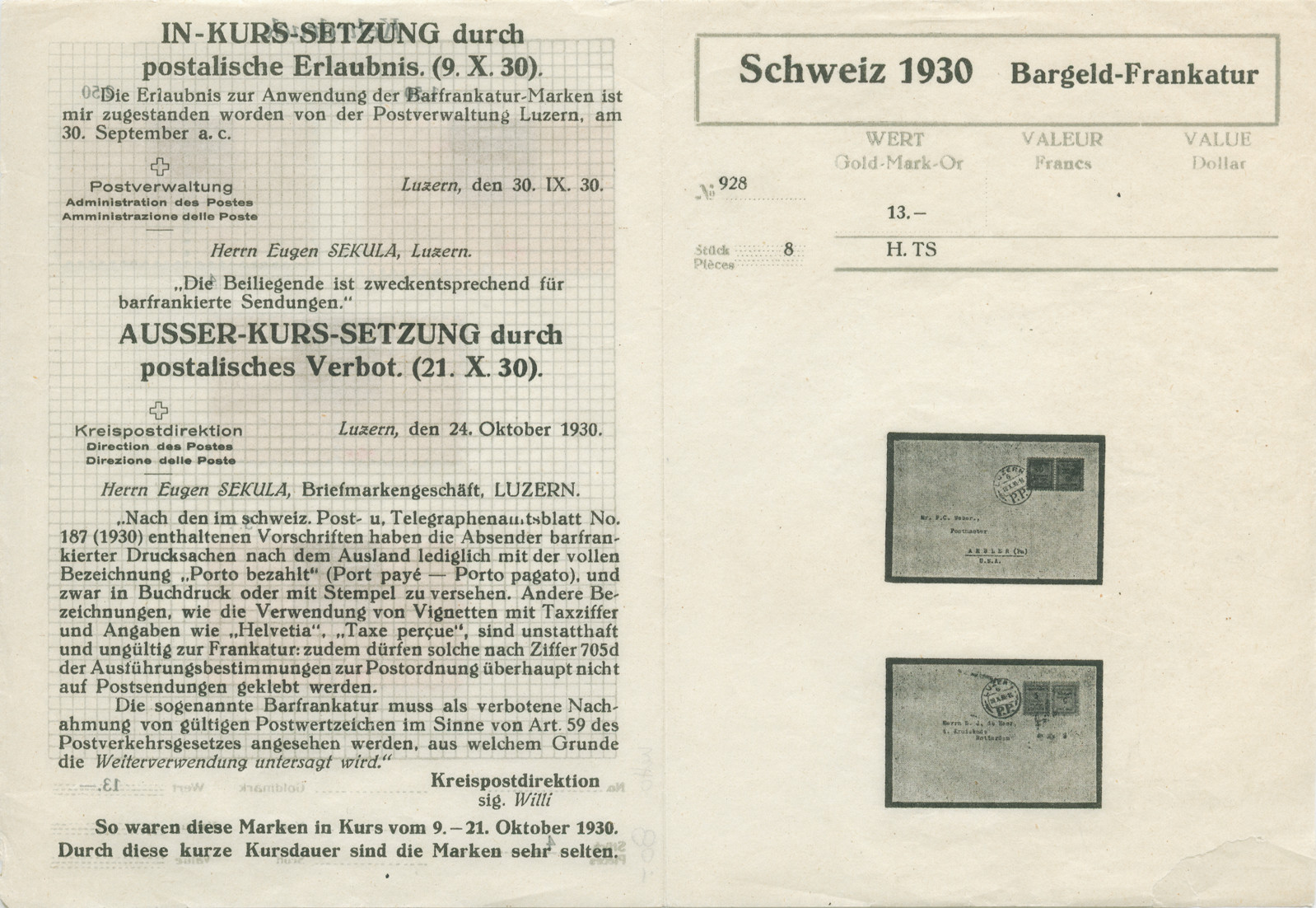
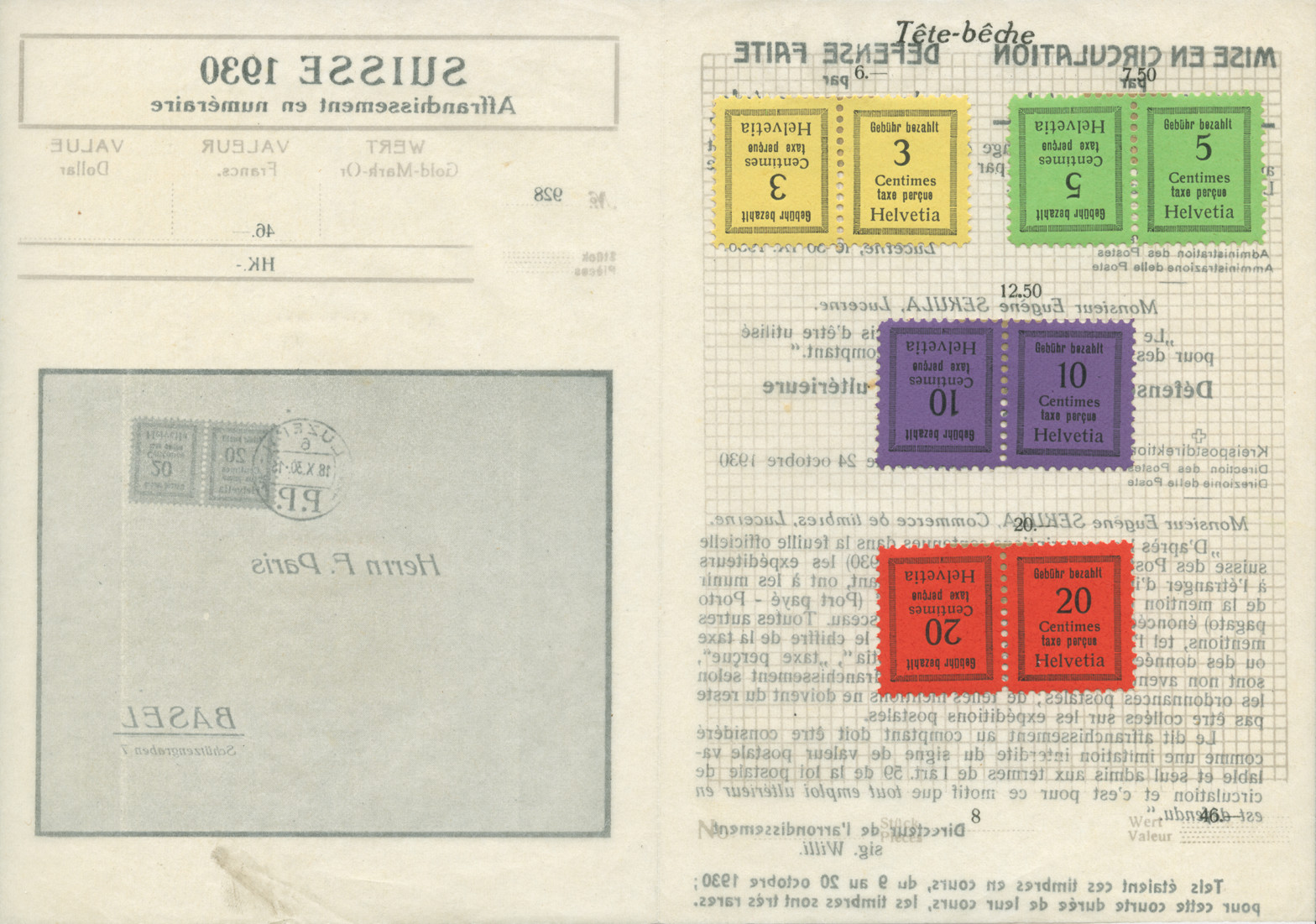
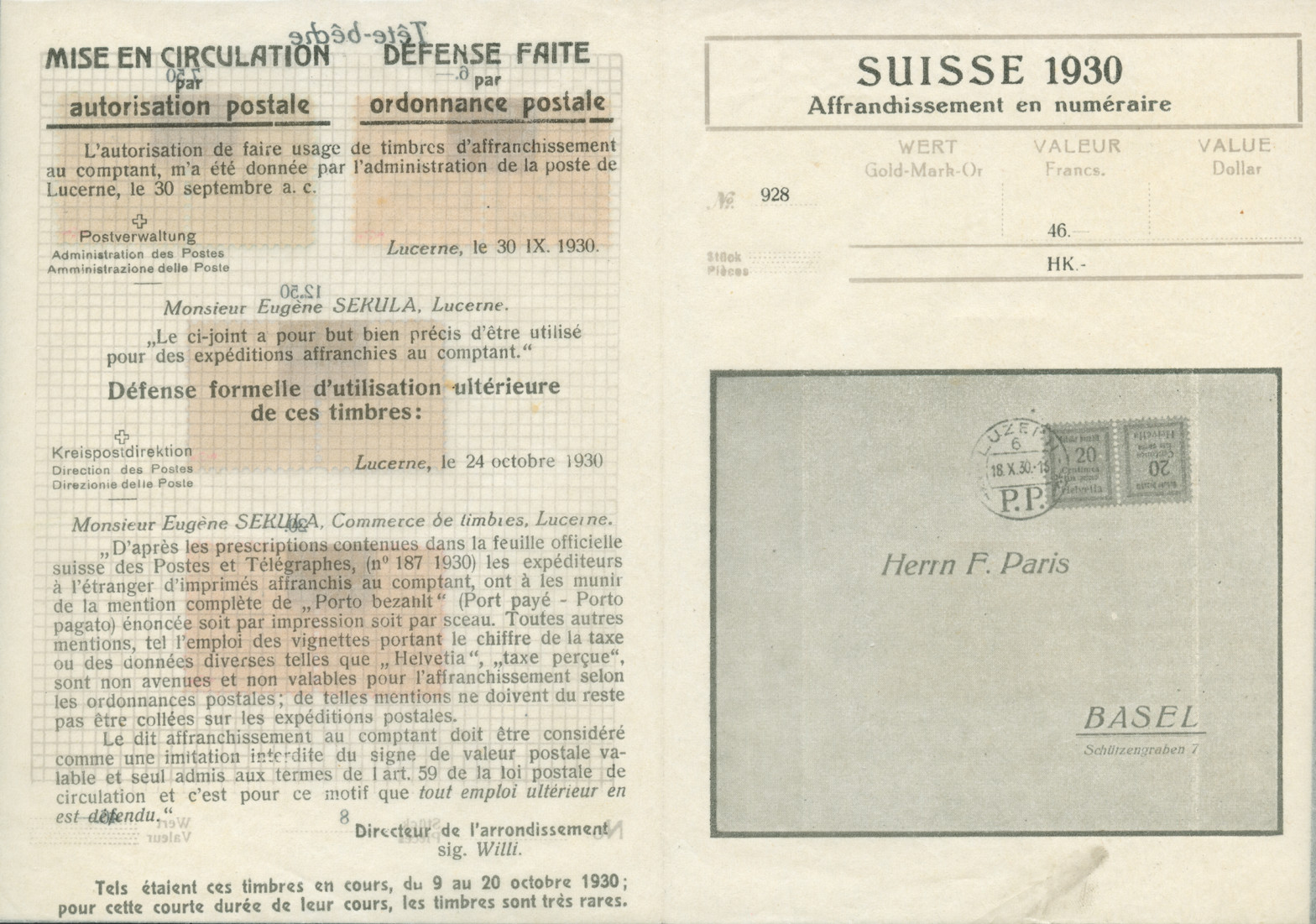
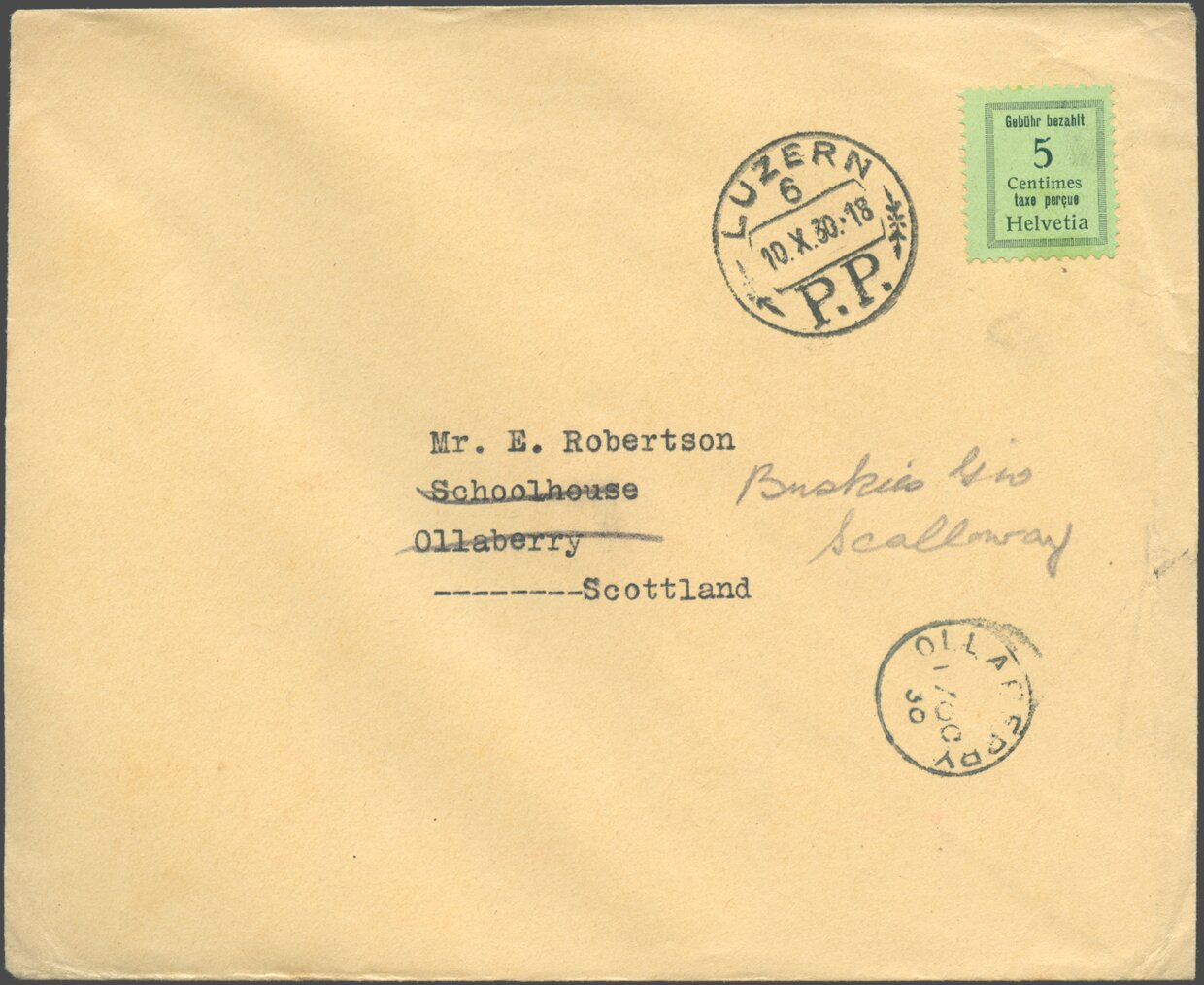
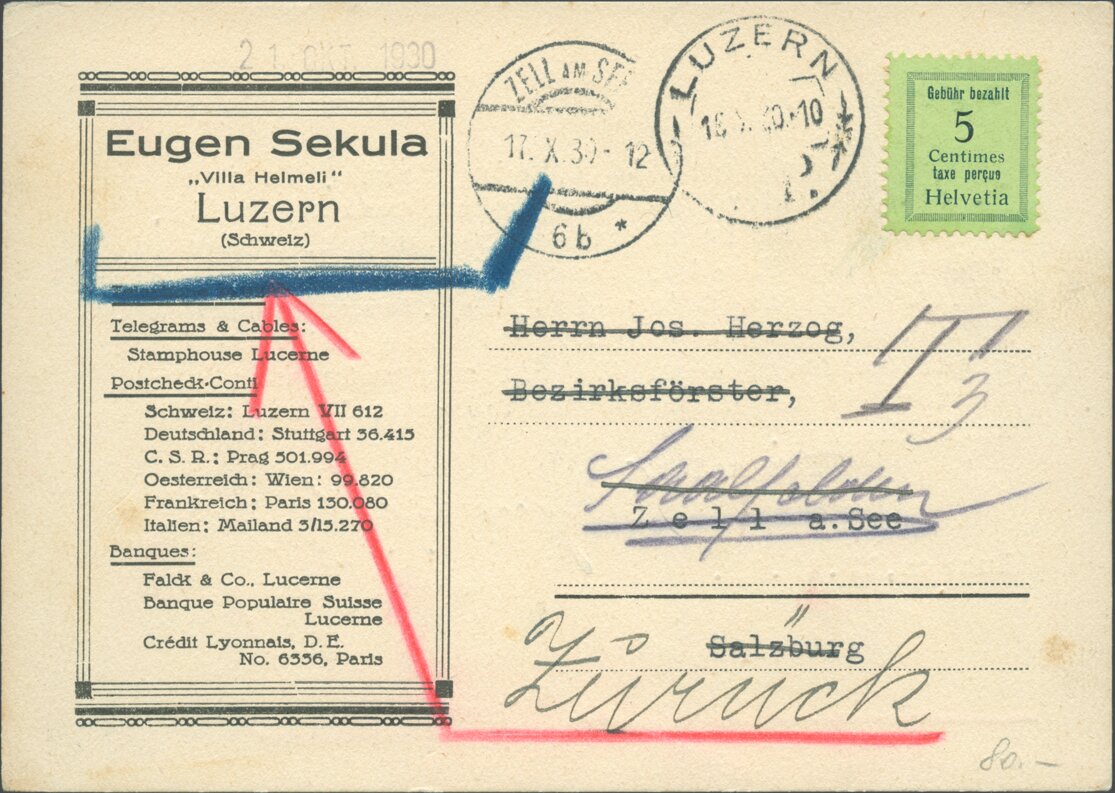
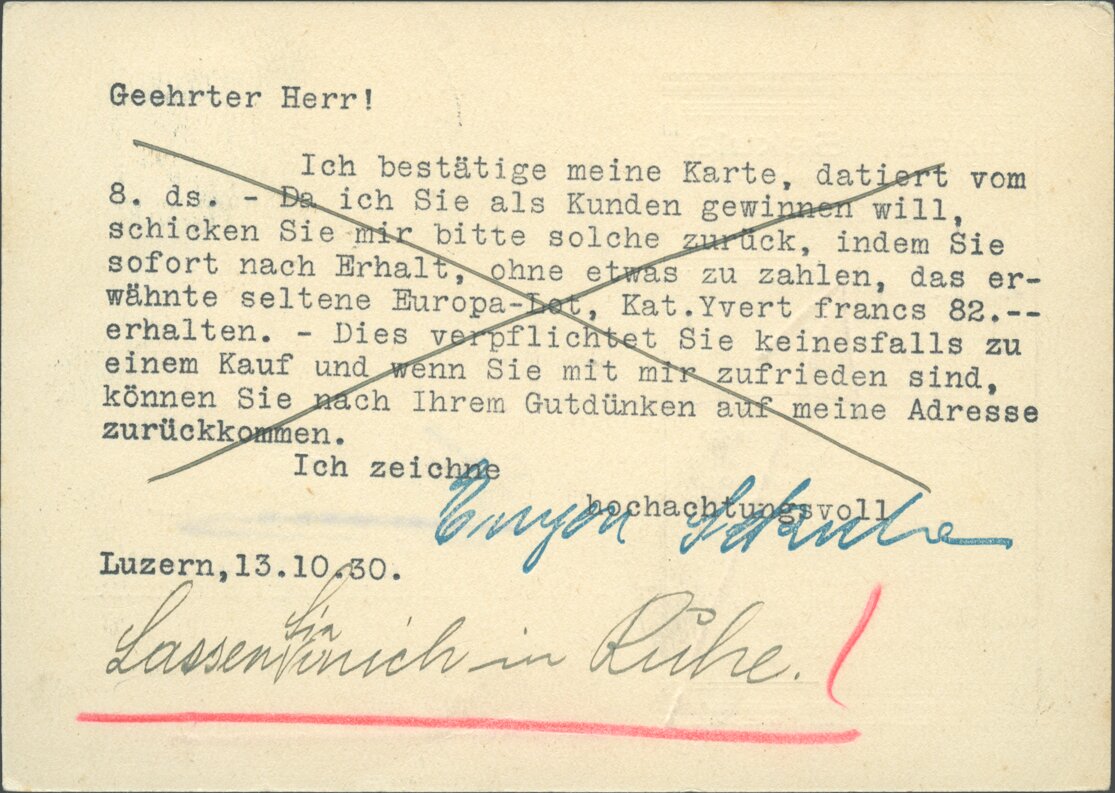
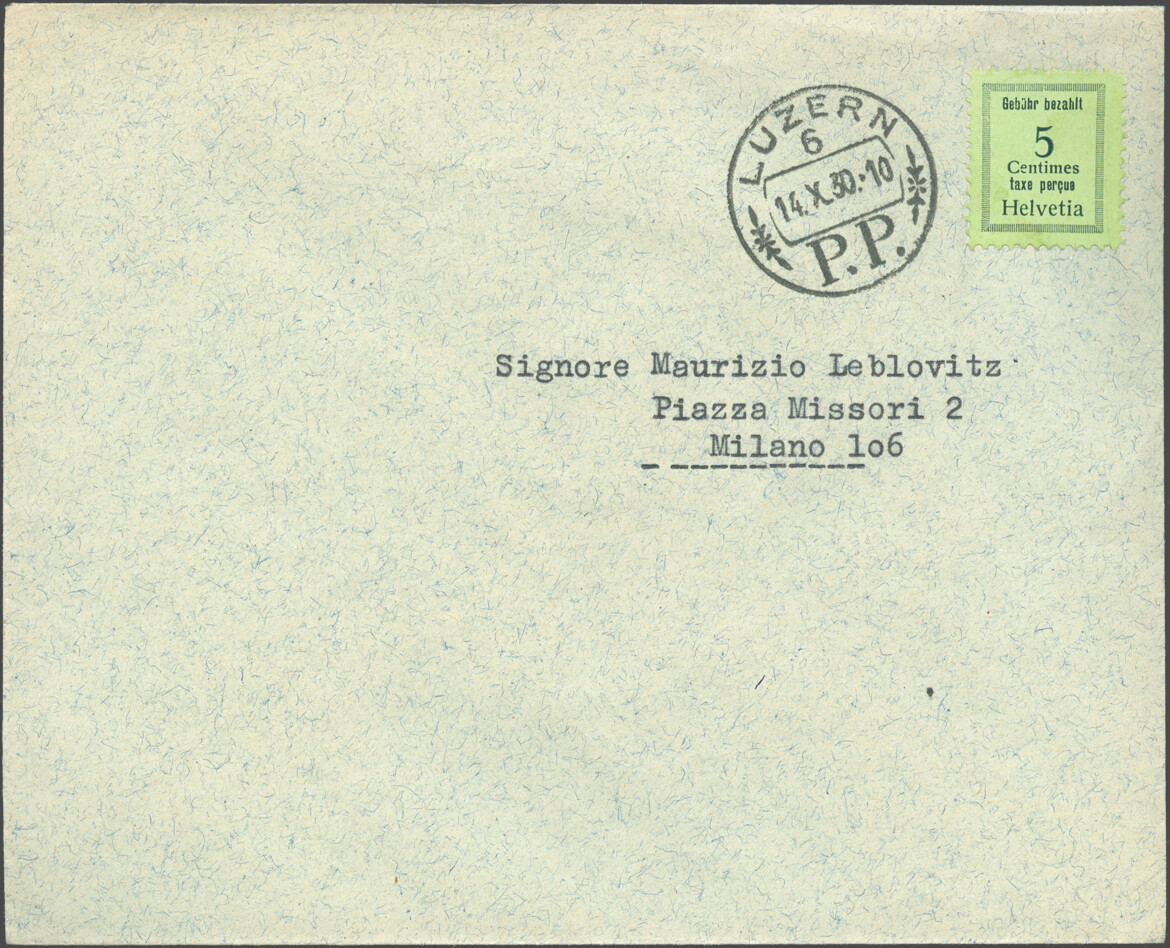
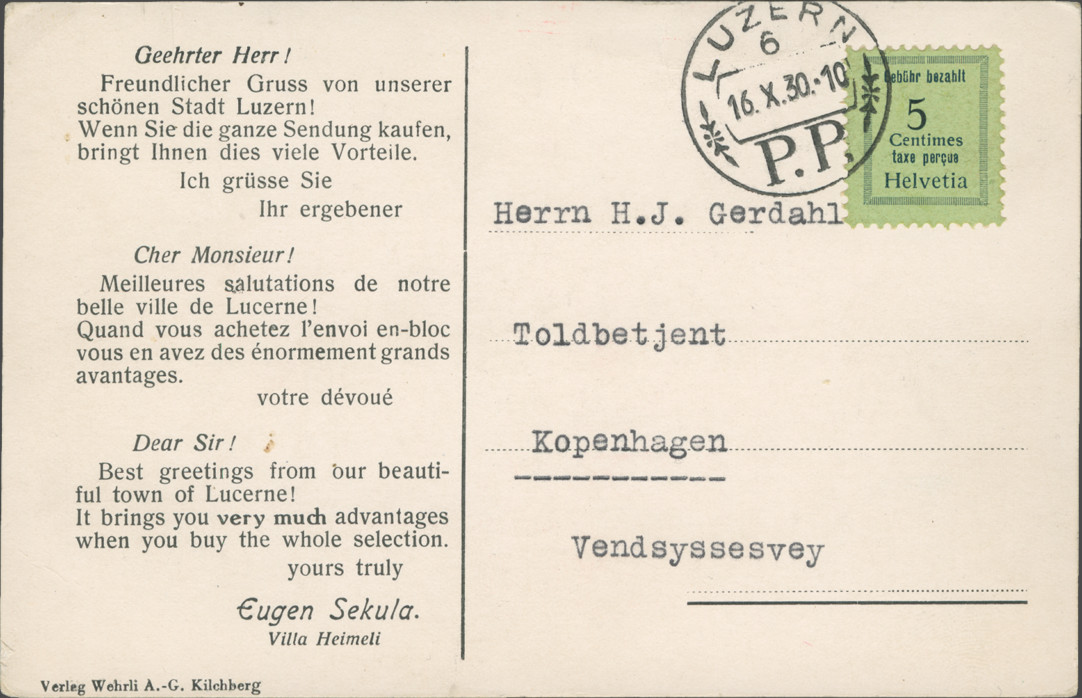
In 1930, Eugen Sekula had a very special idea for injecting his own creations into the philatelic market: instead of printing or writing the words Porto bezahlt, Port payé or Porto pagato (German, French and Italian for Postage paid) on envelopes meant to be sent out as cash paid printed matter, he had postage-stamp-like labels made for that purpose. On September 24 the post office no. 6 of Lucerne granted permission to use these labels. After preparing a few hundred covers he began sending them out on October 10. His marketing ploy only lasted 10 days. On October 20, as soon as the postal administration of Lucerne became aware of this, further use of these labels was prohibited because they violated Swiss postal regulations.
Instead of feeling defeated the businessman Sekula immediately saw an opportunity. Pointing out the rareness of his vignettes in ads placed in various philatelic journals he began selling his leftovers at high prices! Complete sets of all four stamps were offered in special glassine booklets in German, English, and French. The ones shown below contain the scarcer set of tête-bêche printed pairs.
Six covers and three postcards franked with Eugen Sekula’s vignettes postmarked between October 10 and October 18, 1930. Due to the short period of time these labels were accepted by the Swiss post office in Lucerne, traveled covers with these labels are scarce.
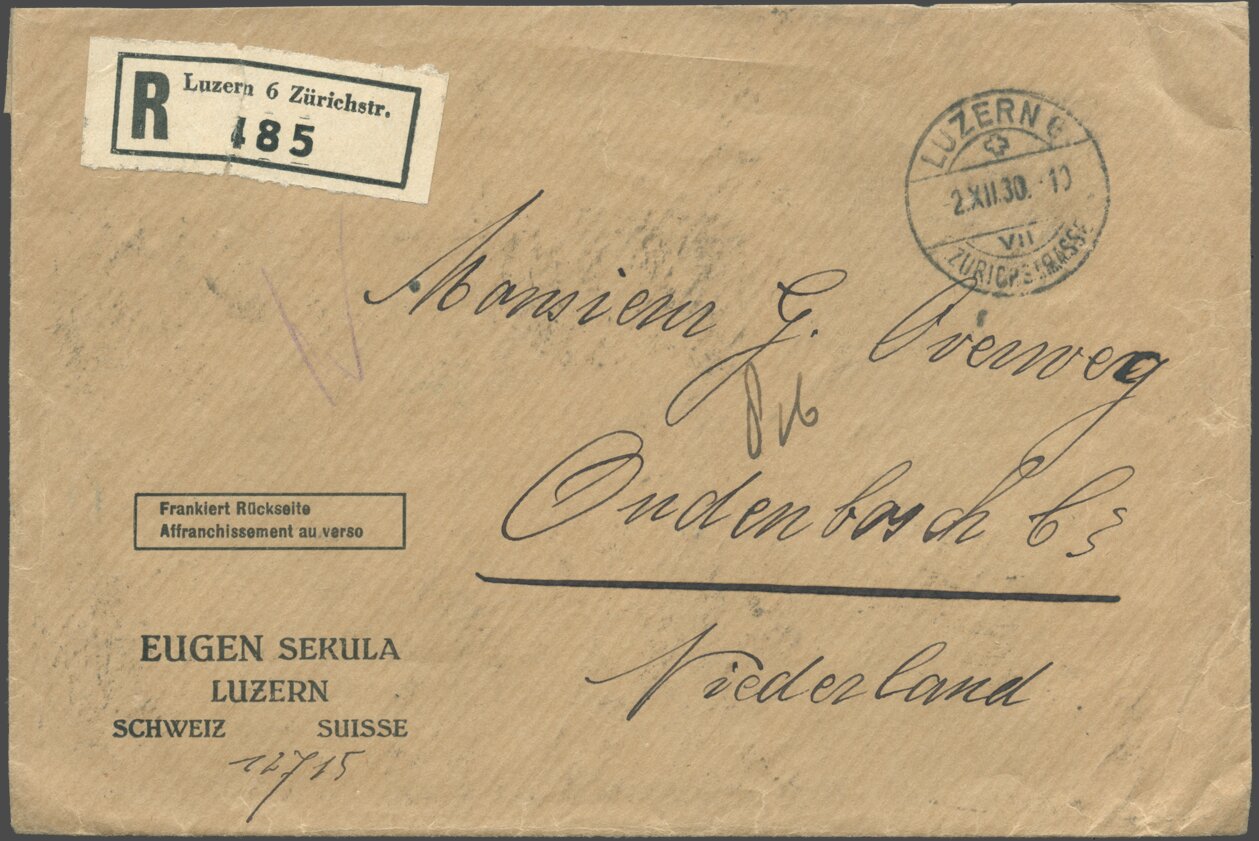
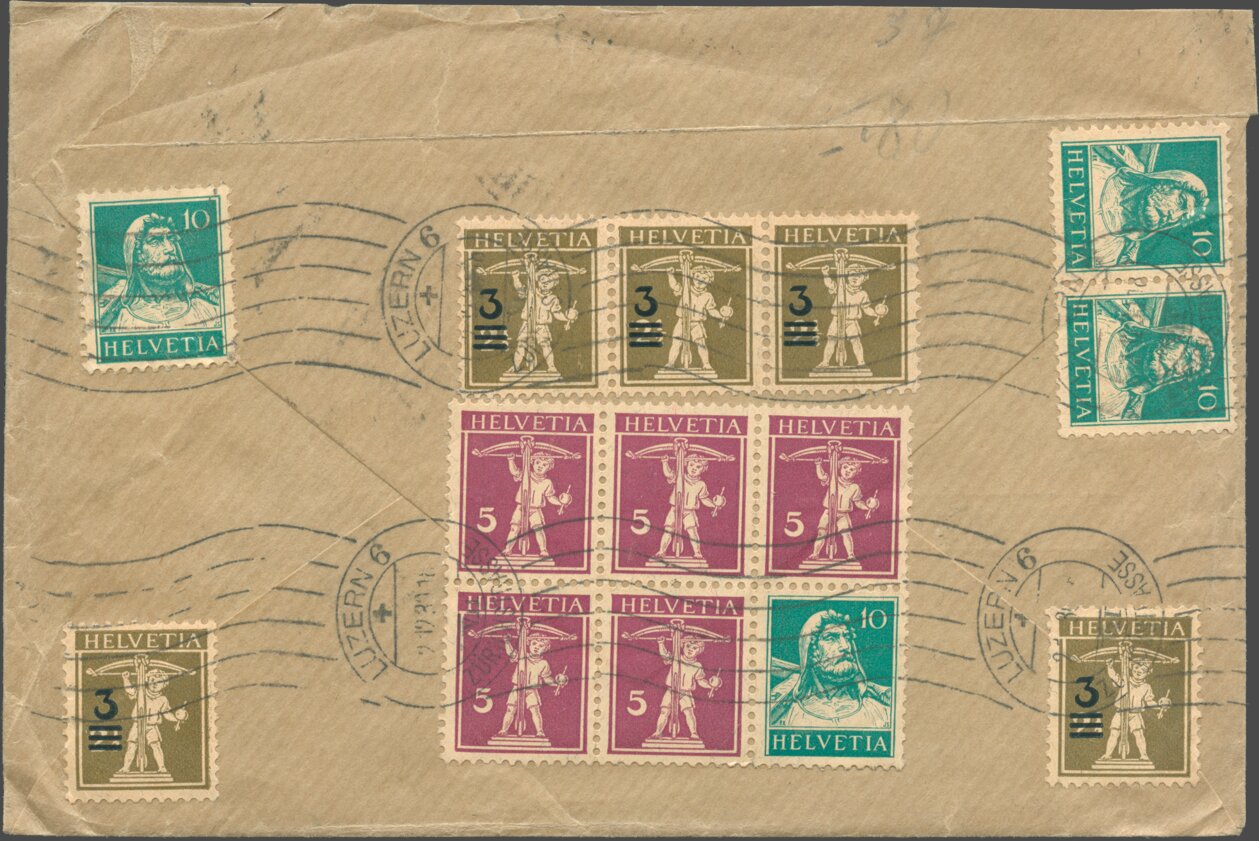
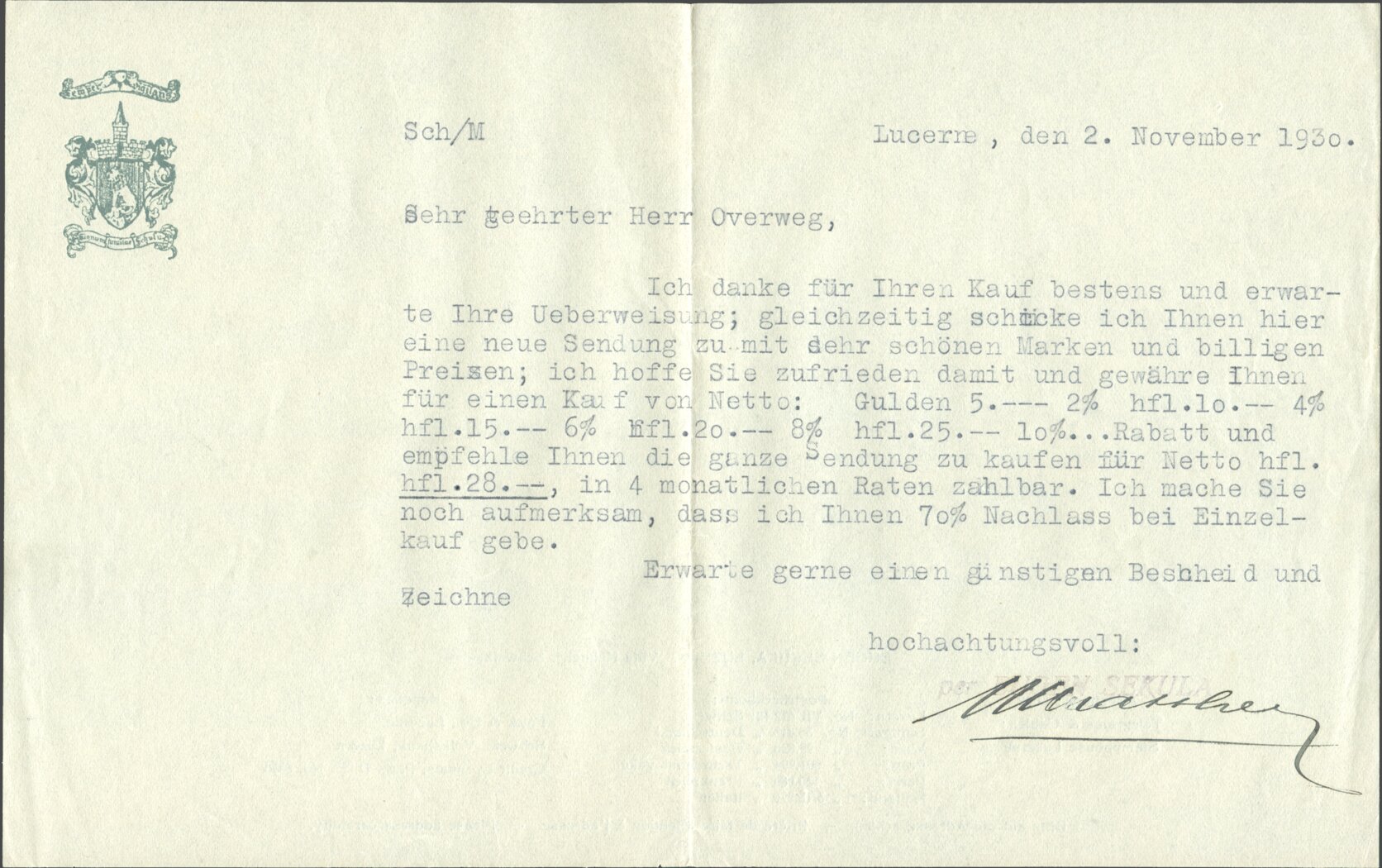
Cover — December 2, 1930
Registered mail sent on December 2, 1930, from Lucerne, Switzerland, to Oudenbosch, Netherlands.
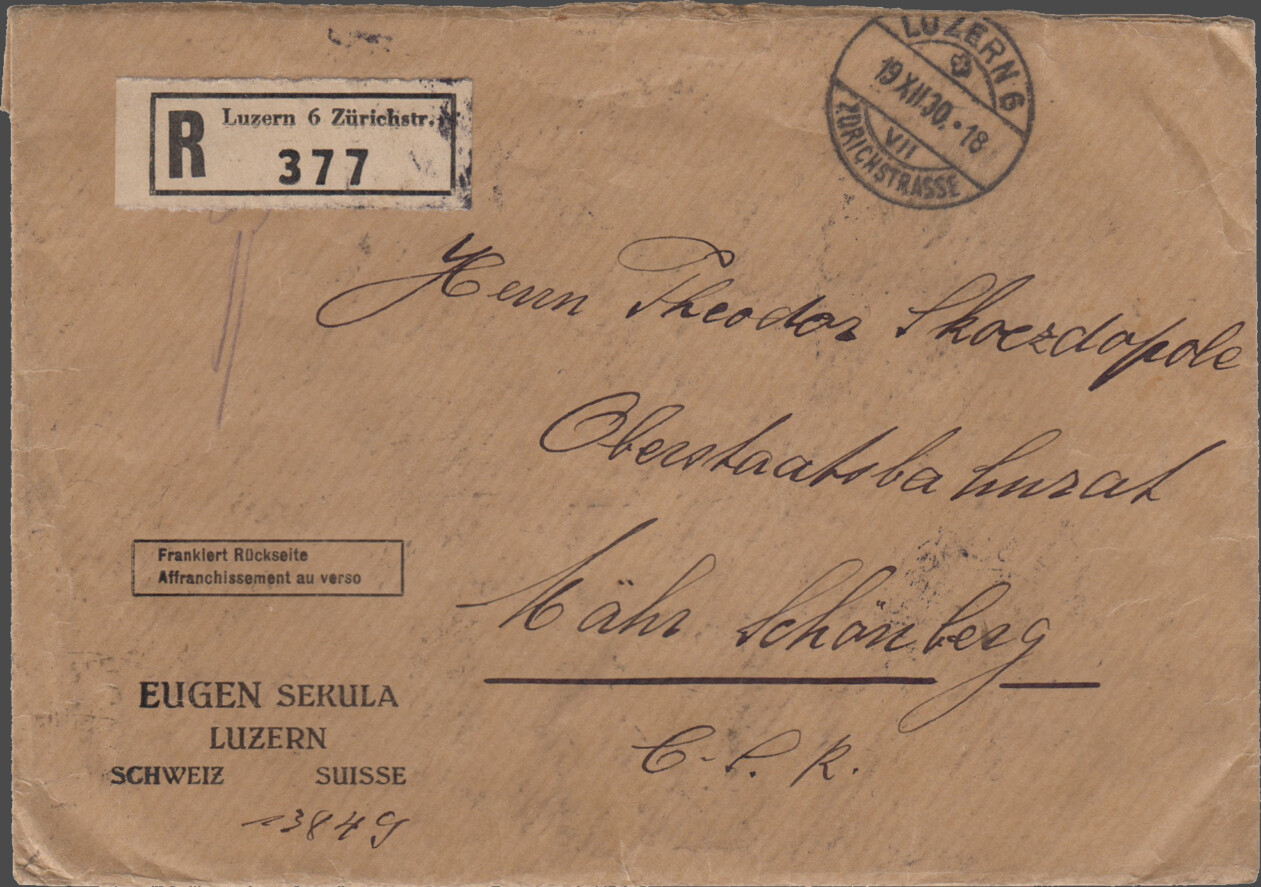
Cover — December 19, 1930
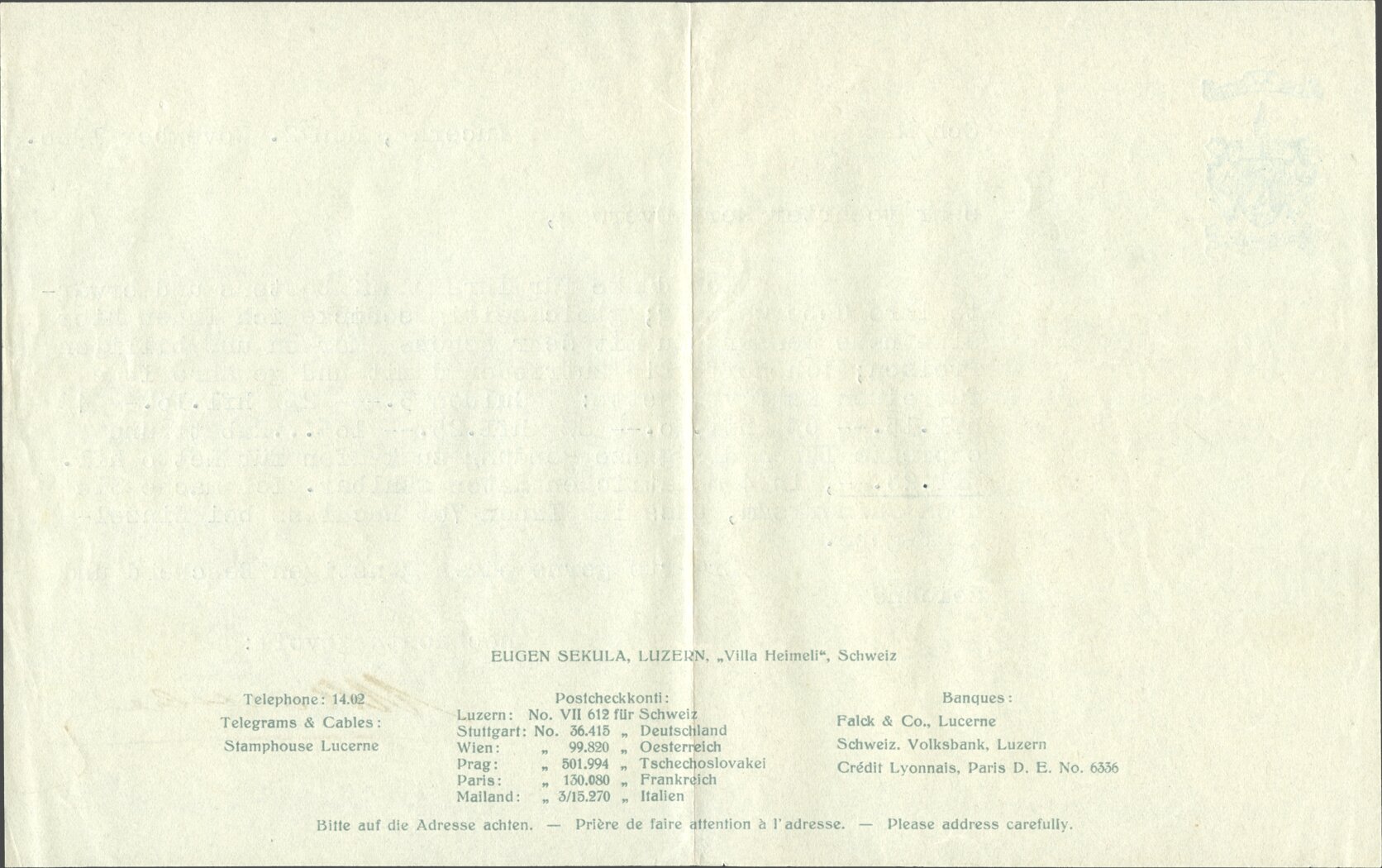
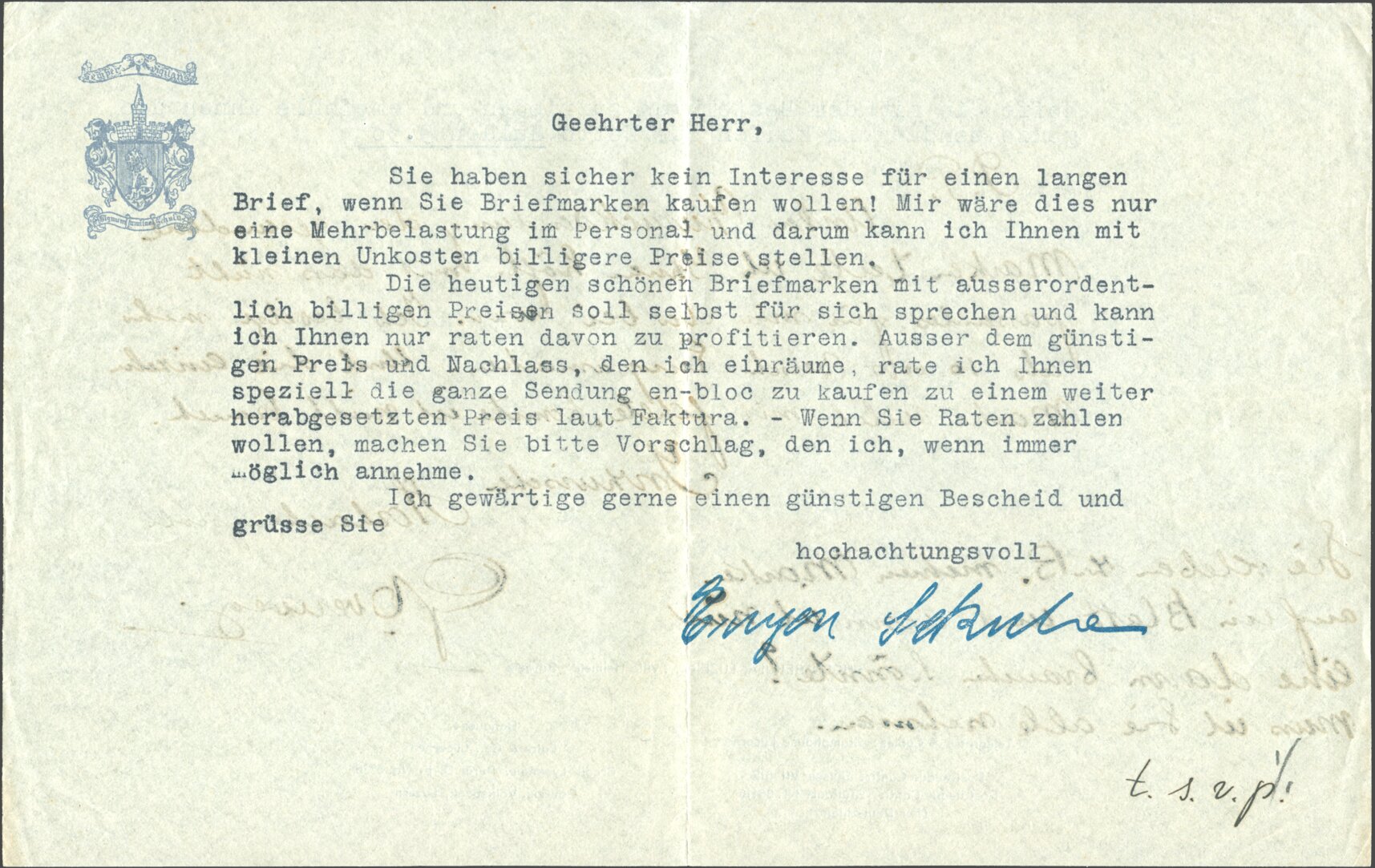
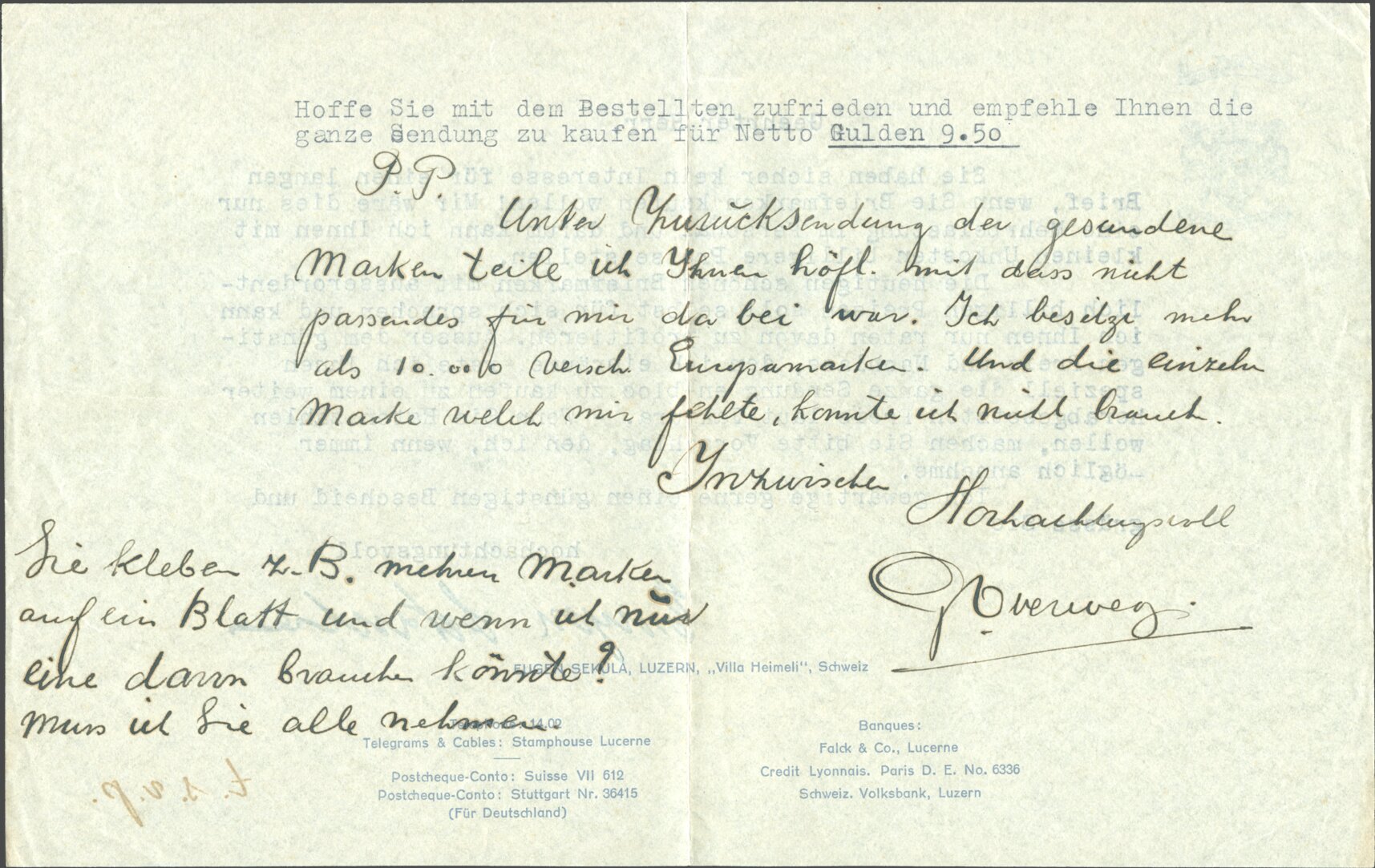
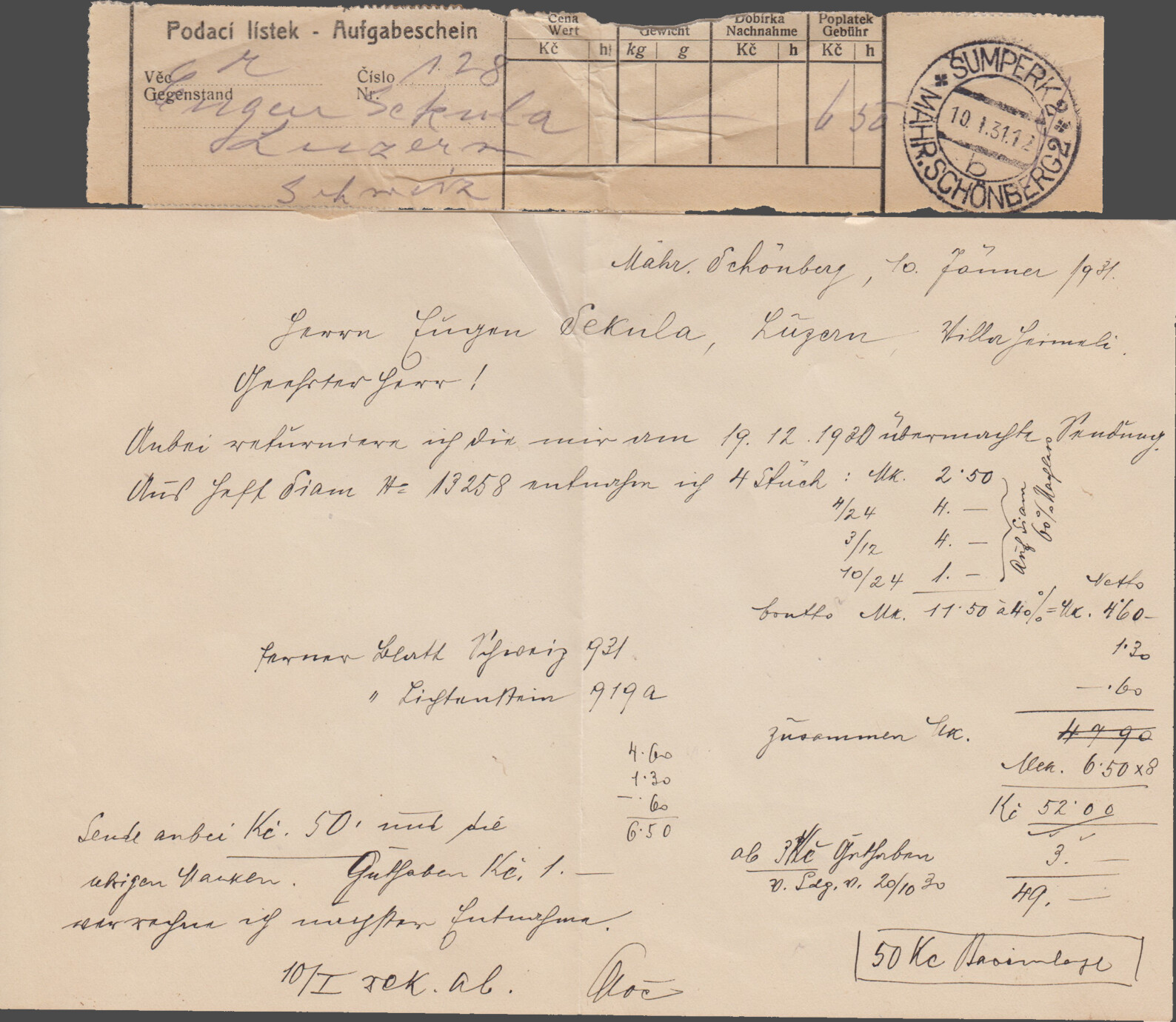
Registered mail sent on December 19, 1930, from Lucerne, Switzerland, to German: Mährisch Schönberg (=Šumperk), Czechoslovakia (today Czech Republic). Arrived on December 21, 1930.
Scans provided by David Rossall.
Postcard — December 26, 1930
Sent on December 26, 1930, from Lucerne, Switzerland, to German: Trebisch (=Třebíč), Czechoslovakia (today Czech Republic).
Scans provided by Max Brack.
Cover — December 30, 1930
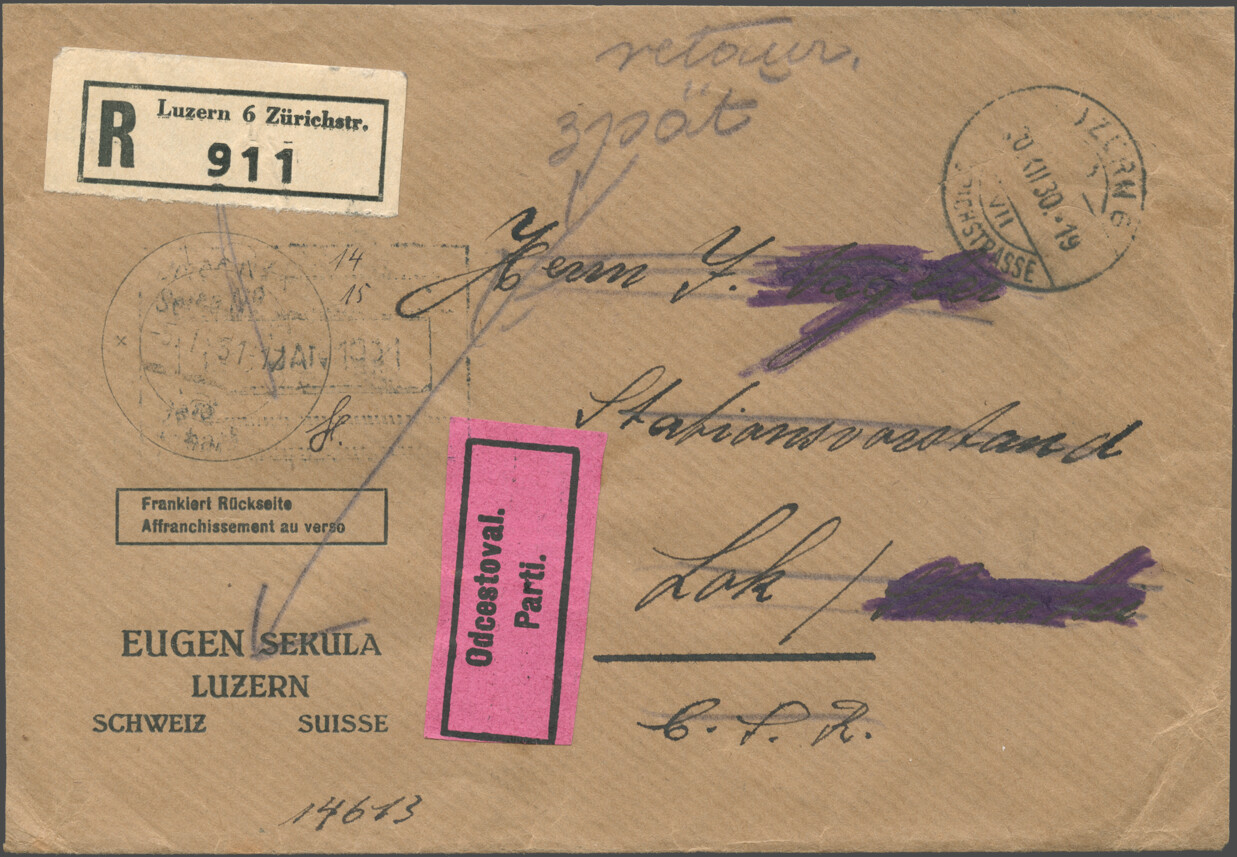
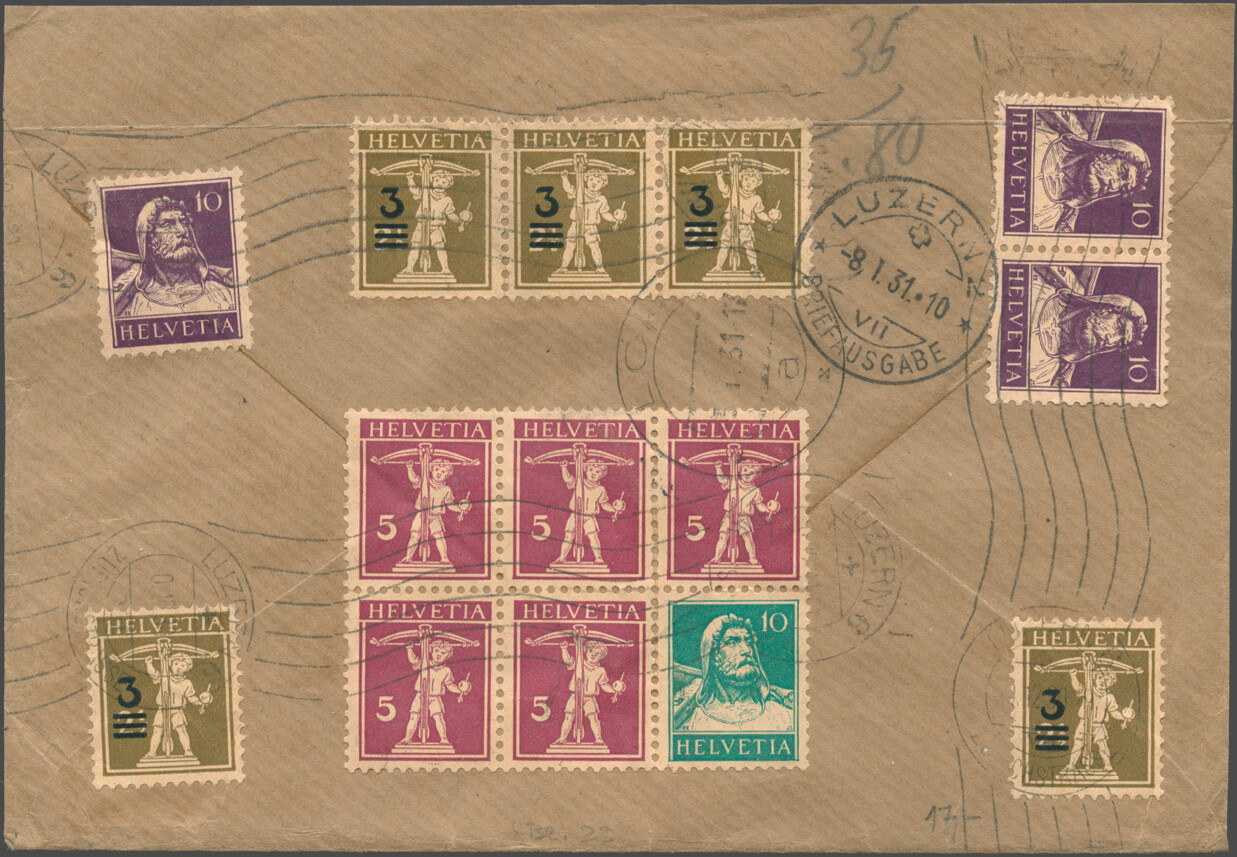
Registered mail sent on December 30, 1930, from Lucerne, Switzerland, to Lok, Czechoslovakia (today Slovakia). Arrived on January 5, 1931.












_p7.png)































.jpg)
.jpg)